Hernández de Cos Chosen as Next ECB President
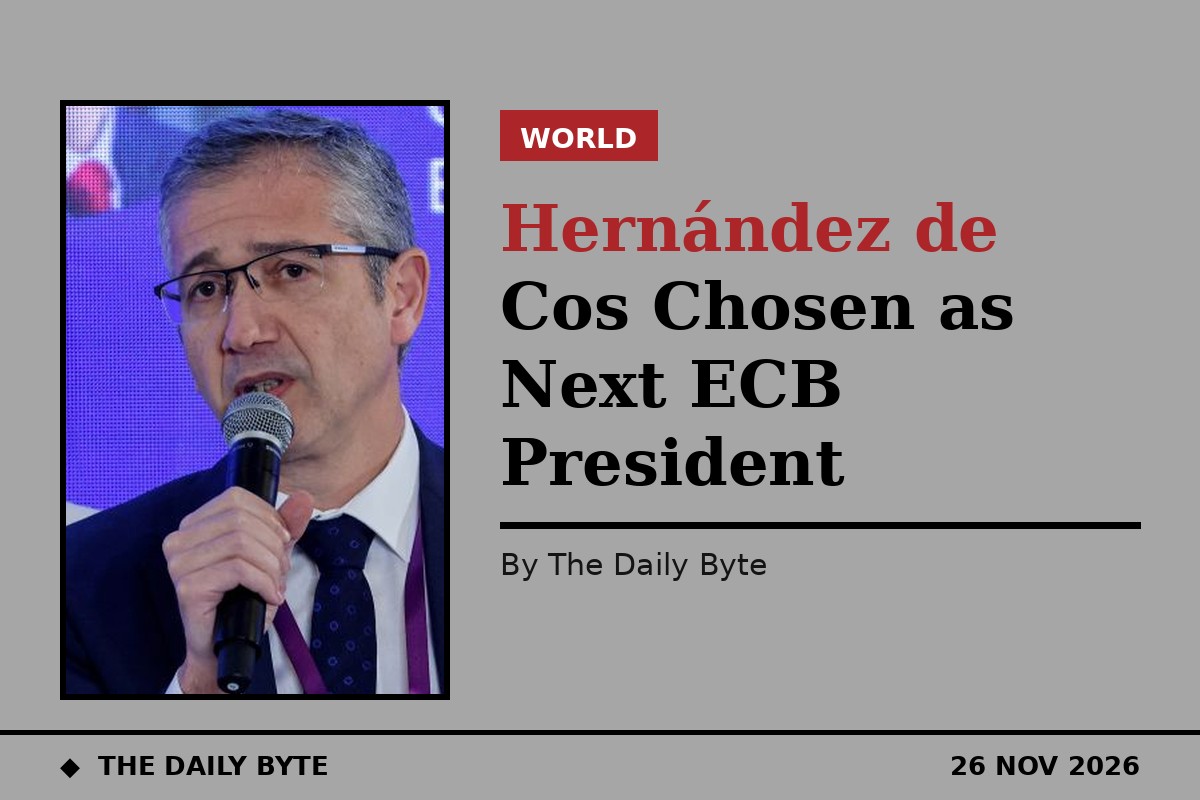
European Union leaders have chosen Spain's Pablo Hernández de Cos as the next president of the European Central Bank, to succeed Christine Lagarde when she steps down in February 2027.
The decision was reached on Thursday 26 November during the EU summit in Brussels, after the Netherlands agreed to back Mr Hernández de Cos over its own candidate, former Dutch central bank chief Klaas Knot. EU officials agreed to recommend him formally to the bloc's leaders, with a final seal of approval expected in December.
Mr Hernández de Cos, 55, is a career central banker. He served as governor of the Bank of Spain from 2018 to 2024, sitting on the ECB's rate-setting Governing Council, and now heads the Basel-based Bank for International Settlements. If appointed, he would become the first Spaniard to lead the ECB since it was created in 1998.
How the race was settled
The contest came down to two candidates: Mr Hernández de Cos and Mr Knot. Germany and France backed the Spanish candidate last week, and the Netherlands' decision to support a consensus choice on Thursday removed the last obstacle. Mr Knot, viewed as the more hawkish of the two, had been the only other contender.
The appointment is not yet final. The European Parliament and the ECB's Governing Council must endorse the nomination before EU leaders give their formal approval, expected in December. Those steps are widely treated as formalities, but they must still be completed before Mr Hernández de Cos can take up the post.
Mrs Lagarde announced in late October that she would step down on 7 February 2027, almost nine months before the end of her eight-year term. She said she wanted to be able to speak more freely on matters beyond monetary policy, and her early departure allows a successor to be chosen while the pro-European French President Emmanuel Macron is still in office.
A wider reshuffle at the ECB
Leaders also settled two other senior ECB posts at the summit. French economist Laurence Boone is set to take charge of market operations, replacing Isabel Schnabel, who leaves on 3 January 2027 to join the International Monetary Fund. German economist Markus Brunnermeier, a professor at Princeton University, is in line to replace chief economist Philip Lane, whose term ends on 31 May 2027.
The package gives the eurozone's three largest economies a stake in the bank's leadership: a Spaniard as president, a French official running market operations and a German as chief economist.
What markets expect
Financial markets took the decision calmly. The euro edged up 0.12 per cent to $1.0988 on Thursday, German 10-year bond yields were little changed, and the STOXX 600 share index rose 1.6 per cent, Reuters reported.
Analysts describe Mr Hernández de Cos as a continuity candidate who is likely to keep broadly to Mrs Lagarde's approach. Some call him slightly dovish, inclined towards lower interest rates to support growth, while others describe him as a pragmatic centrist. MUFG economist Henry Cook said he expected Mr Hernández de Cos to broadly maintain Mrs Lagarde's approach.
The new president will face an immediate test in France, whose bond market has grown volatile as investors worry about mounting government debt and political gridlock. France votes in April 2027 to choose a successor to Mr Macron, and the two leading candidates, Marine Le Pen and Jean-Luc Mélenchon, have both criticised the ECB and called on it to help bring down France's borrowing costs.
Mr Hernández de Cos will take over two months before that vote, and his handling of French debt, including whether to use the ECB's bond-buying tools, is likely to be watched closely from his first weeks in the job.


