Hezbollah: No Independence While Land Occupied
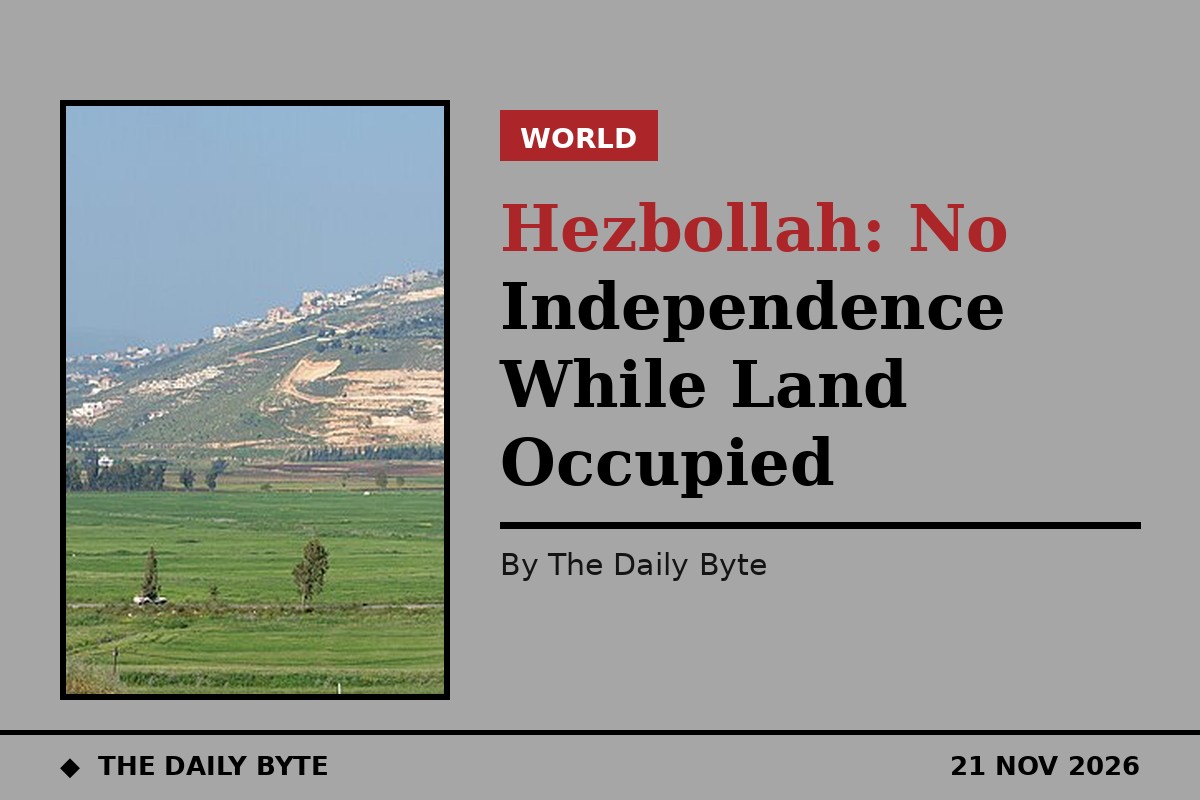
Hezbollah has said Lebanon cannot claim genuine independence while Israeli forces occupy more than 500 square kilometres of its territory in the south. In a statement issued on Saturday, on the eve of the country's 83rd Independence Day, the group called on all Lebanese, regardless of sect, to unite under a national consensus and to confront what it described as existential threats to the state.
"There is no independence while more than 500 square kilometers of Lebanon's soil remain under the Israeli occupation," the statement said, according to PressTV, which carried the full text, and Al-Manar English, which published it on Saturday afternoon. "There is no independence while southerners live under the strains of threats and displacement, their homes and villages get blown up entirely, and they are deprived of their legitimate right to defend their land whilst the government is incapable of protecting them."
A swipe at the government
The statement went further than the occupation itself, criticising the Lebanese government for failing to honour the pledge in its own ministerial statement to deter Israeli aggression and defend the border. It accused the authorities of standing idle amid the daily attacks while yielding to foreign interference, saying outside pressure "turns its institutions into an arena for implementing the dictates of an ambassador, who imposes his choices and paths upon them, working to stoke sedition and division among Lebanese nationals".
The language echoes a theme Hezbollah has returned to throughout the year: that Beirut's leaders have traded sovereignty for the approval of foreign capitals, and that the state has left the south to fend for itself. The statement framed the choice as one for all Lebanese, not only the group's supporters, urging unity "under the umbrella of national consensus" at a moment it said the country faced dangers to its existence.
The backdrop in the south
Israel still occupies parts of southern Lebanon seized during the 2023-2024 war, in which Israeli ground troops advanced around 10 kilometres into Lebanese territory. The Lebanese Health Ministry says Israeli strikes since 2 March this year have killed at least 4,390 people and displaced more than one million, figures cited by PressTV. Israeli raids continued into Saturday, with Lebanese media reporting air strikes and explosions in the south on the same day the statement was issued.
The statement came on the same day President Joseph Aoun used his own Independence Day address to tell Hezbollah that the era of weapons outside the state was over, and to insist that sovereignty remained incomplete while land stayed under occupation. The two messages, delivered within hours of each other, captured the unresolved argument at the heart of Lebanese politics: the president demanding the state monopolise arms, and Hezbollah insisting that disarmament cannot precede liberation.
Resistance as the answer
That argument was also made in Beirut on Saturday by Ammar al-Moussawi, head of Hezbollah's international and Arab relations office, speaking at the Arab National Conference. He said resistance in Lebanon was a direct response to Israeli occupation and aggression, and would not have emerged without the enemy's continued violations. The Framework Agreement that ended the 2024 war, he added, had delivered neither liberation of occupied territory, nor a halt to aggression, nor a timetable for Israeli withdrawal.
Lebanon marks its independence from France on 22 November, the anniversary of the release of its first president and prime minister from detention in 1943. Hezbollah's statement turns the anniversary into a challenge: independence, it argues, is not a date on a calendar but a condition on the ground, and until the last occupied square kilometre is recovered, the celebrations ring hollow.


