HMRC duty to correct tax errors from April 2028 explained
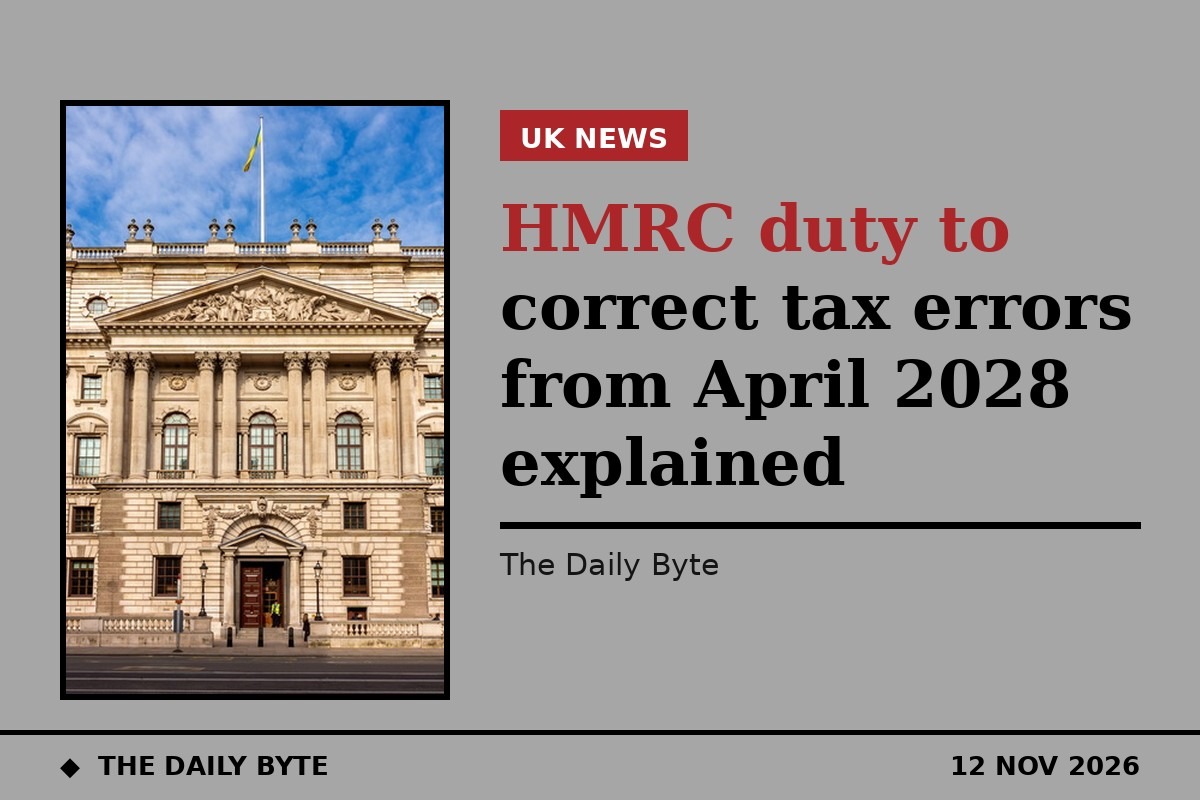
From 1 April 2028, anyone who spots an error in a tax return or document they have given to HMRC will be under an explicit legal duty to correct it, under measures confirmed in the Autumn Budget 2026. HMRC will also gain a new power to issue Customer Correction Notices, and a known error left uncorrected will be treated as deliberate for penalty purposes.
The changes, set out in HMRC’s policy paper “Modernising the correction of errors”, create a general taxpayer obligation that does not exist in this form today. At present, a taxpayer who discovers an error and does not report it is generally treated as careless. From April 2028, failing to take reasonable steps to fix a known inaccuracy will carry the heavier consequences that currently apply to deliberate behaviour.
What is the duty to correct?
The duty applies to documents covered by Schedule 24 of the Finance Act 2007, which includes returns and documents for income tax, corporation tax, VAT and the Construction Industry Scheme. If a person becomes aware of an inaccuracy in such a document, they must take reasonable steps to secure its correction — either by correcting it directly or by notifying HMRC where a correction cannot be made directly.
The obligation applies only while the inaccuracy can still be corrected within the existing statutory time limits for amending returns or making assessments. It does not create a new deadline for filing returns, and it does not change any deadline a taxpayer faces today. The Government has confirmed the measures will be legislated for in Finance Bill 2026-27, so the draft legislation published for consultation in July 2026 could still change before it becomes law.
Customer Correction Notices
Alongside the duty, HMRC will be able to issue a Customer Correction Notice where it has reason to suspect an inaccuracy in a document. The taxpayer must respond by a deadline set in the notice, by correcting the inaccuracy, making a disclosure, or confirming that no correction is required.
The consequences of ignoring a notice are significant. HMRC’s policy paper states that errors found later by HMRC after a response — or a lack of response — to a Customer Correction Notice will be presumed to be careless, unless the inaccuracy is deliberate or the taxpayer can satisfy HMRC that they took reasonable care in the first place. And where a taxpayer becomes aware of an inaccuracy and does not take reasonable steps to correct it or notify HMRC, the inaccuracy is treated as deliberate for the purposes of penalties and assessment time limits.
There is a safeguard for those who cooperate. Penalties may be removed where a taxpayer makes an unprompted disclosure, or takes reasonable steps to secure a correction after receiving their first Customer Correction Notice within a six-year period, provided the error was not deliberate.
Why the stakes are higher
The deliberate treatment matters because of how far back HMRC can go. HMRC can currently assess back four years for an error made despite reasonable care, six years for a careless error, and up to 20 years for a deliberate one. Treating an uncorrected known error as deliberate therefore extends both the assessment window and the penalty exposure, even if the original mistake was an honest one.
The measure was first announced at Budget 2024 and included in HMRC’s transformation roadmap. Draft legislation was published on Legislation Day 2026, 13 July, beginning an eight-week technical consultation that ran until 7 September 2026. The Government confirmed the 1 April 2028 start date in Budget 2026 on 28 October. The policy paper gives no revenue costing yet, stating that the final costing will be subject to scrutiny by the Office for Budget Responsibility and set out at a future fiscal event.
Separate Budget proposals would also broaden HMRC’s ability to request digital material relevant to tax inquiries, potentially including records of calculations carried out through AI chatbots, with failures to comply attracting penalties starting at £300. Taxpayers and small businesses should keep clear records of how figures in returns were worked out, and seek professional advice if they discover a past error. This article is general information, not tax advice; the official detail is on GOV.UK.
Sources: GOV.UK, HMRC policy paper: Modernising the correction of errors; All In Accountancy; Addleshaw Goddard.