Honduras Launches Farm Plan for 400,000 Farmers
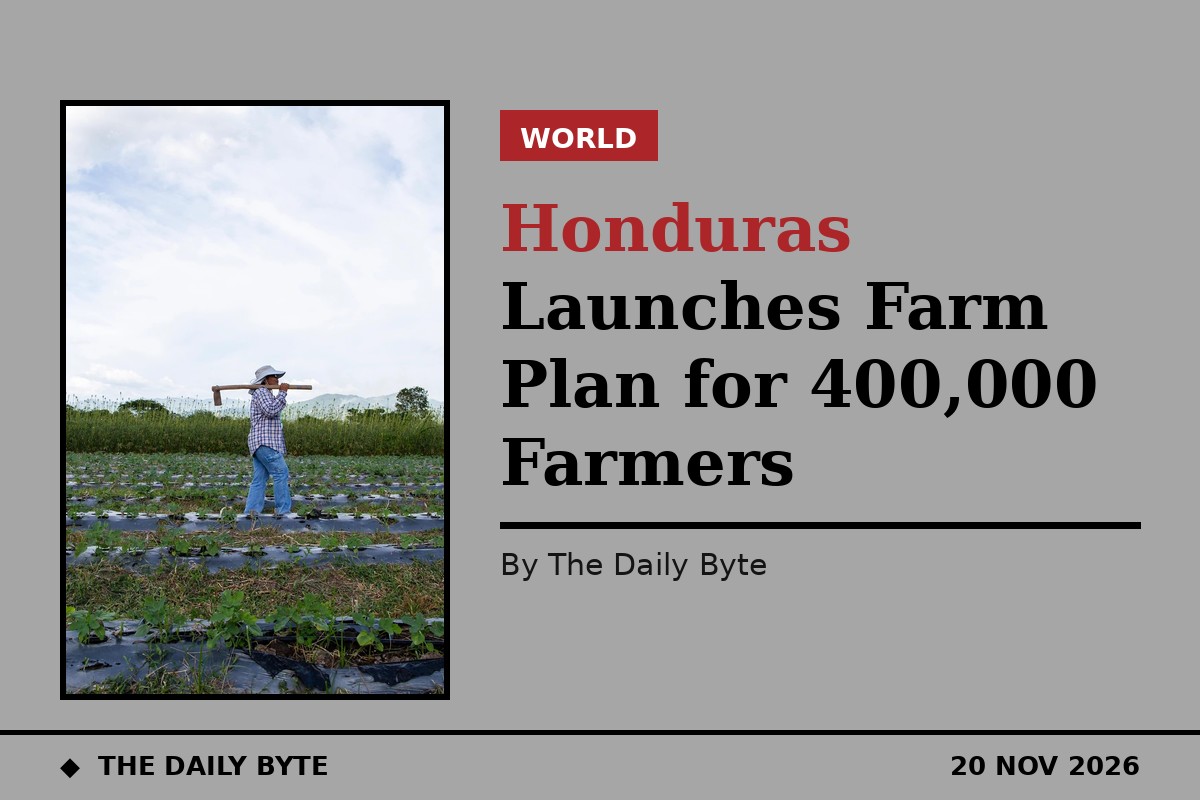
Honduras has launched a five-year agricultural plan with the World Bank Group and the Central American Bank for Economic Integration (CABEI) that aims to give 400,000 family farmers better access to finance, market information and digital tools by 2030. The AgriConnect Honduras Joint Action Plan 2026-2030 was launched in the capital, Tegucigalpa, on Friday, 20 November.
The plan is led by Honduras' Ministry of Agriculture and Livestock and brings together the government, the World Bank Group, CABEI and regional partners. It is built around three priorities: expanding agricultural finance, strengthening trade and market access, and scaling up digital tools for small producers.
Targets for 2030
By 2030, the plan aims to help 400,000 family farmers gain improved services and access to crop and market data, support 200,000 farmers in raising their incomes, and improve food security for 100,000 people. The figures were published by the World Bank and reported on Friday.
Susana Cordeiro Guerra, the World Bank's regional vice president for Latin America and the Caribbean, said access to finance, technology and timely information could help small producers invest, grow and connect to larger markets. She said Honduras had the potential to move more of its agricultural production up the value chain, supporting stronger businesses, more investment and more jobs.
Gisela Sanchez, executive president of CABEI, said the agreement strengthened cooperation on preparing priority projects in sectors including agriculture, infrastructure and water management, and that the bank remained committed to turning member countries' priorities into high-impact investments.
A wider Central America agreement
Alongside the launch, the World Bank Group and CABEI signed a memorandum of understanding to prepare priority projects across Central America, covering agriculture, food security, water, infrastructure and logistics, digital transformation, job creation and the mobilisation of private capital.
The action plan was developed in consultation with technical and financial partners including the Latin American Association for the Development of Agricultural Insurance, the Food and Agriculture Organization, the Inter-American Development Bank, the International Fund for Agricultural Development, the Inter-American Institute for Cooperation on Agriculture and the World Food Programme.
Why farming finance matters in Honduras
AgriConnect is the World Bank Group's global initiative to help 300 million smallholder and family farmers gain access to services, markets and finance by 2030. Its Latin America and Caribbean chapter was launched in Washington in April 2026, with a goal of benefiting 10 million farming families in the region by 2030.
The focus on finance reflects the realities of rural Honduras, where nearly 80 per cent of the rural workforce works in the informal economy, according to the International Finance Corporation. The IFC reports that a related government initiative, ComRural II, supported by the World Bank Group, has backed 19 business plans across the country, benefiting more than 10,000 people, many of them women moving from informal subsistence work into structured, wage-earning employment for the first time, while mobilising more than US$14 million in private capital.


