Hong Kong Completes Colonial-Era Law Overhaul
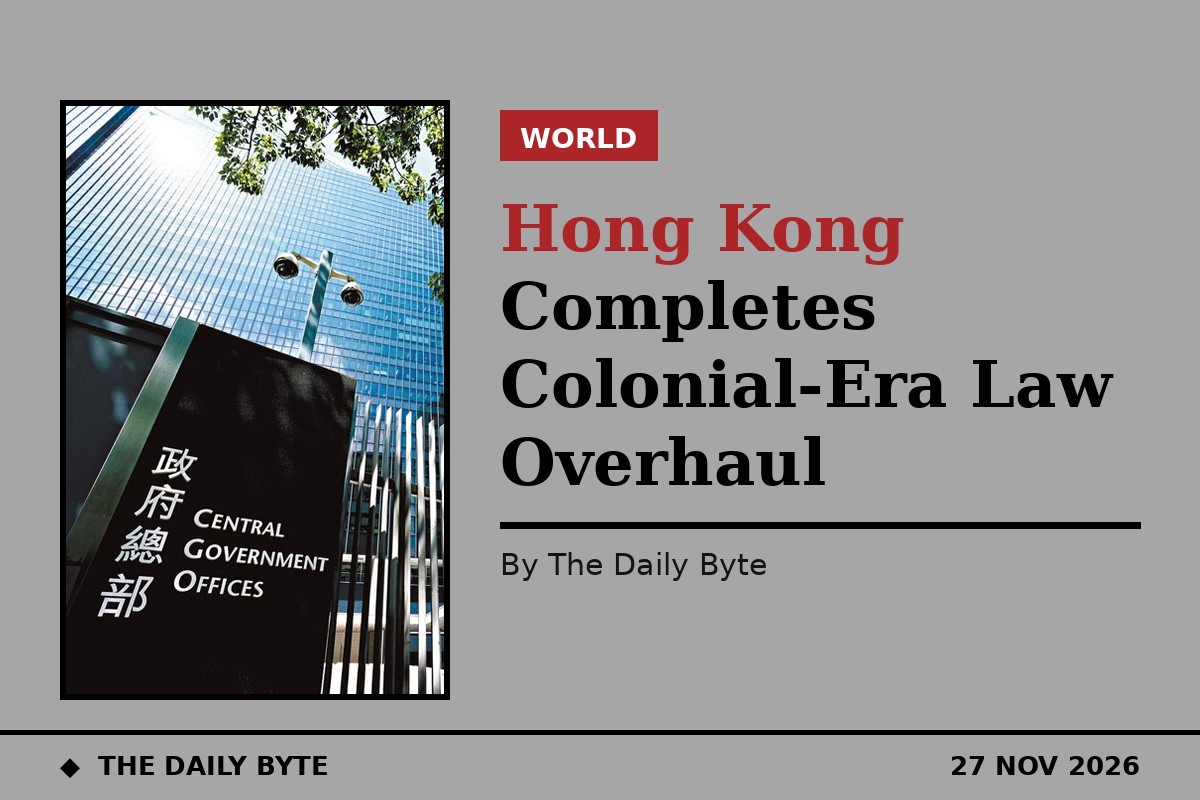
Hong Kong has formally completed a decades-long exercise to rewrite its colonial-era laws, gazetting the final set of amendments on Friday, 27 November, seven months ahead of schedule.
The government published the Statute Law (Miscellaneous Provisions) Ordinance 2026 in the Gazette, together with three pieces of subsidiary legislation amending the rules of court: the Rules of the High Court (Amendment) (No. 3) Rules 2026, the High Court Fees (Amendment) Rules 2026 and the Rules of the District Court (Amendment) (No. 3) Rules 2026. The government said the gazetting marked the formal completion of the adaptation of laws in the Hong Kong Special Administrative Region.
What the exercise changed
The exercise involved amending laws that were in force immediately before 1 July 1997, when Hong Kong returned to Chinese sovereignty, so that they comply with the Basic Law and reflect the city's status as a special administrative region of China. It gives effect to the decision of the Standing Committee of the National People's Congress of 23 February 1997 on the handling of laws previously in force, under Article 160 of the Basic Law. Once adapted, the laws no longer need to rely on substitution rules in the Interpretation and General Clauses Ordinance or on other principles of statutory interpretation.
The scale of the work was large. The government examined 185 pieces of legislation in detail and the responsible policy bureaux introduced 11 dedicated ordinances containing adaptation amendments, alongside the subsidiary legislation amending court rules. The Department of Justice also introduced one omnibus bill a year for three consecutive years from 2024, with each bill running to more than 750 pages in each of its Chinese and English texts. The Legislative Council bills committees held 13 meetings to scrutinise them. The Law Reform Commission Secretariat has led a systematic review of Hong Kong's statute book since February 2022, with priority given to the adaptation exercise.
Government hails a milestone
Secretary for Justice Paul Lam said the early completion was the result of direction and support from central authorities, leadership from the Chief Executive, co-operation between policy bureaux and the judiciary co-ordinated by the Department of Justice, and co-operation from Legislative Council members. He said completing the work before the 30th anniversary of the establishment of the Hong Kong Special Administrative Region next year fulfilled a constitutional duty under Article 160 and other relevant articles of the Basic Law, and marked a milestone in implementing the principle of "one country, two systems".
Mr Lam said the exercise made Hong Kong's legislation clearer, more intelligible and more accessible, and would strengthen understanding and practice of the rule of law. The Department of Justice will continue to lead work to keep the city's laws in line with Article 160 and to maintain a common law system that complies with the constitutional order of "one country, two systems", he said.
Beijing welcomes completion
Beijing welcomed the completion. An article published on Friday by the Hong Kong and Macao Work Office of the Communist Party of China Central Committee and the Hong Kong and Macao Affairs Office of the State Council described the outcome as the thorough resolution of a historical issue in Hong Kong's laws, and said it demonstrated executive-led governance and patriots administering Hong Kong. A spokesperson for the Liaison Office of the Central People's Government in Hong Kong said the exercise gave clearer and more definite legal guidance for judicial adjudication, government administration, commercial activity and social governance.
Senior counsel Grenville Cross, Hong Kong's first director of public prosecutions, said the completion would be welcomed by all who support full implementation of "one country, two systems". Jose-Antonio Maurellet, chairman of the Hong Kong Bar Association, said the clearer written laws would be easier for the public to understand, which he described as a facet of the rule of law.
A process begun in 1997
Work to adapt pre-existing laws began after the 1997 handover, with policy bureaux weaving amendments into legislation as it came forward. The pace quickened after the current-term government took office, with the government adopting an approach of dealing with simpler issues before difficult ones and introducing amendments in batches as soon as they were ready.


