Hong Kong Public Housing Wait Falls to 10-Year Low
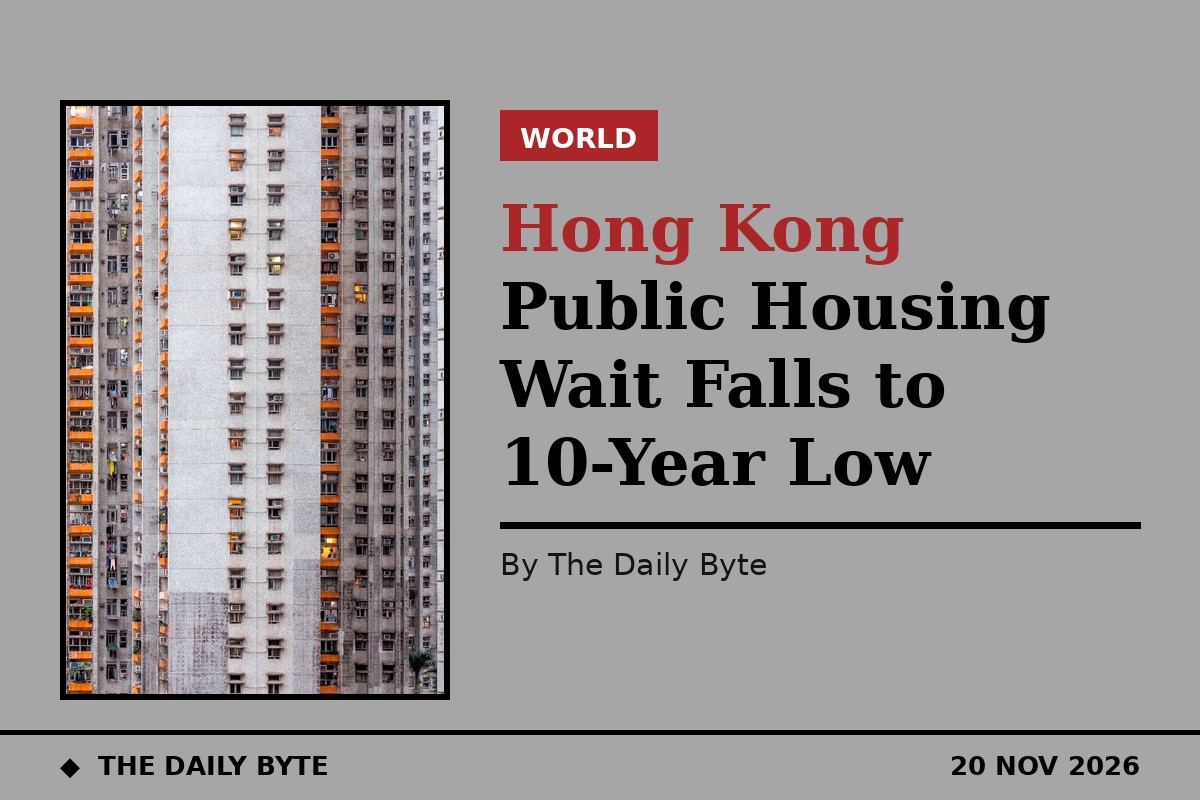
Hong Kong’s wait for subsidised rental housing has fallen to 4.4 years, its lowest level in a decade, the Housing Bureau said on Friday. The figure is down 0.4 years from 4.8 years at the end of June, and is the first time the composite waiting time has dropped below four and a half years.
The composite waiting time, known as the CWT, measures the average wait for general applicants who were housed in public rental housing or light public housing in the 12 months to the end of September 2026. General applicants are family applicants and elderly one-person applicants.
What the 4.4-year figure measures
The bureau said the latest figure is 1.7 years below the peak of 6.1 years recorded before the current-term government took office. A bureau spokesman said long-standing backlogged applications had been gradually cleared as public housing production rose and projects were completed in stages, producing a steady downward trend.
The improvement is not evenly spread across housing types. General applicants housed in public rental housing waited 5.3 years on average, down 0.2 years, while those housed in light public housing waited only 2.8 years. Elderly one-person applicants waited 3.2 years, down 0.3 years on the previous quarter.
“We are confident that we can achieve the target of reducing the CWT to 4.5 years in 2026-27 as announced by the chief executive in the 2022 Policy Address,” the spokesman said. The latest reading already sits below that target.
A queue at a 15-year low
The waiting list itself has shrunk sharply. At the end of September there were about 96,100 general applications for public rental housing, down nearly 40 percent from the peak of 156,400 in September 2020. It is the first time the figure has fallen below 100,000 since 2012, and the bureau described the queue as its lowest in 15 years.
Non-elderly one-person applications have fallen by more than 40 percent from their peak. Among applicants aged below 30, the decline is about 60 percent over the past decade, to around 29,300.
In the third quarter of this year, about 11,200 general applicants were housed in public rental or light public housing. That included about 3,100 newly completed flats, about 2,700 recovered flats and about 5,450 light public housing units, the last figure more than four times the previous quarter’s. Average quarterly supply over the past 12 months rose to about 8,200 units, double the average of about 4,100 units in the four years before the current-term government took office.
Light public housing does the heavy lifting
Light public housing, the transitional flats built on temporary sites, has been central to the improvement. About 29,800 of the planned 30,000 light public housing units had been completed by the middle of November. The remaining two projects, converted from school premises in Kwun Tong and Wong Tai Sin, will provide about 210 units on completion in the first quarter of next year.
All 13 light public housing projects will be completed in slightly over four years, ahead of the five-year target set when the scheme was announced.
What comes next
The bureau said public housing production is entering what it called a harvesting phase. In the next five years, from 2027-28 to 2031-32, more than 35,000 units a year on average will be provided, about 73 percent more than in the five years since the current-term government took office and the highest level in 25 years.
For families still waiting, the figures point in the right direction, but the headline average still means more than four years between applying and being housed. The test of the new supply pipeline will be whether the waiting time keeps falling once the light public housing programme is complete and permanent flats have to carry the load alone.


