Hormuz ship attacks hit highest level since war began
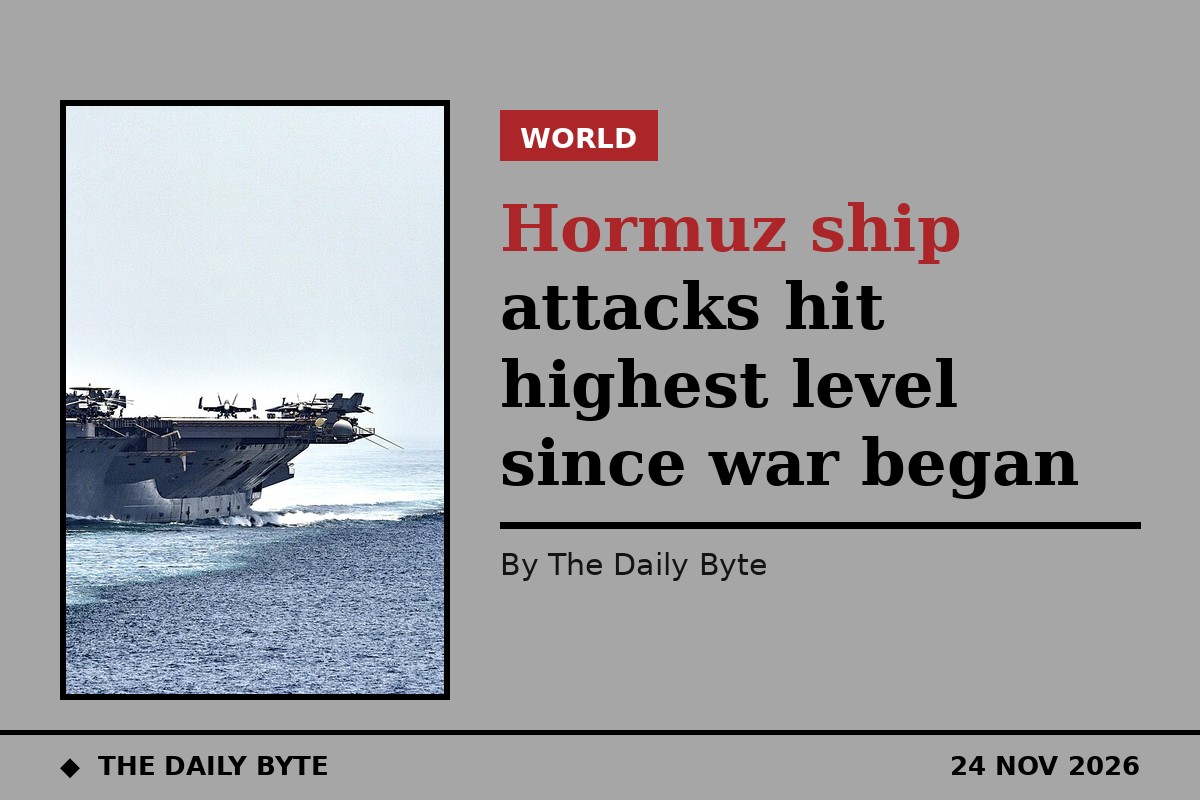
Reported attacks on shipping in and around the Strait of Hormuz have reached their highest level since the war with Iran began, according to maritime data analysed by CNN, as Tehran seeks to reassert control over the waterway while oil prices fall.
In October, the number of attacks reported to the United Kingdom Maritime Trade Operations centre, known as UKMTO, exceeded 30 for the first time since the United States-Iran war began in late February. As of Sunday, at least 22 attacks had been reported in November, the second-highest monthly figure of the war, according to CNN's analysis of the centre's data. The figures cover the Strait of Hormuz, the Persian Gulf and the Gulf of Oman.
Before October, reported attacks in the region averaged around 10 a month. Data from the International Maritime Organization also points to October as having the highest number of confirmed incidents so far this year. UKMTO cautioned that its numbers are probably an undercount, because it only records incidents verified through primary sources. "Additional incidents are known but cannot be independently verified," the centre said in its weekly overview published on Friday.
Three tankers struck in two days
The latest attacks saw projectiles strike three tankers leaving the strait on Friday and Saturday, according to Marisks, a maritime risk management company. Fire broke out aboard the Captain Leon, a Marshall Islands-flagged chemical and oil tanker, after it was hit at the bow at 3 p.m. UTC on Friday. All crew were reported safe.
The Torkel, a Hong Kong-flagged crude oil tanker, caught fire after being struck in the stern at 5 a.m. UTC on Saturday. Less than an hour later, the Arina, also Hong Kong-flagged, was hit in the engine room by a missile. Marisks did not confirm who was behind the attacks, though it said Iranian involvement was "assessed as likely."
The Friday strike was also recorded by UKMTO as Warning 214-26, placing it about eight nautical miles north of Khasab, Oman. Marisks described a "continued critical threat" to commercial shipping in the region, especially through the southern corridor along Oman's coast, which Iran strongly opposes.
Weekly toll at its highest since mid-October
The wider picture is deteriorating. Shipping experienced 15 attacks and piracy-related incidents over the past seven days, a 50 percent increase on the previous week and the highest weekly total since mid-October, according to Martin Kelly of Orbital Risk Intelligence. In the Persian Gulf, the Strait of Hormuz and the Gulf of Oman, he recorded seven strikes involving six vessels, including the liquefied petroleum gas tanker Tara Gas, which was attacked twice.
The violence has left two seafarers missing and 13 injured, according to Kelly's assessment. Among the most serious incidents was the November 17 attack on the tanker Navig8 Messi, which caught fire after being struck 13 nautical miles north of Khasab. Its operator confirmed that one crew member was missing and 11 others were injured, and the remaining crew were evacuated.
Commercial traffic through the channel, through which a fifth of the world's oil passed before the war, remains far below normal. UKMTO recorded 115 outbound and 148 inbound transits over the preceding seven days, down from 139 outbound and 169 inbound the week before, leaving combined traffic about 65 percent below pre-conflict levels.
Why the attacks are intensifying
The Joint Maritime Information Center continues to assess the threat to commercial shipping in the strait as severe, warning that further deliberate attacks are highly likely. Since the United States-Iran ceasefire agreement expired on August 17, UKMTO has recorded six total vessel losses, while 22 vessels required assistance and 31 were confirmed to have continued their voyages.
Analysts say Tehran is stepping up attacks as its leverage fades. The International Energy Agency attributes the recent decline in oil prices to a recovery in Gulf exports, and maritime data service Kpler reported in late October that Iranian oil on water outside the American blockade zone had hit zero, meaning Iran's oil revenues could drop to zero by mid-December.
"Markets appear to be increasingly assuming that a return to full-scale war is unlikely and that oil supplies will gradually recover," Hamidreza Azizi, a senior Iran analyst at the International Crisis Group, told CNN. "But that assumption could change quickly if Iran decides to intensify the confrontation."
President Donald Trump said this month that the United States does not "need a deal" with Tehran and ordered Vice President JD Vance to turn his focus elsewhere. He later indicated that he would not hesitate to resume military strikes in Iran if necessary. Read the CNN analysis here and the gCaptain report on the latest tanker strike here.


