Hormuz Tankers Hit Mines as Iran Claims Two Ablaze
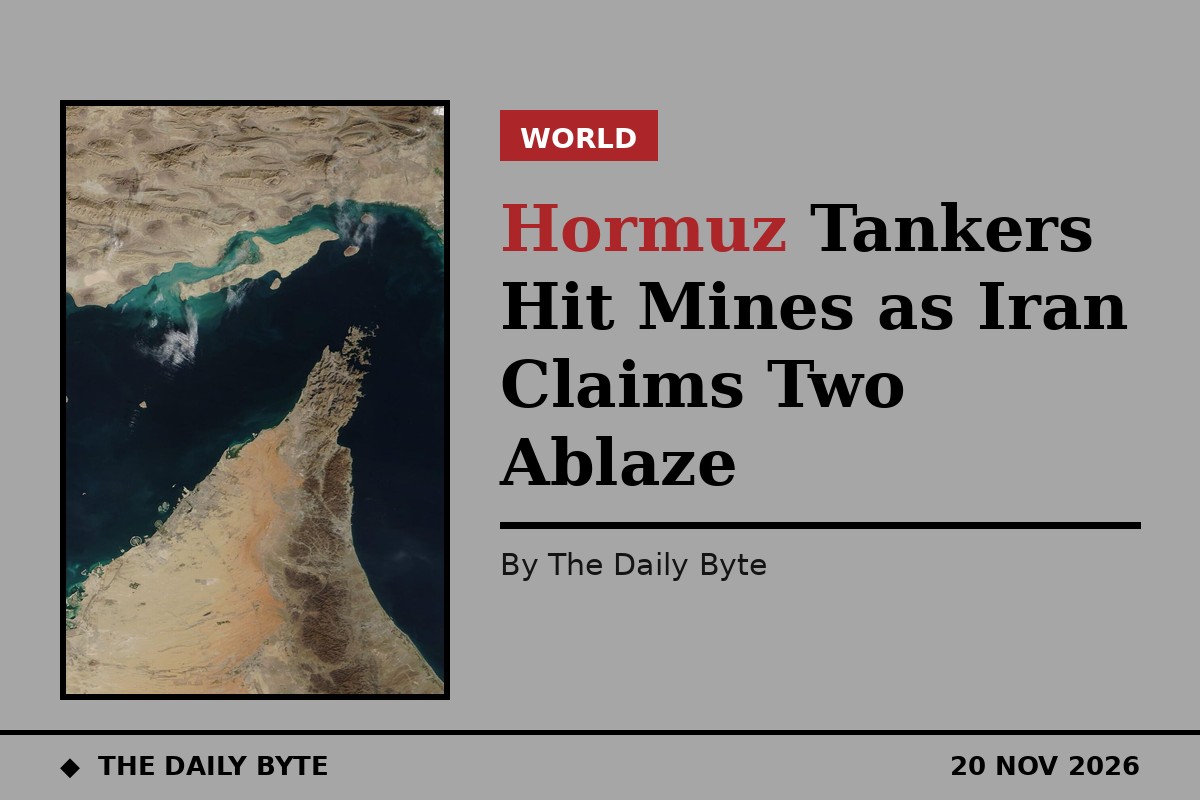
Two oil supertankers struck naval mines and exploded in the Strait of Hormuz on Thursday, Iran's Revolutionary Guards Navy said, in the latest incident in a shipping corridor that has become one of the most dangerous stretches of water in the world.
The Guards said the two vessels, carrying more than four million barrels of crude oil between them, were on fire near the southern coast of the strait after attempting what Tehran calls an unauthorised passage through a restricted route. The statement, carried by Iranian state media, said the tankers had been accompanied by United States fighter jets and surveillance drones. Reuters, which first reported the claim, said it could not independently verify it, and the Guards did not name either vessel.
In a separate statement reported by Anadolu Agency, Iran's army said three oil tankers had struck naval mines and caught fire in the eastern Strait of Hormuz on 18 November, leaving them unable to sail. The two claims, taken together, would make it one of the worst days for commercial shipping in the strait since the conflict began.
There is independent evidence of at least one attack in the same waters. The United Kingdom Maritime Trade Operations centre said an unidentified projectile struck a tanker's engine room about six nautical miles north of Khasab, Oman, on the evening of 18 November. All crew members were reported safe. A day earlier, Abu Dhabi's ADNOC Logistics and Services said one of its vessels had come under attack while transiting the strait, leaving one crew member missing and 11 injured. The abandoned LPG tanker Tara Gas was still burning and drifting off Oman's Musandam coast on 18 November, according to a navigational warning.
Oil markets took the reports in their stride. Brent crude settled up three cents at 91.98 dollars a barrel on Thursday, while United States West Texas Intermediate fell five cents to 83.21 dollars, its lowest close since late August. On Friday, Brent edged up to 92.22 dollars as concern over supplies resurfaced, although both benchmarks remained on course for a third consecutive weekly decline. The International Energy Agency has put cumulative supply losses from the Middle East conflict at 2.8 billion barrels of oil and 60 billion cubic metres of gas, while noting that crude shipments through the strait have returned to roughly pre-war levels.
The strait, the narrow passage between Iran and Oman through which about a fifth of the world's seaborne oil normally flows, has been at the centre of the war between the United States, Israel and Iran since February. Tehran has said the waterway will remain closed until Washington meets its conditions in a verifiable manner, and its forces have repeatedly claimed tanker sinkings and mine strikes that outside monitors have been unable to confirm. United States Central Command has disputed the scale of the disruption, saying its forces have cleared the main routes and helped Gulf partners move about 1.7 billion barrels of oil through the region since the summer.
The human and financial cost of the wider conflict continues to rise. The Pentagon has told lawmakers the war on Iran has cost more than 48.3 billion dollars as of 13 November, and the United States Senate this week rejected another attempt to limit President Donald Trump's war powers, by 48 votes to 51. OPEC+ ministers are due to hold a series of meetings on 29 November, with the security of Gulf exports high on the agenda.
Sources: Reuters; Anadolu Agency.


