Houthis Free 600 Detainees in Sanaa in ICRC Release
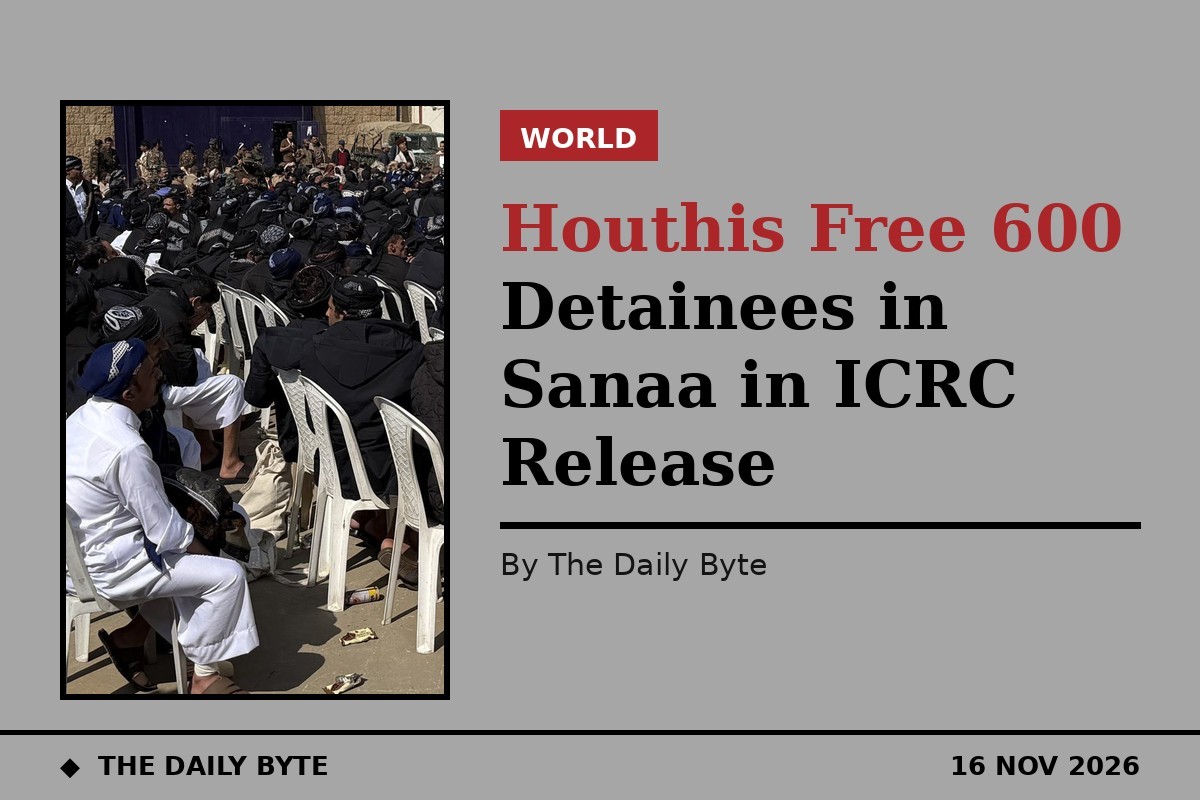
Yemen's Houthi authorities released 600 people detained in connection with the country's war on Sunday, 15 November, in Sanaa, in what the International Committee of the Red Cross (ICRC) described as a unilateral release supported by its delegates.
The freed detainees were men held in connection with the Yemen conflict, many of whom had spent years in detention. The release was organised by the Houthis' National Committee for Prisoners' Affairs and was not part of the Stockholm Agreement, the United Nations-brokered framework for prisoner exchanges agreed in December 2018. No reciprocal release by the internationally recognised government was announced.
What the Red Cross said about the release
The ICRC said its delegates interviewed every detainee privately before the release, carried out health checks and provided assistance to help ensure their dignified return home. The organisation stressed that it had played no role in determining who would be released or how many people would be freed.
A ceremony was held in Sanaa to mark the release, attended by Christine Cipolla, head of the ICRC delegation in the city. The ICRC said it remained ready to act as a neutral intermediary in future releases and transfers of detainees if the parties asked it to.
The release was initiated by the Houthis' National Committee for Prisoners' Affairs, the ICRC said, rather than negotiated as an exchange between the two sides. That distinction matters because previous large releases in Yemen have generally been carried out as swaps, with each side freeing detainees held by the other.
Who was freed, according to the Houthis
Abdulqader al-Murtada, who heads the Houthi prisoners committee, told a news conference in Sanaa that the men were fighters from forces backed by the Saudi-led coalition who had been captured on several fronts, especially along the Saudi border. He said many had spent years in detention and that the group included elderly and sick men.
Media reports from Sanaa indicated that most of those released were fighters captured in 2019 in the Abu Jabara Valley, along the border with Saudi Arabia. The Spanish news agency EFE, whose reporter witnessed the ceremony, identified the released men as government-aligned soldiers captured during fighting near the Saudi border in 2018 and 2019.
Al-Murtada described the release as the largest unilateral release by the Houthis since the Saudi-led coalition intervened in Yemen in 2015, and said it brought the total freed under the group's amnesty initiatives to 2,612, all without an exchange. Those figures are the Houthi committee's own and could not be independently verified, and there was no immediate comment from the Yemeni government.
Why the release stands out in Yemen's war
The Associated Press described the release as the largest unilateral release of detainees in Yemen's 12-year civil war. Yemen's war, which had been largely dormant under a United Nations-brokered truce from 2022, reignited in July 2026, and fighting has intensified again in the south in recent weeks.
The release came on the same day that forces loyal to Yemen's internationally recognised government said they were withdrawing from the Bab el-Mandeb area west of Taiz to focus on defending Aden, leaving the Houthis in control of ground overlooking the strategic strait at the mouth of the Red Sea.
That contrast — a humanitarian release in the capital on the same day as a military setback for the government in the south — underlines how far apart the two sides remain. The release frees 600 men and their families from years of uncertainty, but it does not by itself signal a wider settlement, and no new exchange deal has been announced.
For the families of the released men, the practical effect is immediate: after private interviews and health checks by the Red Cross, the detainees were helped on their journey home. For the wider conflict, the test will be whether either side follows a unilateral gesture with a negotiated exchange, and whether the ICRC is asked to play the intermediary role it has said it is ready to take on.
Sources: The Insight International; Yemen Monitor; Reuters.


