How Do Airplanes Fly? Lift Explained
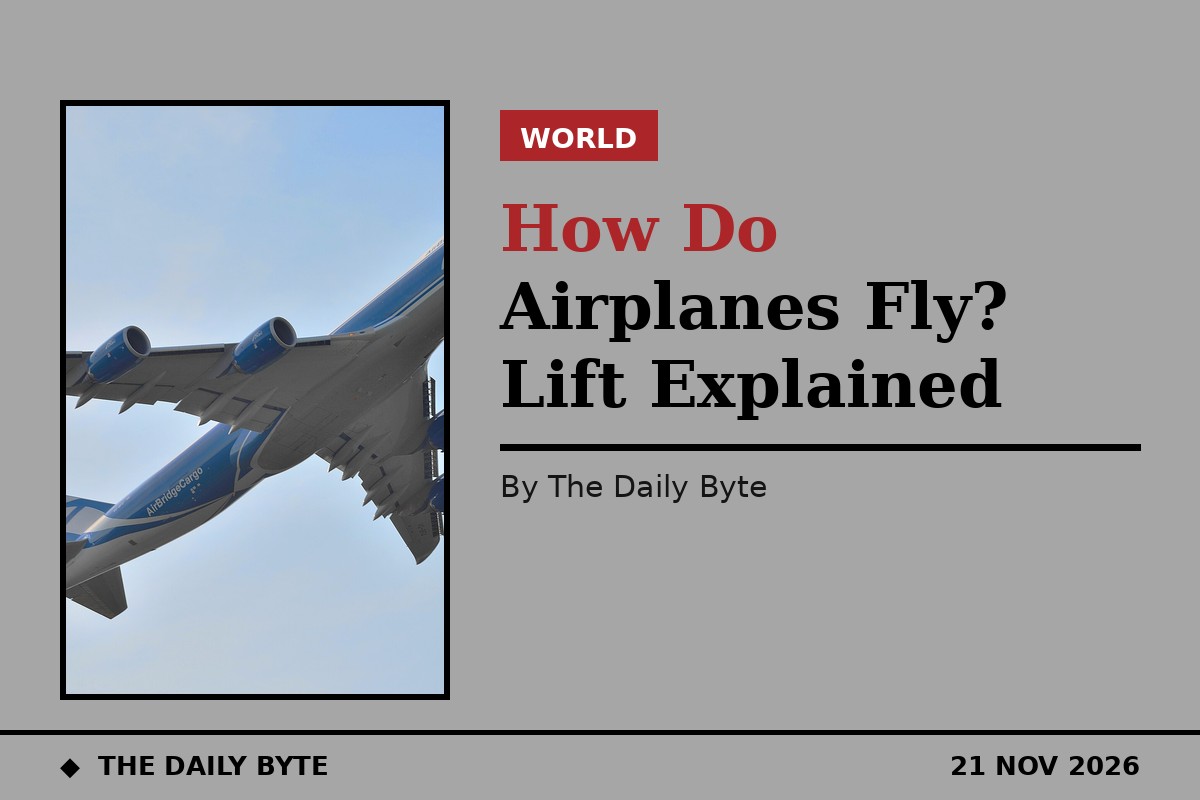
An airplane flies because its wings turn the air flowing past them downward, and the air pushes back upward. That upward push is called lift, and when it is greater than the weight of the airplane, the airplane climbs; when it equals the weight, the airplane flies level. The shape of the wing and the angle at which it meets the air do the work, not any single trick of the wing's curve.
This explainer sets out the four forces acting on every airplane, what a wing actually does to the air, why the two famous explanations of lift agree with each other, why the most popular explanation taught in schools is wrong, and what speed, flaps and thin air have to do with staying in the sky.
The four forces that decide whether a plane flies
Every aircraft in flight has four forces acting on it, and flying is the art of keeping them in balance. Lift pulls up and is made by the wings moving through the air. Weight pulls down and is the force of gravity on the airplane. Thrust pushes forward and comes from the engines. Drag pulls backward and is the air resisting the airplane's movement. In steady, level flight, lift equals weight and thrust equals drag. If lift is bigger than weight, the plane climbs. If thrust is bigger than drag, the plane speeds up.
| Force | Direction | Where it comes from |
|---|---|---|
| Lift | Up | The wings moving through the air |
| Weight | Down | Gravity acting on the airplane |
| Thrust | Forward | The engines |
| Drag | Backward | Air resisting the airplane's movement |
A useful consequence follows at once: the engines do not hold the airplane up. They provide thrust, which keeps the airplane moving forward, and the movement of the wings through the air is what makes lift. That is why a glider with no engine can fly, and why an airplane whose engines stop does not fall out of the sky, as the questions at the end of this article explain.
What a wing actually does
The cross-section of a wing is called an airfoil. It has a rounded leading edge that meets the air first, a thin trailing edge where the air leaves, and a chord line running straight from one to the other. Most airfoils are cambered, meaning the mean line through the middle of the wing is curved, with the top surface more curved than the bottom. The wing also meets the oncoming air at a slight upward tilt, and the angle between the chord line and the airflow is called the angle of attack.
As the wing moves through the air, two things happen at once. Air flowing over the curved upper surface follows the shape of the wing and is bent downward, and air striking the tilted underside is also pushed downward. To bend air around a curve, a force is needed, and in air that force is a pressure difference: pressure is lowest right at the top surface of the wing and higher underneath it. The pressure difference over the whole wing adds up to an upward force, and that is lift. Behind the wing, the air leaves heading downward in a stream called downwash.
The United States Federal Aviation Administration's Pilot's Handbook of Aeronautical Knowledge describes it in the same terms: the airfoil develops a positive-pressure lifting action from the air below the wing and a negative-pressure lifting action from lowered pressure above it, and if the lift force is greater than the weight of the aircraft, the aircraft will fly. NASA's Glenn Research Center makes the same point from the other side: the magnitude of the lift depends on the shape of the wing and how it moves through the air, and the lift of a typical airfoil rises almost linearly with angle of attack at small angles.
Bernoulli and Newton: two views of the same flow
Two famous names are attached to lift, and they are often presented as rival theories. They are not rivals. Daniel Bernoulli's principle says that along a streamline, faster-moving fluid has lower pressure, which describes the pressure difference around the wing. Isaac Newton's third law says that for every action there is an equal and opposite reaction, which describes the same event as the wing pushing air downward and the air pushing the wing upward. The pressure story and the airflow-turning story are two ways of describing one flow field, and both are correct.
The lift equation used by engineers brings the pieces together. Lift equals one half times the air density times the square of the speed times the wing area times a lift coefficient, which depends on the wing's shape and its angle of attack. The square on the speed matters: doubling the speed quadruples the lift at the same angle of attack. That is why takeoff speed is so important, and why a fully loaded Boeing 747, weighing close to 400 tonnes, needs a long runway run before its wings can make enough lift.
The popular explanation that is wrong
Ask almost anyone why an airplane flies and you will hear the same story: the top of the wing is curved, so the air going over it has further to travel, so it must speed up to arrive at the back edge at the same time as the air underneath, and faster air means lower pressure, which pulls the wing up. It is a neat story, and the middle step is wrong. There is no physical law requiring the two streams of air to reunite at the trailing edge at the same time, and wind-tunnel measurements show that the air over the top actually arrives at the back edge earlier than the air underneath, sometimes twice as fast.
The story also fails simple tests. Paper planes fly, and their wings are flat, so the path over the top is no longer than the path underneath. Aerobatic airplanes have symmetrical wings, with the top and bottom the same shape, yet they fly perfectly well and can even fly upside down. Fighter jets use symmetrical wing profiles too. In each case the wing makes lift by its shape and its angle of attack, turning air downward. NASA's education pages have called the equal-transit-time idea incorrect for many years, and the Federal Aviation Administration's handbook does not rely on it either.
Why speed, flaps and thin air matter
Because lift grows with the square of speed, a small change in speed makes a large difference to lift, and pilots manage speed carefully. During takeoff, the pilot applies as much thrust as possible and then rotates the aircraft, raising the nose to increase the angle of attack and produce the extra lift needed to leave the ground. NASA notes that for a typical airfoil, lift rises almost linearly with angle of attack within about ten degrees either way, but the relationship becomes complex at higher angles.
There is a limit. If the angle of attack grows too large, the layer of air close to the wing's surface, called the boundary layer, separates from the top of the wing, and lift falls sharply while drag rises. This is a stall, and for many wings the critical angle is roughly 15 to 18 degrees. A stall happens at a critical angle of attack, not at a fixed speed: in a turn or a pull-up, the wing must carry more weight and can stall at a higher speed than in level flight.
Two other factors matter. The first is the wing itself: flaps change the wing's shape for slow flight. Leading-edge Krueger flaps and trailing-edge Fowler flaps extend from the wing and turn the airfoil into a more deeply curved shape, generating much greater lift at low speed for takeoff and landing, then retract for efficient cruising. The second is the air itself: thinner air at high altitude or on a hot day gives less lift, because there is less air for the wing to push against, so airplanes need more speed or a bigger angle of attack to make the same lift.
Frequently asked questions
Do airplanes fall out of the sky if the engines stop? No. The engines provide thrust, not lift, and the wings keep making lift as long as the airplane keeps moving through the air. An airplane with no engine power becomes a glider: it descends gradually while the pilot trades height for speed, and airliners are designed to glide a long way to a landing.
Can an airplane fly upside down? Aerobatic airplanes can, because their symmetrical wings make lift from angle of attack rather than from camber. The pilot flies with the wing tilted the other way, so the lift still points up relative to the ground. An airliner is not built or flown that way.
Why do airplanes take off into the wind? A headwind increases the airflow over the wings before the airplane has even started moving, so the wings reach flying speed sooner and the takeoff run is shorter. That is also why runways are built to face the prevailing wind where possible.
What is a stall? A stall is a sudden loss of lift when the angle of attack passes its critical value, usually around 15 to 18 degrees, and the airflow separates from the top of the wing. The remedy is to lower the nose, reduce the angle of attack, and let the smooth airflow reattach.
Why are airplane wings swept back? Swept wings delay the effects of air compressing at high speed, which lets airliners cruise efficiently near the speed of sound. Slow airplanes do not need the sweep, which is why small training aircraft have straight wings.


