How Do Birds Fly? The Science of Flight Explained
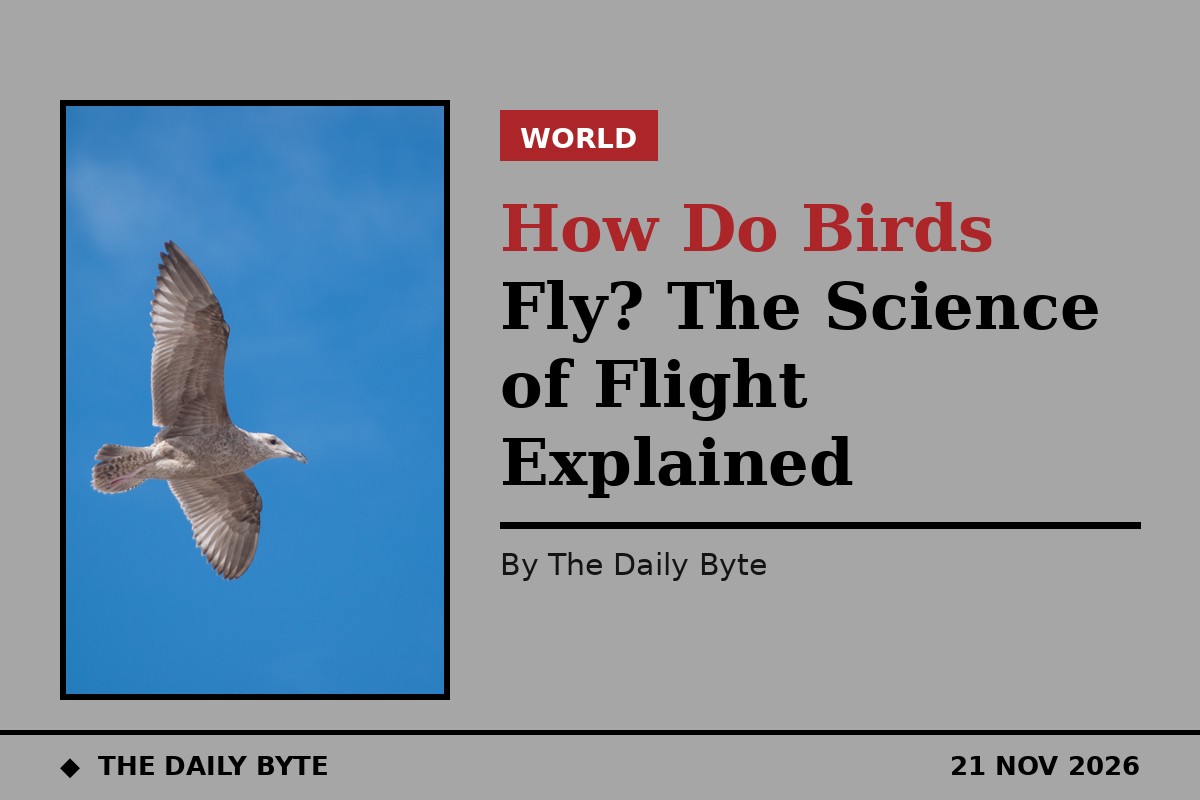
Birds fly because their wings turn muscle power into lift, the upward force that balances the pull of gravity. A bird's wing is curved on top and flatter underneath, so air moving over the top travels faster and presses down less than the air beneath, and that pressure difference pushes the wing upward. Flapping supplies the forward thrust that keeps air streaming over the wings, and lift and thrust together hold the bird up and drive it forward. It is a system refined over roughly 150 million years of evolution, from the first feathered gliders to the swifts that spend months on the wing without landing.
This explainer sets out the four forces every flying bird must balance, how a wing makes lift, what feathers actually do, how the bird's body is built for flight, why wing shapes differ so much between species, the difference between flapping, gliding, soaring and hovering, how birds take off and land, and the record breakers that show just how far the system can be pushed.
What is lift, and where does it come from?
A flying bird is always balancing four forces at once. Lift pushes it up, weight pulls it down, thrust pushes it forward, and drag holds it back. When lift equals weight and thrust equals drag, the bird cruises in a straight line. When lift exceeds weight it climbs, and when thrust exceeds drag it speeds up. Every part of the bird, from its hollow bones to the microscopic hooks on its feathers, is shaped by this balance, and the wing is where the balance is struck.
The wing works as an airfoil, a shape that is curved on top and flatter underneath. As the wing moves forward through the air, the air flowing over the curved upper surface has to travel further and faster than the air beneath the lower surface, and faster-moving air exerts less pressure. That leaves higher pressure below the wing and lower pressure above it, and the difference pushes the wing upward. This is Bernoulli's principle, named after the Swiss physicist Daniel Bernoulli, and it is only half of the story.
The other half comes from Isaac Newton. The wing is also tilted slightly against the oncoming air, at what pilots call the angle of attack, so it deflects air downward as it passes. By Newton's third law, pushing air down pushes the bird up with an equal and opposite force. Lift grows with wing area, air density, and the square of speed, which means doubling speed quadruples lift. Birds control lift moment by moment by changing the angle of attack, but only up to a point: tilt too far and the smooth airflow breaks away from the wing surface, lift collapses, and the wing stalls. Birds live close to this edge on purpose, especially when landing slowly, and they use a small tuft of feathers called the alula, the bird's thumb, as a slot that re-energises the airflow and delays the stall.
What feathers actually do
Feathers are what make a bird's wing a working surface rather than a bare membrane. Each flight feather has a central shaft with parallel branches called barbs, and each barb carries tiny branches called barbules. Barbules on one side have microscopic hooks, while those on the other side have ridges, and the hooks latch onto the ridges of neighbouring barbules, zipping the feather into a smooth, airtight sheet that air cannot slip through. When the sheet is ruffled, a bird runs its beak along the feather while preening, and the hooks zip back together like a broken zip being closed.
The feathers are arranged in two working teams. The outer flight feathers, the primaries anchored to the hand bones, act as propellers during the downstroke, twisting to push air backward and drive the bird forward. The inner flight feathers, the secondaries along the forearm, generate most of the steady lift. Over them lie layers of smaller covert feathers that smooth the airflow over the wing, and the whole wing can change shape in flight: it spreads wide for slow, powerful flapping, folds back for a fast dive, and sweeps into a narrow point for speed.
The body built for flight
Flight is expensive, and the bird's body is built to pay for it as cheaply as possible. Many bones are hollow, braced inside with thin struts like the inside of an aircraft wing, which keeps them strong while cutting weight. The breastbone carries a deep keel, a blade of bone that anchors the huge pectoral muscles that power the downstroke, and in strong fliers those muscles are the largest in the body. The tail is a rudder and a brake, fanning out to steer and to add lift at low speed.
Breathing is rebuilt for flight as well. Birds have a system of air sacs that keeps air flowing through their lungs in one direction, so fresh oxygen-rich air passes over the exchange surface both when the bird breathes in and when it breathes out. Mammals, by contrast, fill and empty the same air, so part of every breath is stale. The one-way flow means a bird extracts oxygen far more efficiently, which matters at altitude, where the air is thin, and during the hard work of flapping. A bird also runs hot: its body temperature is usually around 40 to 42 degrees Celsius, and its heart beats several hundred times a minute in flight, feeding oxygen to muscles that burn fuel at a furious rate.
Why wing shapes differ
Not all wings are alike, because not all birds fly the same way, and wing shape is a signature of lifestyle. Long, narrow wings suit ocean gliders: an albatross can lock its wings and ride the wind over the waves for hours, barely flapping, covering enormous distances on very little energy. Broad wings with slotted, spread wingtip feathers help eagles and vultures soar on rising columns of warm air, called thermals, carrying heavy loads without flapping. Pointed, swept-back wings let falcons and swifts fly fast and turn sharply, and short, broad, rounded wings give forest birds the quick manoeuvrability they need to dodge between branches. Hummingbirds have gone furthest of all: their wings pivot at the shoulder so they can beat in a figure of eight, producing lift on both the forward and the backward stroke, which is what lets them hover in front of a flower.
The trade-offs are strict. A wing built for speed is poor at slow flight, and a wing built for soaring is clumsy in a forest. That is why a swift, the fastest bird in level flight, can barely walk on the ground, and why an albatross needs a running start into the wind to get airborne. Evolution has tuned each species to its own way of making a living, and the wing is the record of that bargain.
Flapping, gliding, soaring and hovering
Flapping is the engine. On the powerful downstroke the wing pushes air downward and backward, and the reaction drives the bird forward and up. On the upstroke the wing folds slightly and slices back through the air with as little drag as possible. Small birds flap continuously, while larger birds flap in bursts and then glide, trading height for distance. A gliding bird is slowly sinking, and it pays for that sink with altitude; that is why gliders start high, circle in thermals to gain height, and then glide on to the next thermal.
Soaring takes this further. Some seabirds use dynamic soaring, crossing the boundary between fast air above the waves and slow air near the surface to gain energy from the wind itself, which is how albatrosses can travel thousands of kilometres without a single wingbeat. Hovering is the most expensive style of all: a hummingbird beats its wings about 50 times a second and burns energy so fast that it must feed every few minutes, and some species enter a torpid, almost hibernating state overnight to survive until dawn.
Taking off and landing
Getting airborne is the hardest part of flight, because the wings need fast-moving air before they can make useful lift. Small birds solve it with a jump and a few hard wingbeats. Large birds need a run: swans patter across the water, albatrosses run into the wind, and heavy birds often launch from a height. Once the air is moving over the wings, lift builds quickly and the bird climbs away. Landing is the reverse problem: the bird must shed speed without stalling. It raises its body, spreads its tail and feet as air brakes, and uses the alula to keep the airflow attached at a steep angle, dropping onto its feet at the last moment. Birds that get it wrong skid, tumble, or splash, and young birds learning to land are famously clumsy for a few weeks.
The record breakers
The numbers show how far the system can go. The fastest animal on Earth is a bird in a dive, and the longest non-stop flight ever recorded belongs to a shorebird smaller than a pigeon. These records are measured, tracked and verified, not estimated from stories.
| Record | Bird | Figure |
|---|---|---|
| Fastest dive | Peregrine falcon | Up to 389 km/h in a hunting stoop |
| Fastest level flight | Common swift | 111.5 km/h under its own power |
| Longest non-stop flight | Bar-tailed godwit | 13,560 km from Alaska to Tasmania in 11 days |
| Longest time airborne | Common swift | Up to 10 months without landing |
The godwit's record deserves a closer look. A five-month-old bar-tailed godwit, tracked by satellite tag, flew from Alaska to Tasmania without stopping for food, water or rest, burning the fat it had stored before departure and shrinking its own digestive organs to save weight. It flew for eleven days straight, day and night, over open ocean where landing was impossible. The peregrine's dive is a different kind of marvel: it folds its wings, drops like a stone, and at the last moment pulls out, striking its prey in mid-air at a speed no other animal can match. Its nostrils have bony tubercles that slow the airflow, like the intake of a jet engine, so it can still breathe at that speed.
Why some birds cannot fly
About sixty living bird species have given up flight altogether, and each one shows the bargain from the other side. Ostriches traded wings for running legs and became the fastest birds on land. Penguins turned their wings into flippers and became superb swimmers. Kiwis, living on islands with no ground predators, shrank their wings to stubs and became nocturnal foragers. Flightlessness evolves when flying costs more than it returns, usually on islands without predators or in the water, where swimming pays better. The birds keep their feathers, their hollow bones and their keeled ancestors' body plan, but the wings are put to new work or left to shrink. Their existence is a reminder that flight is a tool, not a definition: a bird is a bird because of its feathers, its beak and its warm-blooded metabolism, not because it can fly.
Frequently asked questions
Can birds fly in the rain? Yes, but it costs them. Rain wets the feathers, adds weight and disrupts the smooth airflow over the wing, so most birds shelter during heavy rain and fly again when it eases. Seabirds have especially oily, waterproof plumage and cope better than songbirds.
Why do birds fly in a V formation? Geese and other large migrants fly in a V so each bird rides the rising air, the upwash, from the wingtip of the bird ahead, which saves energy. The lead bird works hardest, so flocks take turns at the front, and the formation also keeps the group together and in visual contact.
Do birds sleep while flying? Some do. Frigatebirds and swifts have been recorded sleeping in short bursts while airborne, shutting down one half of the brain at a time while the other half keeps flying. Most birds, though, sleep perched, often standing on one leg with the other tucked into their feathers to save heat.
How high can birds fly? Most birds cruise below 3,000 metres, but bar-headed geese have been tracked crossing the Himalayas at over 6,000 metres, and a Ruppell's griffon vulture once collided with an aircraft at about 11,300 metres. At those heights the air is thin and cold, and only birds with exceptionally efficient lungs and blood can cope.
Why do birds not get tired of flapping? They do get tired, which is why most birds mix flapping with gliding, and why migrants stop to rest and feed. But their muscles are rich in the slow, fatigue-resistant fibres that suit endurance, and their breathing and circulation deliver oxygen far more efficiently than a mammal's, so they can sustain effort that would exhaust a land animal of the same size.


