How Do Earthquakes Happen? Explained
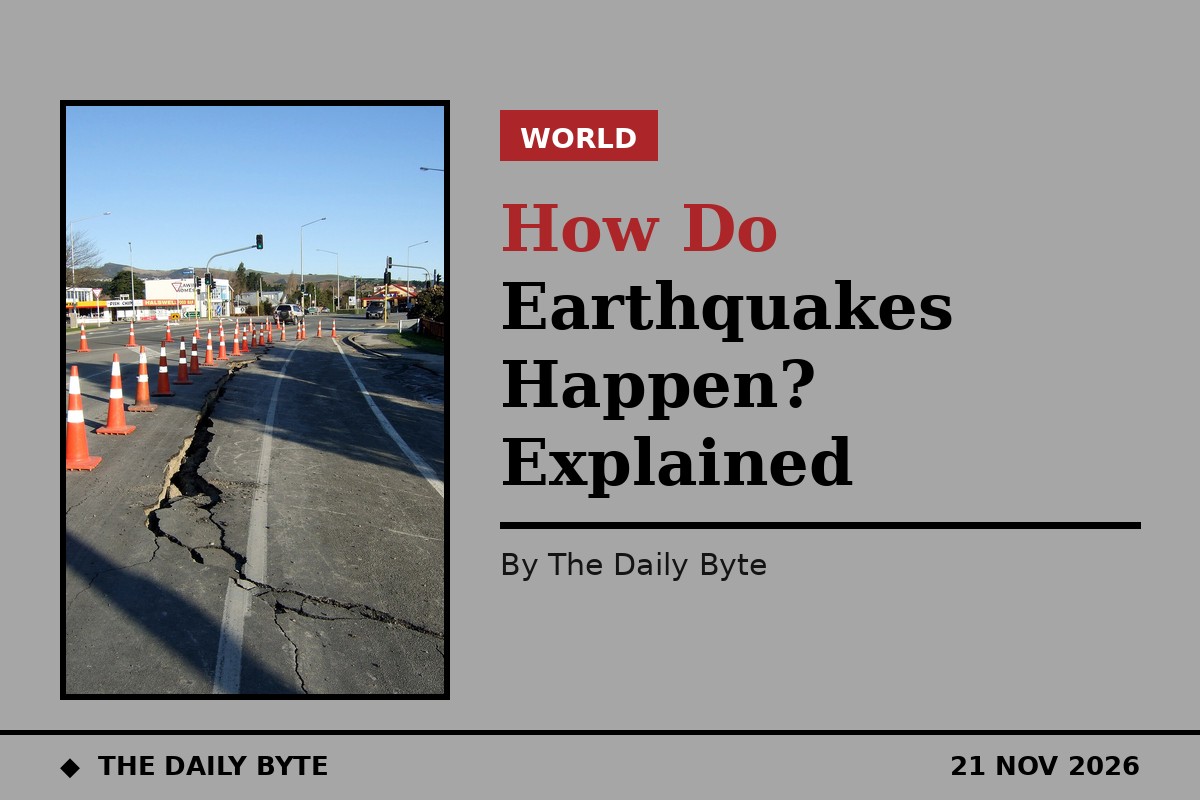
An earthquake happens when two blocks of the Earth's crust suddenly slip past each other along a crack called a fault. The tectonic plates that make up the Earth's surface are always moving, but their rough edges can get stuck together by friction. Stress builds up slowly over years or even centuries, and when it finally overcomes the friction, the stuck edges break free in a sudden jolt. The energy stored during all that slow strain is released in waves that travel through the Earth and shake the ground. That shaking is the earthquake.
What is a fault?
A fault is a fracture in the Earth's crust along which two blocks of rock have slipped relative to each other. The place underground where the slip starts is called the focus, or hypocentre. The point on the surface directly above it is the epicentre, the place usually named in news reports. Earthquakes can start anywhere from just below the surface to about 800 kilometres down, in the crust and the upper mantle, but the shallow ones are the ones people feel most strongly, because the shaking weakens with distance from the source.
Faults are grouped by how the blocks move. In a normal fault, the rocks are being pulled apart and one block drops down. In a thrust, or reverse, fault, the rocks are being squeezed together and one block is pushed up over the other. In a strike-slip fault, the blocks slide sideways past each other. The San Andreas Fault in California, more than 650 miles (about 1,050 kilometres) long and reaching at least 10 miles deep, is a strike-slip fault, and it marks the boundary between the Pacific Plate and the North American Plate.
Why do the plates move at all?
The Earth's outer shell is not one solid piece. It is made up of a dozen or so large, rigid slabs called tectonic plates, which sit on top of hotter, slowly moving rock in the mantle. Heat escaping from the Earth's interior keeps that mantle material moving, and the plates ride along with it at a few centimetres a year, roughly the speed at which fingernails grow. The Pacific Plate, for example, grinds north-west past the North American Plate at about two inches (five centimetres) a year along the San Andreas Fault system.
Most of the time that movement is smooth and unnoticed. The trouble starts where plates meet. Their edges are rough, so instead of sliding freely they lock together while the rest of the plate keeps moving. The locked section bends and stores energy like a stretched spring. When the stress finally exceeds the strength of the rocks, the fault ruptures, the blocks lurch forward by anything from a few centimetres to several metres, and the stored energy radiates outward as seismic waves. Where a fault creeps steadily instead of locking, the same movement produces only tiny tremors; where it locks for hundreds of years, the eventual release can be a great earthquake.
The three types of plate boundary
Nearly all large earthquakes happen at plate boundaries, and there are three kinds. At a divergent boundary, two plates pull apart and molten rock rises to fill the gap, building new crust; the earthquakes here tend to be shallow and moderate. At a convergent boundary, two plates collide, and the denser one is forced down into the mantle in a process called subduction; these boundaries produce the largest earthquakes on Earth, including the magnitude 9.1 Sumatra earthquake of 2004 and the magnitude 9.0 Tohoku earthquake off Japan in 2011. At a transform boundary, two plates grind sideways past each other without creating or destroying crust; the San Andreas Fault is the best-known example. Earthquakes can also strike inside plates, far from any boundary, where old zones of weakness in the crust react to stresses transmitted from the plate edges, but these are much less common.
What are seismic waves?
The energy released by a fault rupture travels as seismic waves, and there are two main families. Body waves travel through the Earth's interior. The fastest are P-waves, or primary waves, which compress and stretch the rock as they pass, like sound waves, and can travel through solids and liquids. Close behind come S-waves, or secondary waves, which shake the rock from side to side and can only travel through solids. Because P-waves are faster, they arrive first, and the gap between the P-wave and S-wave arrivals is one of the ways scientists locate an earthquake.
When the body waves reach the surface they generate surface waves, which roll along the ground and cause most of the damage to buildings. Love waves shake the ground from side to side, while Rayleigh waves roll it in an elliptical motion, like ocean waves. It is the surface waves, arriving last but carrying much of the energy, that topple chimneys, crack roads and bring down poorly built structures. A large undersea earthquake can also displace a huge volume of water and set off a tsunami, as happened after the 2004 Sumatra earthquake.
How are earthquakes measured?
Two different things are measured, and they are often confused. Magnitude measures the energy released at the source, and scientists now use the moment magnitude scale, written as Mw. It is based on the size of the fault that slipped, how far it moved, and the stiffness of the rocks, and it has replaced the older Richter scale for large earthquakes because the Richter scale saturates and stops distinguishing between very large events. Each whole-number step on the magnitude scale represents about 32 times more energy released, so a magnitude 7 earthquake releases roughly 32 times the energy of a magnitude 6.
Intensity, by contrast, measures what people actually feel and what damage occurs at a particular place, and it is reported on scales such as the Modified Mercalli scale, which runs from I, not felt, to XII, total destruction. Intensity falls with distance from the epicentre and depends on local ground: soft sediments can amplify shaking, which is why two neighbourhoods in the same city can suffer very different damage from the same earthquake. Seismometers record the ground motion, and readings from at least three stations are combined by triangulation to pinpoint the location and depth of the event.
How often do earthquakes happen?
Far more often than most people realise. The United States Geological Survey (USGS) estimates that about 500,000 earthquakes detectable by instruments occur worldwide every year. Of those, about 100,000 are strong enough to be felt by people, and about 100 cause damage. The global seismic network locates roughly 20,000 of them in detail each year. Long-term averages work out at about one earthquake of magnitude 8 or larger per year and around 15 of magnitude 7 or larger.
The largest earthquake ever recorded was the magnitude 9.5 Valdivia earthquake in Chile in 1960. About 90 per cent of the world's earthquakes happen around the Pacific Ocean, in the horseshoe-shaped belt of volcanoes and faults known as the Ring of Fire, which runs from New Zealand and Indonesia up through Japan and Alaska and down the west coasts of North and South America. That is where most of the planet's subduction zones are, and where the largest earthquakes are born.
Can earthquakes be predicted?
No. Scientists cannot reliably predict the exact time, place and magnitude of an earthquake before it happens, and no method has ever been shown to work consistently. What they can do is forecast probabilities: by studying how fast strain is building up on a fault and how long it has been since the last big rupture, they can estimate the chance of a large earthquake in a region over the next 30 years, which is how building codes and emergency plans are set. Early-warning systems are a different idea altogether. They detect the fast, weak P-waves and send an alert before the slower, stronger shaking arrives, giving people seconds to tens of seconds of warning. Japan has operated such a system for years, and the USGS runs ShakeAlert on the west coast of the United States.
What should you do during an earthquake?
The advice from the USGS and emergency agencies is simple: drop, cover and hold on. Drop to your hands and knees, take cover under a sturdy table or desk, and hold on until the shaking stops. If there is no table nearby, cover your head and neck with your arms and crouch against an interior wall, away from windows, bookcases and anything that could fall. Most injuries in earthquakes come from falling objects and debris, not from buildings collapsing outright. Stay indoors until the shaking stops rather than running outside, where facades and glass can fall. If you are outdoors, move to open ground away from buildings, trees and power lines. If you are driving, pull over, stop, and stay in the vehicle with the seat belt on until the shaking ends. Afterward, expect aftershocks, which can continue for days or weeks, check for gas leaks and damaged wiring, and avoid entering badly damaged buildings.
Frequently asked questions
What causes an earthquake? A sudden slip on a fault, when the stress built up by moving tectonic plates overcomes the friction holding the fault locked. The slip releases stored energy as seismic waves, which shake the ground.
Why do earthquakes happen in the same places? Because most occur at plate boundaries, which stay in the same place for millions of years. The Ring of Fire around the Pacific is the most active belt, which is why Japan, Indonesia, Chile and California are repeatedly hit.
What is the difference between magnitude and intensity? Magnitude measures the energy released at the source of the earthquake, on the moment magnitude scale. Intensity measures the shaking and damage felt at a particular place, on scales such as the Modified Mercalli scale.
Can animals predict earthquakes? There are many anecdotes of animals behaving strangely before earthquakes, but no reliable evidence that animals can predict them. Unusual animal behaviour has many causes, and it is only noticed as a warning after the event has happened.
Do small earthquakes prevent big ones? No. Small earthquakes release very little energy compared with large ones: it would take about a thousand magnitude 4 earthquakes to release the energy of a single magnitude 6. A swarm of small tremors does not bleed off the strain that drives a great earthquake.


