How Do Employment Tribunals Work? UK Guide
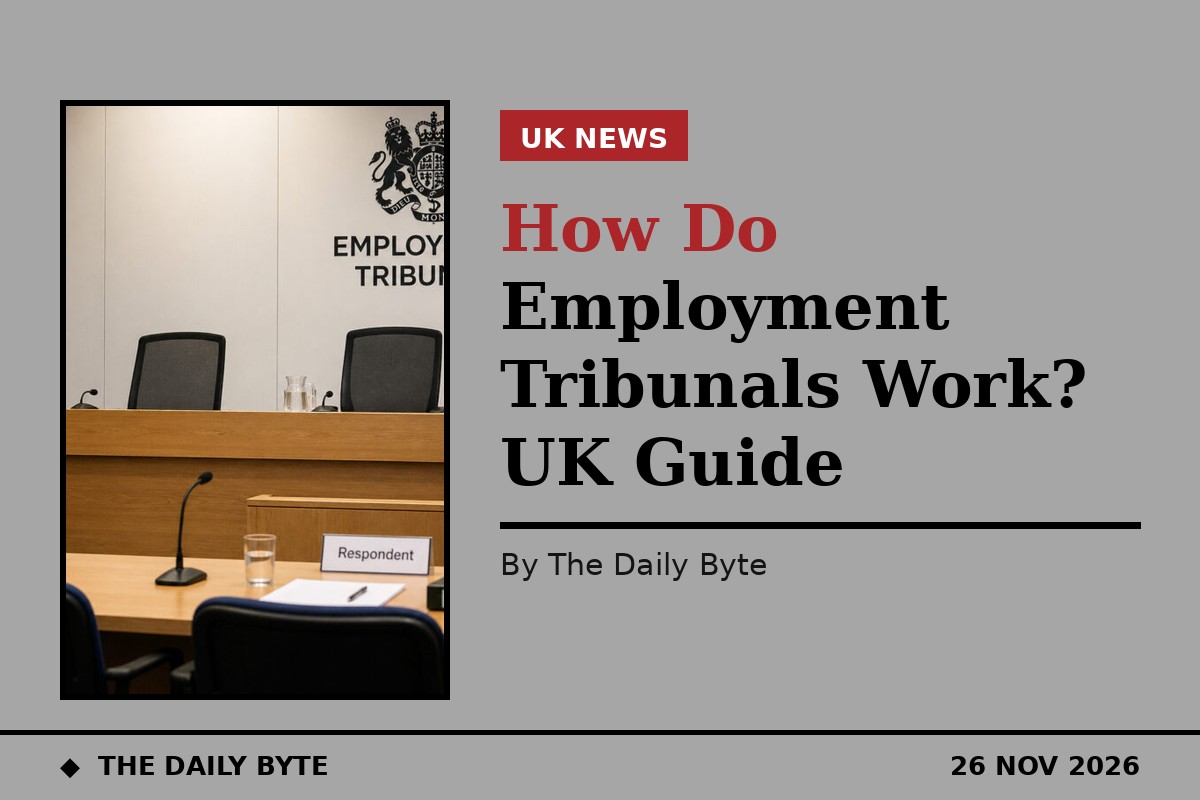
An employment tribunal is the specialist court that decides most workplace disputes in England, Wales and Scotland, including unfair dismissal, discrimination and unpaid wages. There is no fee to make a claim, but there are strict time limits, and in most cases you must notify Acas for early conciliation before you can claim. This guide explains what an employment tribunal is, what kinds of claims it hears, the step-by-step process from first checking your deadline to the final hearing, what it costs, how long it takes, and what happens if you win or lose. It covers England, Wales and Scotland; in Northern Ireland, similar cases go to an industrial tribunal and some time limits differ. This is general information, not legal advice, and the rules are changing, so check the official GOV.UK and Acas pages linked at the end before you act.
What is an employment tribunal?
An employment tribunal is a court that hears disputes between workers and employers, and in some cases between workers and trade unions or prospective employers. It is less formal than an ordinary civil court, but it is still a court: evidence is given under oath, witnesses can be cross-examined, and its decisions, called judgments, are legally binding. Most claims are heard by an employment judge sitting alone or with two lay members, who are people with experience of the workplace from the employer and employee sides. The tribunal can order an employer to pay compensation, to give a worker their job back, or to take other steps, and it can also dismiss a claim. Judgments are published on the online register of employment tribunal decisions on GOV.UK, where they stay searchable, which is one reason many employers prefer to settle a claim before a hearing. The tribunal hears a wide range of claims, including unfair dismissal, constructive dismissal, wrongful dismissal, discrimination based on a protected characteristic, equal pay, unauthorised deductions from wages, breach of contract, whistleblowing detriment, and claims about redundancy pay, holiday pay and working time. Some complaints go elsewhere instead: complaints about the national minimum wage usually go to HMRC, and some health and safety complaints go to the Health and Safety Executive.
Who can make a claim?
You can make a claim if you think someone has treated you unlawfully, such as your employer, a potential employer or a trade union. GOV.UK lists the situations in which a claim can be made, including discrimination at work based on a protected characteristic, unfair dismissal, and being owed money such as unpaid wages or redundancy pay. Some claims need a qualifying period of employment, and some do not: for example, an ordinary unfair dismissal claim usually needs two years of continuous service, falling to six months for dismissals taking effect on or after 1 January 2027 in England, Scotland and Wales, while a discrimination claim has no minimum service requirement. The tribunal's jurisdiction covers England, Wales and Scotland; Northern Ireland has its own industrial tribunals, with different forms and time limits. Before deciding to claim, it is worth checking whether the problem can be solved another way, because the tribunal will usually expect you to show that you tried to resolve the dispute yourself, for example by raising it informally or through a formal grievance. Free advice is available from Acas, Citizens Advice and, for members, a trade union.
How long do you have to make a claim?
The time limits are the most important thing to get right, because a late claim is usually rejected whatever its merits. How long you have depends on when the problem happened. GOV.UK says you usually have six months if the problem happened on or after 1 October 2026, and three months if it happened before 1 October 2026. Acas gives the exact form: six months minus one day, or three months minus one day, counted from the triggering event. For an unfair dismissal claim the period begins on the date the employment ended; for a discrimination claim it runs from the most recent incident; and for an unauthorised deduction from wages it runs from the date of the incorrect payment. The change to six months was made by the Employment Rights Act 2025 and came into force on 1 October 2026; it does not apply in Northern Ireland, where most claims must still be brought within three months. Notifying Acas for early conciliation within the time limit pauses the clock until conciliation ends, so the first practical step is to check your deadline and notify Acas in good time. Raising the problem with your employer, or waiting for a grievance outcome, does not pause the limit, and GOV.UK warns that a missed deadline may mean no claim can be made even if you were trying to resolve the dispute directly.
Step 1: Notify Acas and try early conciliation
In most cases you must notify Acas before you can make a tribunal claim. Early conciliation is a free, legal process in which an Acas conciliator talks to you and to your employer and tries to help you reach a legal agreement, called a COT3 settlement, without going to a tribunal. Taking part is voluntary for both sides, and the conciliator cannot take sides, represent you, or tell you whether you have a valid case. Early conciliation should not be your first step: Acas advises trying to solve things informally first, then raising a formal grievance, and appealing if a disciplinary or grievance outcome was wrong. When you notify Acas, the time limit for your claim is paused. Early conciliation can last up to 12 weeks, a period that doubled from six weeks for notifications made on or after 1 December 2025, although it can end sooner if either side declines to take part. If you reach an agreement, the claim is settled and there is no tribunal hearing. If you do not, Acas issues an early conciliation certificate, and you need the certificate number to submit your claim. A small number of claim types are exempt from early conciliation, and Acas cannot advise whether a particular claim is exempt, so check the Acas guidance on exemptions. The Acas early conciliation support line is 0300 123 1122, Monday to Friday, 9am to 5pm.
Step 2: Submit your claim on form ET1
The claim itself is made on form ET1, normally online through the GOV.UK service called Make a claim to an employment tribunal. The form asks for your details, your employer's details, the type of claim, the dates, a description of what happened, and the remedy you are seeking, together with your Acas early conciliation certificate number. It is important to get the employer's legal name right and to include every claim you intend to bring, because adding a new claim later needs the tribunal's permission and may be refused. There is no fee to submit the form. GOV.UK says you do not have to pay a fee to make a claim to an employment tribunal, and that has been the position since the Supreme Court ruled the earlier fee regime unlawful in R (UNISON) v Lord Chancellor in 2017. You may still have to pay other costs, such as witness expenses and legal fees, and the tribunal can order you to pay the respondent's costs if it decides you acted unreasonably. For unfair dismissal claims, interim relief may be available while the case is waiting to be decided, and it must be applied for with the main claim within seven days of dismissal. Once the claim is accepted, the tribunal sends it to the employer and sets the process in motion.
Step 3: The employer replies, and the tribunal manages the case
The employer, called the respondent, usually has to reply in writing within 28 days of receiving the claim form, using form ET3. The reply sets out the employer's version of events and any defence. The tribunal then decides whether a full hearing is needed, and in most cases it will hold a preliminary hearing, by phone or video, to identify the issues, agree a timetable, and deal with any early questions, such as whether the claim was made in time or whether the claimant has the service needed to claim. The tribunal will give directions, or orders, for the steps before the final hearing: each side discloses the documents it relies on, the parties exchange written witness statements, and a bundle of documents is prepared. Meeting those deadlines matters, because a party that ignores directions can be penalised or can find its evidence excluded. Many cases settle at this stage, often with the help of Acas conciliation, which can continue even after a claim has been submitted. Settlement is usually recorded in a COT3 agreement through Acas or in a settlement agreement, and once a claim is settled it cannot be revived.
Step 4: The final hearing and the judgment
If the case does not settle, it goes to a final hearing, where the judge hears evidence from both sides, including witnesses, and decides the case. The claimant usually gives evidence first and is cross-examined by the respondent, and then the respondent's witnesses give evidence. Hearings can last from a day to several weeks depending on the complexity of the case. There is no fixed length of time for a tribunal claim, and waiting times are long: a first hearing is often more than a year away, and final hearings in complex cases are being listed well into the future, so most claims settle beforehand. At the end of the hearing the tribunal gives its judgment, usually in writing a few weeks later. If the claim succeeds, the tribunal decides the remedy. For unfair dismissal it can order reinstatement, giving the employee their previous job back, or re-engagement, employing them in another suitable job, or it can award compensation, which is the usual outcome. For discrimination it can award compensation for financial loss and for injury to feelings, and can make a recommendation. For unpaid wages it can order the money to be paid. The judgment is published on the GOV.UK register of tribunal decisions.
What does a tribunal cost, and do you need a lawyer?
There is no fee to make a claim, and each side normally pays its own legal costs. Costs orders are rare and are generally reserved for cases where a party has acted unreasonably or brought a hopeless claim. The other costs to budget for are witness expenses, any expert evidence, and the cost of taking time off work to attend the hearing. You do not need a lawyer to make a claim: many people represent themselves, and the tribunal is designed to be accessible to people without legal representation. You can also be represented by a solicitor, a barrister, a trade union representative, or a friend or family member, with the tribunal's permission. Free help is available from Citizens Advice, from the Acas helpline, and from law centres, and some solicitors act under a damages-based agreement, the employment version of no win no fee, where the fee is a share of what you recover and the law caps it at 35 per cent including VAT. Before choosing representation, check what is included and what you would pay if the claim fails.
What if you lose, and can you appeal?
If the claim fails, the tribunal will dismiss it, and each side normally bears its own costs, although the tribunal can make a costs order if it finds a party acted unreasonably. If you think the tribunal made an error of law, you can appeal to the Employment Appeal Tribunal, generally within 42 days of the judgment being sent to the parties. An appeal is not a re-hearing: it can only succeed if the tribunal got the law wrong, not simply because you disagree with its findings of fact. If the tribunal orders your employer to pay you money and the employer does not pay, the award can be enforced, for example through the county court, and GOV.UK gives guidance on enforcing a tribunal award. If the claim succeeds, the employer must comply with the judgment, and the award is usually paid within a few weeks. Whatever the outcome, the process is a serious step that takes time and can be stressful, so it is worth taking advice, keeping careful records, and checking the official GOV.UK and Acas pages before acting, because the time limits and the qualifying periods are changing and the figures are updated regularly.
Frequently asked questions
How much does it cost to make an employment tribunal claim?
There is no fee to make a claim. You may have to pay other costs, such as witness expenses and legal fees, and the tribunal can order you to pay the respondent's costs if it decides you acted unreasonably. Each side normally pays its own legal costs.
Do I have to go through Acas first?
In most cases, yes. You must notify Acas and obtain an early conciliation certificate before you can submit a claim, unless your claim type is exempt. Notifying Acas within the time limit pauses the clock.
How long does an employment tribunal claim take?
There is no fixed length of time. A first hearing is often more than a year away and final hearings in complex cases are listed well into the future, so most claims settle before a final hearing.
Can I make a claim if I still work for the employer?
Yes. Some claims, such as discrimination, unpaid wages and whistleblowing detriment, can be brought while you are still employed. Dismissal claims can only be brought after the employment has ended or, for constructive dismissal, after you have resigned.


