How Do Eyes Work?
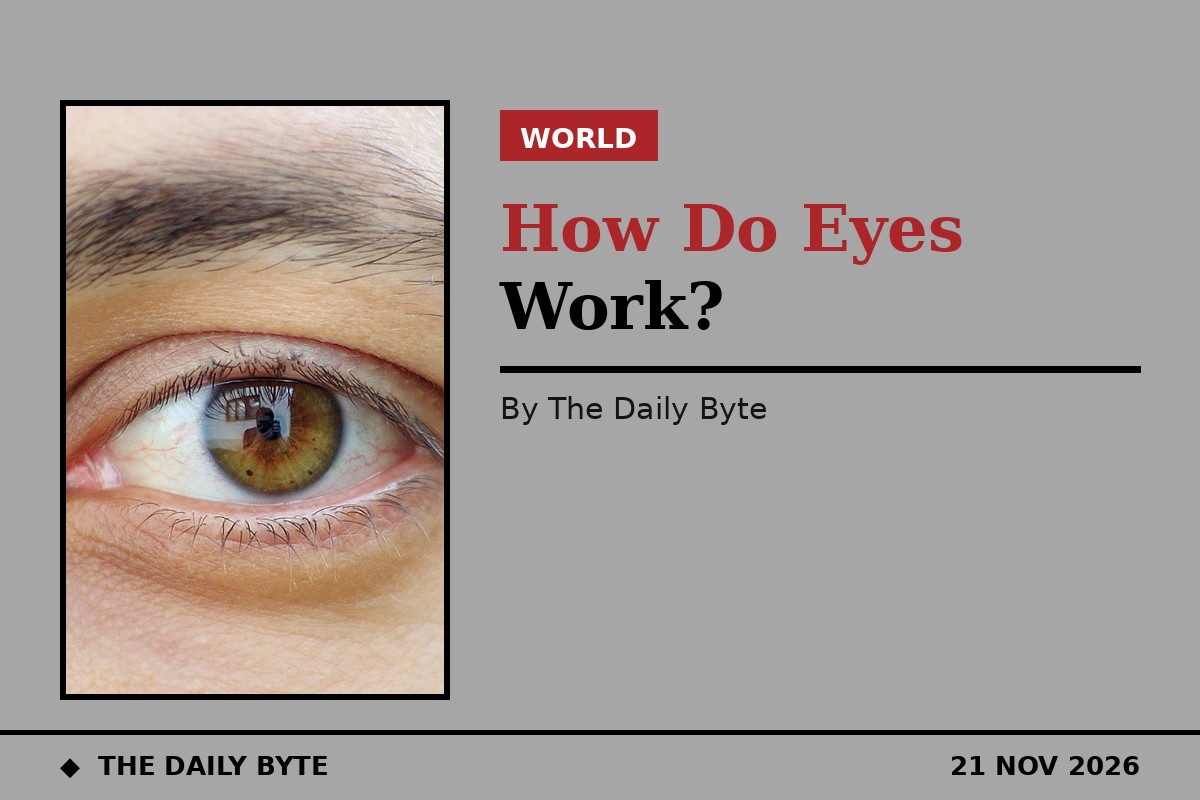
Your eyes work like a living camera: they let light in, focus it into a sharp picture, and turn that picture into electrical signals your brain can read as sight. Each eyeball is about 2.5 centimetres across, roughly the size of a ping-pong ball, and it sits in a bony socket in your skull, protected by your eyelids and eyelashes. The whole process, from light entering the eye to the brain recognising a face, takes a fraction of a second, and it runs constantly, every moment your eyes are open.
Seeing is a team effort between the eye and the brain. The eye itself only collects light and converts it into signals. The brain does the recognising: it works out shapes, colours, movement and distance, and it fills in the gaps, including a blind spot you never notice. To understand how your eyes work, it helps to follow the light on its journey through the eye, part by part.
The parts of the eye and what each one does
Light enters through the front of the eye and passes through a series of clear parts before it reaches the light-sensitive layer at the back. Each part has one job, and if any of them is cloudy, misshapen or damaged, the picture suffers.
| Part | What it does |
|---|---|
| Cornea | The clear curved window at the front; does most of the focusing |
| Iris | The coloured ring that controls how much light gets in |
| Pupil | The black opening in the middle of the iris; lets light through |
| Lens | Changes shape to fine-tune the focus for near and far objects |
| Vitreous humour | The clear jelly filling the eyeball; keeps its round shape |
| Retina | The light-sensitive layer at the back; turns light into signals |
| Optic nerve | Carries the signals from the retina to the brain |
| Sclera | The tough white outer coat; protects the eyeball |
The cornea is the first and most powerful lens in the eye, and it does most of the focusing work, not the lens behind it. It is a clear, curved layer with no blood vessels of its own: its cells get oxygen and clear away waste through the tear fluid that bathes them. That is one reason tears matter so much. If the cornea dries out or is scratched, vision blurs, because the light is no longer bent cleanly onto the retina.
Behind the cornea is the iris, the coloured part of the eye, with the pupil, the black hole in its middle. The iris is a muscle, and it works like the aperture of a camera: in bright light it shrinks the pupil to let less light in, and in dim light it widens the pupil to let more in. The pupil can change from about 2 millimetres across in bright light to about 8 millimetres in the dark, which lets in roughly sixteen times as much light.
How light becomes a picture
Seeing follows the same five steps every time you look at anything. First, light reflected from an object enters the eye through the cornea, which bends the rays towards the back of the eye. Second, the light passes through the pupil, whose size the iris has already adjusted to the brightness. Third, it passes through the lens, which fine-tunes the focus so that the rays land exactly on the retina.
Fourth, the lens changes shape to suit the distance, a process called accommodation. To focus on something close, the small ciliary muscles around the lens contract, releasing the tension on the fibres that hold the lens, so the lens springs into a thicker, more curved shape that bends light more strongly. To focus on something far away, the muscles relax, the fibres pull the lens flatter, and it bends light less. The cornea does the heavy lifting, and the lens does the fine adjustment, which is why the lens can be replaced in cataract surgery without changing the basic design of the eye.
Fifth, the focused light lands on the retina, where it is turned into electrical signals, and those signals travel along the optic nerve to the brain. One curious detail: the lens turns the picture upside down, so the image on your retina is inverted. Your brain flips it the right way up again as it processes the signals, so you never notice. The eye is often compared to a camera, and the comparison is fair as far as it goes, but a camera only records, while your eye and brain together interpret.
Rods and cones: seeing in the dark and in colour
The retina is lined with two kinds of light-sensitive cells, called photoreceptors, and they divide the work between them. Rods are for dim light and for seeing movement out of the corner of your eye. Cones are for sharp detail and colour in bright light. Each eye has about 120 million rods and about 6 million cones, so rods outnumber cones by about twenty to one.
| Rods | Cones | |
|---|---|---|
| How many per eye | About 120 million | About 6 million |
| Where they are | Spread across the retina, none in the fovea | Packed into the fovea at the centre |
| Best at | Dim light, movement, peripheral vision | Bright light, fine detail, colour |
| Colour vision | No — shades of grey only | Yes — three types, for red, green and blue light |
| Sensitivity | About 1,000 times more sensitive than cones | Need bright light to work well |
Cones are packed most tightly into a tiny pit at the centre of the retina called the fovea, which is where the light is focused when you look directly at something. That is why your sharpest vision is always in the centre of your view, and why you have to look straight at small print to read it. Rods are spread across the rest of the retina and are absent from the fovea, which is why faint stars are easier to see when you look slightly to the side of them: the light falls on the rods instead of the cones.
Rods are so sensitive that, under the best dark-adapted conditions, a single rod can respond to as little as a single photon of light. That sensitivity comes at a price: rods cannot tell colours apart, so in very dim light the world looks grey. Cones come in three types, sensitive to red, green and blue light, and your brain mixes their signals to produce the full range of colours you see.
There is one place on the retina with no photoreceptors at all: the blind spot, where the nerve fibres leave the eye to form the optic nerve. You never notice it, because your brain fills in the missing patch from the surrounding picture, and because your two eyes cover each other’s blind spots.
From the eye to the brain
The signals from the rods and cones are gathered by nerve fibres that bundle together into the optic nerve, a cable of around a million nerve fibres that carries the picture to the brain. The optic nerve runs to the visual cortex, the part of the brain at the back of the head that processes sight, where the signals are turned into the images you actually see.
The retina does some of the work before the signal even leaves the eye. Its layers of nerve cells compare neighbouring signals, sharpening edges and picking out movement, so the brain receives a picture that is already partly processed. The brain then does the rest: it combines the two slightly different views from your two eyes to judge distance, it recognises faces and objects, and it keeps the world steady even though your eyes are constantly moving in small jumps.
Having two eyes is what gives you depth perception. Each eye sees the world from a slightly different angle, and your brain measures the difference between the two pictures to work out how far away things are. Close one eye and try to catch a ball, and you will find it noticeably harder: with one picture instead of two, distance is much more of a guess.
Blinking, tears and keeping the eye clean
Your eyes stay working because they are constantly cleaned and protected. You blink about 15 to 20 times a minute, and each blink spreads a thin layer of tears across the cornea, washing away dust and keeping the surface smooth and clear. Tears also carry oxygen to the cornea, which has no blood vessels of its own, and they contain substances that help fight infection.
The eyelids and eyelashes are the first line of defence. Eyelashes catch dust and dirt before it reaches the eye, and the blink reflex closes the lids in a fraction of a second if something flies towards your face. The eye also waters when it is irritated, flushing out whatever caused the problem. All of this runs automatically, which is why you rarely have to think about it until something goes wrong, such as a dry or windy day that makes your eyes water and sting.
When focusing goes wrong
Most eyesight problems are focusing problems: the light lands in front of or behind the retina instead of on it. In short sight, or myopia, the eyeball is a little too long, or the cornea curves too steeply, so light focuses in front of the retina and distant objects look blurred. In long sight, or hyperopia, the eyeball is a little too short, so light focuses behind the retina and close objects are harder to see clearly.
Astigmatism happens when the cornea is not evenly curved, like a rugby ball rather than a football, so light focuses at different points and vision is blurred at all distances. Presbyopia is different again: it is the lens stiffening with age, usually from the forties onwards, so it can no longer change shape enough to focus on close objects, and reading glasses become necessary. Cataracts are a clouding of the lens itself, which blurs vision like looking through frosted glass, and are treated by replacing the cloudy lens with a clear artificial one.
Glasses and contact lenses work by adding an extra lens in front of the eye that bends the light before it arrives, so that it lands exactly on the retina. They do not change the eye itself, which is why the prescription can change as the eye grows or ages. Anyone whose vision changes suddenly, or who notices pain, flashes of light, a shower of new floaters or a dark shadow across their vision, should see an optician or a doctor promptly, rather than waiting for a routine check.
Frequently asked questions
Why is the image on the retina upside down? Because the lens bends the light rays so that they cross over on their way to the back of the eye. Your brain turns the picture the right way up as it processes the signals, so you never notice.
Do eyes work exactly like cameras? Only up to a point. A camera records a picture and stops; your eye turns light into signals, your retina starts processing them, and your brain interprets them, fills in gaps such as the blind spot, and combines two pictures into one view with depth.
Can you see in complete darkness? No. Rods are extremely sensitive and can respond to a single photon, but with no light at all there is nothing for them to detect. In very dim light you can still see, but only in shades of grey, because the colour-seeing cones are not working.
Why do your pupils get bigger in the dark? To let in more light. The iris opens the pupil from about 2 millimetres across in bright light to about 8 millimetres in the dark, letting in roughly sixteen times as much light, which is what makes it possible to see at all after your eyes have had a few minutes to adjust.
Sources: the MSD Manual’s guide to the structure and function of the eyes; the RNIB’s guide to how the eye works; Khan Academy’s lesson on photoreceptors, rods and cones; and Idaho Public Television’s Science Trek on the eye. Your eyes are a living camera, but the seeing happens in the brain.


