How Do Hurricanes Form?
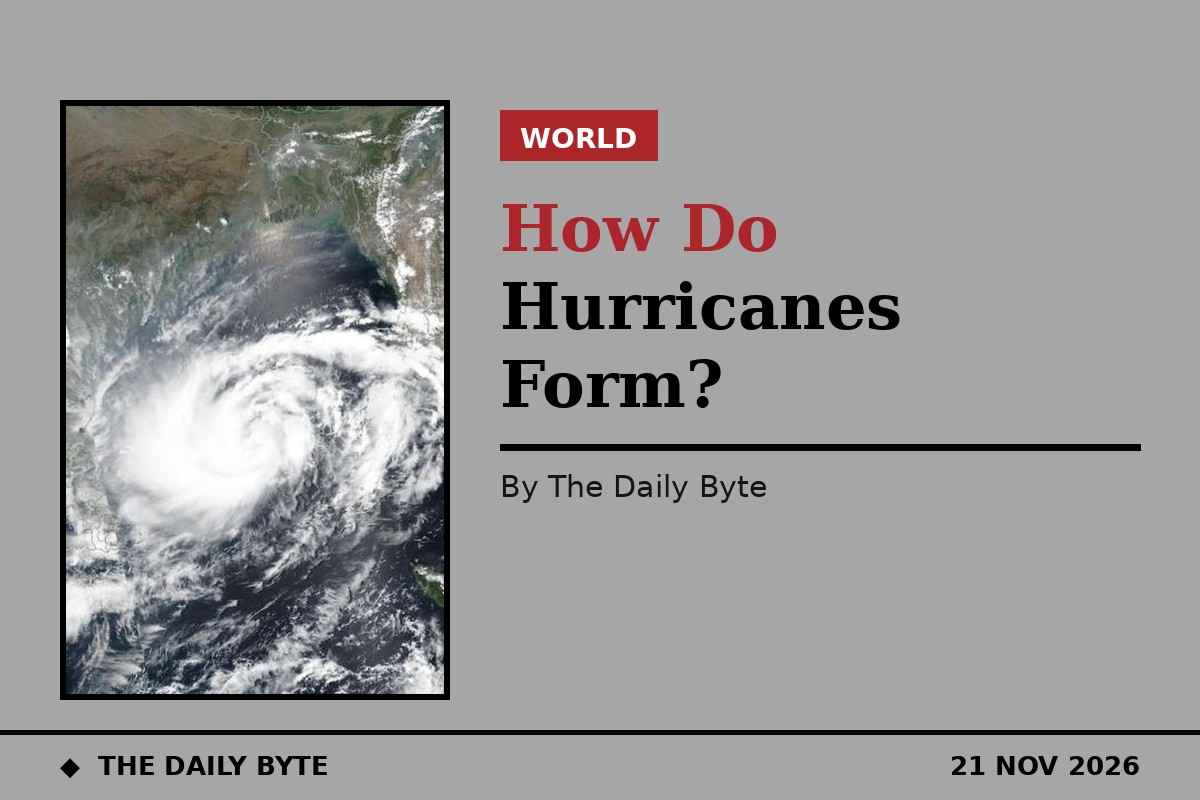
A hurricane forms when a cluster of thunderstorms over a warm tropical ocean organises itself around an area of low pressure and starts to spin. It needs warm water, moist air, a pre-existing disturbance and light winds above it. Take any one of those away and the storm never gets going.
Hurricanes are heat engines. They take energy from warm ocean water and release it through thunderstorms, and that is why they only form over tropical seas. The same kind of storm is called a typhoon in the north-west Pacific and a cyclone in the South Pacific and Indian Ocean. The scientific name for all of them is tropical cyclone.
What does a hurricane need?
Four ingredients have to come together, according to the US National Oceanic and Atmospheric Administration (NOAA). First, warm ocean water of at least 26.5 degrees Celsius, extending about 50 metres below the surface. Second, a pre-existing weather disturbance, often a tropical wave, a low-pressure area that moves westwards across the tropics from Africa. Third, thunderstorm activity to turn the ocean's heat into energy. Fourth, low wind shear, meaning the winds above the storm must not change much with height, or they will tear the developing storm apart. Even when all four are present, a hurricane does not always develop.
How does a disturbance become a hurricane?
Warm, moist air over the ocean rises, leaving an area of low pressure underneath. More air rushes in to replace it, and that air also warms and rises. As the rising air cools, its water vapour condenses into clouds, releasing more heat, which powers the storm further. The whole system begins to rotate because of the Coriolis effect, the curving of winds caused by Earth's rotation. In the northern hemisphere the storm spins anticlockwise; in the southern hemisphere it spins clockwise.
Meteorologists divide the growth into stages. A tropical disturbance becomes a tropical depression when its winds reach 25 to 38 miles per hour. At 39 miles per hour it becomes a tropical storm and is given a name. At 74 miles per hour it is classified as a hurricane. As the storm spins faster, an eye forms in the centre, a calm area 20 to 40 miles wide with very low pressure. Around it sits the eyewall, a ring of towering clouds holding the storm's strongest winds and heaviest rain.
Why are some hurricanes so much stronger?
A hurricane keeps strengthening for as long as it stays over deep warm water with low wind shear. The longer it feeds, the stronger it gets, and the strongest are ranked Category 5 on the Saffir-Simpson scale. Hurricane Melissa showed how far that can go: it made landfall in Jamaica on 28 October 2026 as a Category 5 storm with sustained winds of about 185 miles per hour near New Hope, tying the record for the strongest Atlantic hurricane landfall. Its central pressure fell to 892 millibars, a sign of extraordinary intensity.
What weakens a hurricane?
Hurricanes weaken when they move over land, where their fuel supply is cut off, or over cooler water. The danger does not end when the winds drop, though. Storm surge, when winds push seawater ashore, and days of torrential rain can cause more damage than the wind itself. In the Atlantic, hurricane season peaks from mid-August to late October and averages five to six hurricanes a year.
| Stage | Wind speed |
|---|---|
| Tropical depression | 25 to 38 mph |
| Tropical storm (named) | 39 to 73 mph |
| Hurricane (Category 1 to 5) | 74 mph and above |
| Warm water needed | At least 26.5°C over the top 50 metres |
Frequently asked questions
What is the difference between a hurricane and a typhoon? Only where it forms. Hurricanes form over the Atlantic and north-east Pacific, typhoons over the north-west Pacific, and cyclones over the South Pacific and Indian Ocean. They are the same kind of storm.
Can a hurricane form over land? No. It needs warm ocean water as fuel, so it can only be born at sea, and it weakens once it moves over land.
Why do hurricanes never cross the equator? The Coriolis effect, which makes the storm spin, is zero at the equator. Hurricanes cannot form within about 500 kilometres of it, and they cannot cross from one hemisphere to the other.


