How Do Spiders Make Webs? Silk Explained
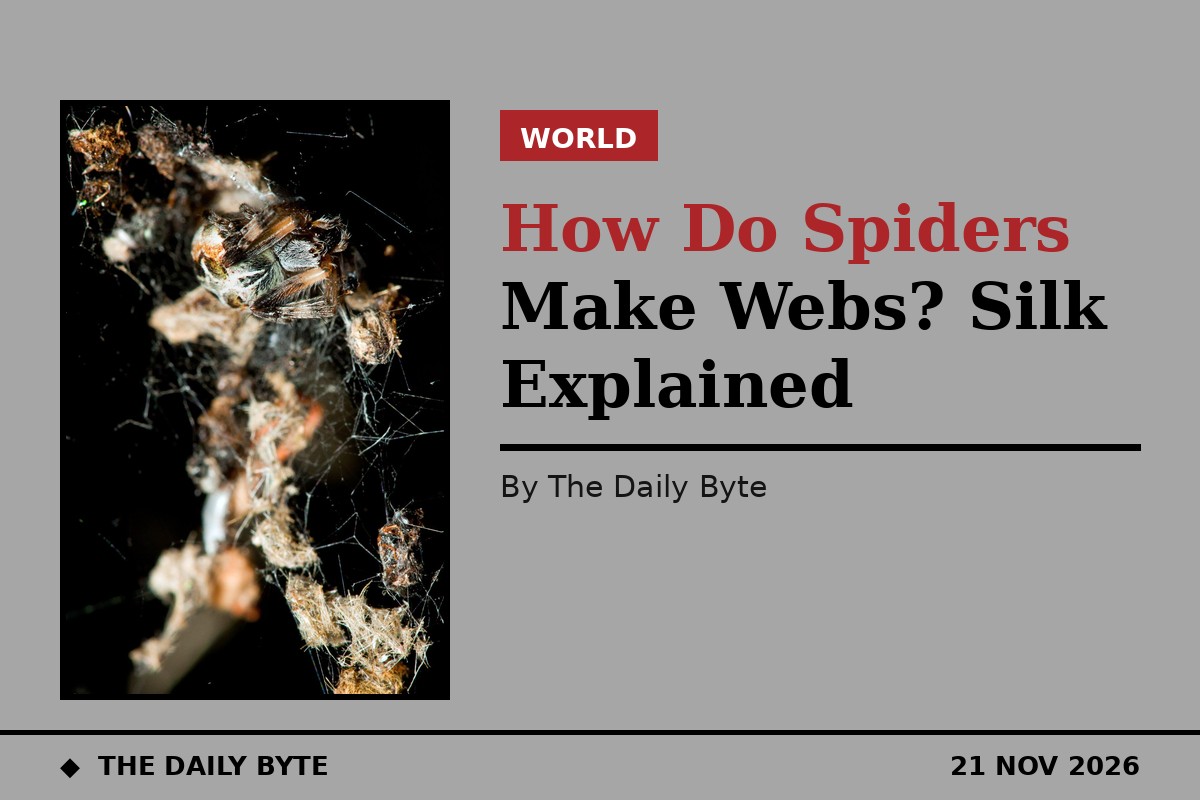
Spiders make webs from silk, a protein fibre they produce as a liquid inside their own bodies and spin into solid thread through organs called spinnerets on the underside of the abdomen. An orb-weaving spider can produce up to seven different kinds of silk, each from its own gland, and it uses them for different jobs: strong frame threads, stretchy capture threads, sticky glue, wrapping silk for prey and tough silk for egg sacs. The finished web is built in a set order, usually at night, and many spiders eat the old web each day to recycle the protein.
This explainer sets out what spider silk is made of, how a liquid inside the spider becomes one of the toughest natural fibres known, how an orb weaver builds its web step by step, and why not every spider builds a web at all.
What spider silk is made of
Spider silk is made of protein, in the form of long chain molecules called spidroins. Inside the silk gland, the protein sits as a concentrated liquid, sometimes called spinning dope. As it is drawn out through a long, narrowing duct, the chemistry changes: water is pulled out of the protein, the solution becomes more acidic, and the physical pull of the duct lines the molecules up into orderly stacks called beta sheets. Those stacks act like tiny crystals embedded in a flexible matrix, and that combination is what gives the fibre both its strength and its stretch.
The result is remarkable. Dragline silk, the strong lifeline thread a spider trails behind it, is stronger than a steel wire of the same weight, and it can stretch by about a third of its length before breaking. It is also made at room temperature, in water, with no harsh chemicals: the spider does in its abdomen what industrial fibre production achieves only with solvents and extreme heat. Scientists have spent decades trying to copy the process, and no factory-made fibre yet matches the combination of strength, lightness and toughness that a spider produces routinely.
There is not one silk but several. The Natural History Museum in London explains that there are seven different silk glands, each producing silk with different characteristics, and that no species has all seven, although orb-web weavers have five. The major ampullate glands make dragline silk for the web frame and the spider's safety line. The minor ampullate glands make a slightly different fibre used for temporary scaffolding. The flagelliform glands make the extremely stretchy core of the capture spiral, the aggregate glands coat it in glue, the aciniform glands make wrapping silk for immobilising prey, the tubuliform glands make tough egg-sac silk, and the piriform glands make the cement-like discs that anchor threads to surfaces.
| Silk type | Gland | What it is used for |
|---|---|---|
| Dragline | Major ampullate | Web frame and the spider's safety line |
| Temporary scaffolding | Minor ampullate | The web's first framework |
| Capture spiral core | Flagelliform | The stretchy centre of sticky threads |
| Sticky glue coating | Aggregate | The glue on capture threads |
| Wrapping silk | Aciniform | Swathing and immobilising prey |
| Egg-sac silk | Tubuliform | Tough silk wrapping the eggs |
| Attachment discs | Piriform | Cementing threads to surfaces |
How the silk gets out of the spider
The spinning organs are the spinnerets, clusters of short, finger-like appendages at the rear underside of the abdomen. Most spiders have three pairs. At the end of each spinneret is a collection of tiny nozzles called spigots, and each spigot connects to one silk gland inside the body. The spinnerets are jointed and muscular: the spider can spread them, pinch them together or twist them independently, which lets it control exactly which silk comes out and where it goes.
A common misunderstanding is that silk hardens when it meets the air. It does not. The silk is already solid by the time it leaves the spigot, because the chemical changes in the duct have done the work. What the spider does with its legs is pull the thread out, using its hind legs or simply by walking away from an attachment point so that gravity and tension draw the silk through. The Natural History Museum puts it plainly: the silk is liquid when it is inside the spider, and it is pulled out by gravity or by the spider's hind leg.
Some spiders make a special kind of silk called cribellate silk, which is combed out through a sieve-like structure called the cribellum and brushed with a row of specialised leg bristles called the calamistrum. The result is a woolly thread that works like Velcro, tangling in the legs and bristles of captured insects instead of sticking to them with glue. It is a completely different trapping strategy from the glue-coated threads of the orb weavers, and it shows how varied silk engineering can be.
How an orb weaver builds its web
The orb web is the classic wheel-shaped web, and building one is a precise piece of construction that usually happens under cover of darkness. The Smithsonian Institution, drawing on the work of spider scientist Jonathan Coddington, describes the sequence. The spider climbs to a high point, points its abdomen skywards and pulls out silk with its fourth leg, letting the breeze carry a balloon of fine threads until one snags on something. The spider tugs to check the line is firmly attached, then walks across it, laying silk behind it, to make the first bridge line.
The spider repeats this process, making about twenty lines radiating in different directions, and then chooses the seven that form a good flat plane for the web, cutting away the rest. It then builds the frame and the spokes, or radii, working from the outside in, and finally lays the capture spiral: concentric circles of sticky silk, attached segment by segment with its legs, ending in a spiral at the centre. The sticky threads are what trap prey. The dry frame threads are what the spider itself walks on, so it does not get stuck in its own trap.
The whole web is an investment. Making silk costs protein, and the spider's protein stores are drained by the effort, which is why many orb weavers eat their old web each morning and build a fresh one each night. Eating the web recovers most of the protein, so the spider can afford to rebuild. A web left standing is also less effective: dust, damage and lost stickiness all reduce its catch, so a daily rebuild is good economics for the spider.
Why not every spider builds a web
There are more than 50,000 described species of spider, and only about half of them build webs to catch prey. The rest are hunters. Wolf spiders chase prey down on foot, jumping spiders stalk and pounce with excellent eyesight, and crab spiders sit in ambush on flowers and grab visiting insects. Even these spiders use silk constantly: for safety lines while they move, for wrapping prey, for building shelters and for protecting their eggs. Silk came first, and the web is only one of its uses.
That is worth remembering when you find a spider in the house. A house spider in a corner is probably a web builder waiting for a fly to blunder in, while a spider running across the floor is probably a hunter. Both are using the same silk technology in different ways, and both are doing useful work: a single spider can eat hundreds of insects in a year, and spiders as a group are one of the most important natural controls on insect numbers.
Frequently asked questions
Is spider silk stronger than steel? By weight, yes. Dragline silk is stronger than a steel wire of the same weight and can stretch by about a third before breaking, which makes it tougher as well as strong.
How many kinds of silk can one spider make? An orb-weaving spider can produce up to seven kinds, each from its own gland, for the frame, the sticky spiral, wrapping prey, egg sacs and anchoring threads. No species has every kind.
Do spiders get stuck in their own webs? Normally no. The spider walks on the dry frame threads, not on the sticky capture spiral, and its feet and body are coated in a way that keeps it from sticking.
How long does it take a spider to build a web? An orb weaver usually builds its web in under an hour, often at night, and many species rebuild it every day.
Do all spiders build webs? No. Only about half of the more than 50,000 described spider species build webs to catch prey. The rest hunt on foot, but they still use silk for safety lines, shelters and egg sacs.


