How Does Electricity Work?
Electricity works by pushing tiny charged particles called electrons through a conductor, usually a metal wire, and that moving charge carries energy from where it is made to where it is used. A battery or a generator provides the push, called voltage, the electrons flow as a current, and anything in the way, a light bulb, a heater, a phone charger, turns the energy of that flow into light, heat or motion. Switch the push off and the flow stops. It is that simple at the core, and everything else, from power stations to the plug in your wall, is a way of making the push, carrying the flow over distance, and controlling it safely.
This explainer starts with the particles themselves, explains the three quantities that describe every circuit, current, voltage and resistance, and the law that ties them together, then follows electricity from the power station to your home, looks at where the energy comes from, and answers the questions people actually ask: why the lights come on instantly, why some countries use different voltages, and what makes electricity dangerous.
What is electric charge?
Every atom has a nucleus of positively charged protons, surrounded by negatively charged electrons, and the two charges are exactly equal in size and opposite in sign, so a whole atom is neutral. Charges of the same sign repel each other and opposite signs attract, and the force between them is enormously stronger than gravity: it is what holds atoms and molecules together. Charge is measured in coulombs, and since 20 May 2019 the charge of one proton, the elementary charge, has been fixed at exactly 1.602176634 times ten to the power of minus nineteen coulombs. One coulomb is the charge of about 6.24 times ten to the power of eighteen electrons.
Static electricity is charge that has built up and stays put. Rub a balloon on your hair and electrons move from hair to balloon: the balloon is now negative, your hair positive, and they attract, which is why the hair stands up. Let the charges find a path back together and you get a spark, a tiny lightning bolt. Current electricity is the same charge on the move, flowing in a steady stream through a conductor instead of jumping in a single spark.
What are current, voltage and resistance?
Three quantities describe how electricity works, and a water analogy makes each one easy to picture. Current is the rate at which charge flows past a point, measured in amperes, or amps. One amp is one coulomb per second, about 6.24 times ten to the power of eighteen electrons passing every second. In a metal wire, the charge that moves is the outer electrons of the metal's atoms, which are free to wander from atom to atom. Current is the flow rate of the water in the pipe.
Voltage, measured in volts, is the push that drives the current. Strictly, it is the energy each coulomb of charge gains or gives up between two points: one volt means one joule per coulomb. A battery's terminals are held at a fixed voltage difference, and that difference is what shoves the electrons around the circuit. Voltage is the water pressure in the pipe.
Resistance, measured in ohms, is how much a material opposes the current. Electrons moving through a wire keep bumping into the metal's atoms, losing energy as heat, and that is why wires get warm when a lot of current flows through them. Metals such as copper have low resistance, which is why wires are made of copper. Plastics and rubber have very high resistance, which is why they coat wires as insulation. Resistance is a narrow section of pipe. The three are tied together by Ohm's law: voltage equals current times resistance, written V equals I times R. More push gives more current, more resistance gives less.
| Quantity | What it means | Unit | Water analogy |
|---|---|---|---|
| Current (I) | Rate of flow of charge | Ampere (A) | Flow rate of water |
| Voltage (V) | Push, or energy per unit charge | Volt (V) | Water pressure |
| Resistance (R) | Opposition to the flow | Ohm | Narrow pipe |
| Power (P) | Rate of energy delivery, V times I | Watt (W) | Energy delivered per second |
| Energy (E) | Power used over time, billed in kilowatt-hours | Kilowatt-hour (kWh) | Total water delivered |
Power is the rate at which energy is delivered, and it is voltage times current, P equals V times I. A 60-watt bulb uses 60 joules of energy every second. Energy used is power times time, which is what an electricity bill counts in kilowatt-hours: run a 1,000-watt heater for one hour and you have used one kilowatt-hour. A kilowatt is 1,000 watts, and most of the time electric power is talked about in kilowatts or megawatts for larger things.
How is electricity made?
Most of the world's electricity is born from a generator, a rotating magnetic machine. The key law is electromagnetic induction: if a wire is caught in a magnetic field and that magnetic field shifts, it induces an electric current in the wire. A generator spins a coil of wire inside a magnetic field, or spins magnets around a coil, and the changing field pushes electrons back and forth through the coil, producing current. In most fossil fuel and nuclear plants, the fuel boils water into steam, the steam spins a turbine, and the turbine spins the generator. The fuel changes, but the spinning is the same.
Not all generation spins. Solar panels work differently because they need no moving magnets at all. When light strikes a solar cell, it excites the electrons within the atoms of the material, knocking them loose so they flow out as a current. Wind turbines spin a generator directly with the wind, and hydroelectric plants let falling water spin one. Batteries do not generate electricity at all in this sense: they store chemical energy and release it as a current when a circuit is connected, and a rechargeable battery reverses the chemistry when it is charged.
What is the difference between AC and DC?
With direct current, or DC, the electrons travel in only one direction, from the negative terminal of a battery to the positive one. That is what batteries supply, and what phones, laptops and cars run on internally. With alternating current, or AC, the electrons reverse direction at regular intervals, flowing first one way and then the other. In the United States the mains supply is AC at 60 cycles per second, or 60 hertz. In the United Kingdom and most of Europe it is AC at 50 hertz.
The grid uses AC for a practical reason: it is easy to change AC voltage with a device called a transformer, and high voltage is the key to moving electricity over long distances without losing most of it as heat. The losses in a wire grow with the square of the current, so doubling the voltage halves the current for the same power, and cuts the losses to a quarter. That is why power leaves a station at hundreds of thousands of volts and is stepped down in stages until it reaches your home. DC cannot be transformed this way, which is why AC won the argument in the 1890s, although modern electronics has since made high-voltage DC useful for a few very long links, such as undersea cables.
From power station to plug
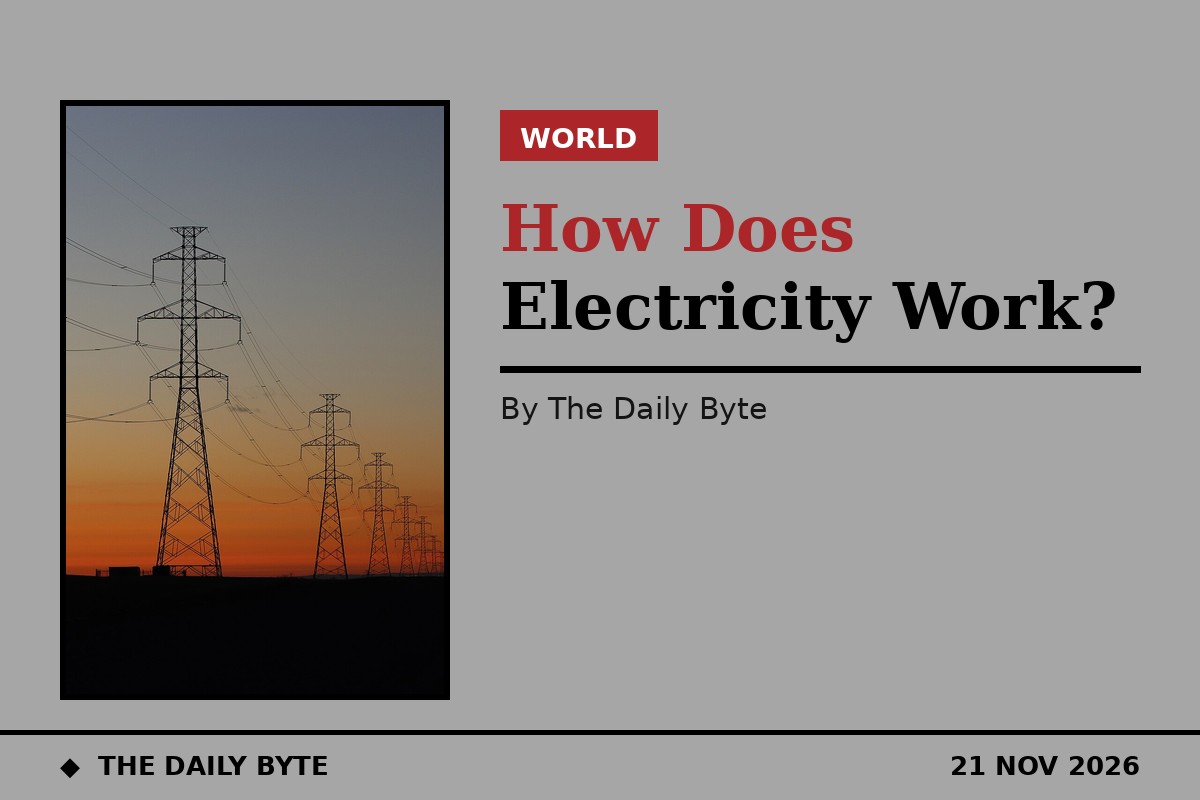
When electricity leaves a power plant, its voltage is increased in order to transmit it over long distances. The high-voltage power travels along transmission lines, the tall lattice towers you see crossing the countryside, to a substation, where transformers step the voltage down. It is then distributed through more lines to local transformers on poles or in street cabinets, which step it down again to the voltage used in homes, around 230 volts in the United Kingdom. The whole system, generation, transmission, distribution and use, is called the grid, and it has to balance supply and demand at every moment: operators call on power plants to produce exactly the right amount of electricity to meet demand, because the grid stores almost no energy itself.
That balancing act is why the grid is one of the largest machines ever built. Demand rises in the morning as people wake up, peaks in the early evening as cooking and heating come on, and falls overnight. Gas plants can ramp up and down quickly to follow it, nuclear plants run steadily as base load, and wind and solar contribute whenever the weather allows, with batteries and pumped hydro storage increasingly filling the gaps. If supply and demand drift apart, the frequency of the grid drifts with them, which is why grid operators watch the 50 hertz frequency in Britain like a pulse.
Where does the electricity come from?
The United States uses many different energy sources and technologies to generate electricity, and the mix shows how the system is changing. The US Energy Information Administration reports that in 2025 total utility-scale generation in the United States was about 4.43 trillion kilowatt-hours. Fossil fuels accounted for about 58 percent of it, nuclear energy about 18 percent, and renewable energy about 24 percent. Natural gas was the single largest source, at about 41 percent, coal was about 17 percent, and wind, at about 11 percent, was the largest renewable source, ahead of solar at about 7 percent and hydropower at about 6 percent.
| Source | Share of US electricity, 2025 | How it generates |
|---|---|---|
| Natural gas | About 41% | Gas turbines and steam turbines |
| Nuclear | About 18% | Fission heat makes steam, steam spins a turbine |
| Coal | About 17% | Burning coal makes steam, steam spins a turbine |
| Wind | About 11% | Wind spins a turbine connected to a generator |
| Solar | About 7% | Light knocks electrons loose in photovoltaic cells |
| Hydropower | About 6% | Flowing water spins a turbine connected to a generator |
| Petroleum | About 0.7% | Oil burned in steam turbines |
The mix varies enormously by country. France generates most of its electricity from nuclear power, Norway almost all of it from hydropower, and the United Kingdom has gone from coal providing most of its electricity a decade ago to wind becoming its largest single source. Every mix is a trade-off between cost, reliability, carbon emissions and what a country's geography allows.
Why do the lights come on instantly?
Here is the surprise: the electrons themselves move astonishingly slowly. The individual electrons in a wire drift along at a crawl, far slower than walking pace, because they keep colliding with atoms. What travels fast is the signal: when you flick a switch, the electric field races along the wire at close to the speed of light, and electrons all along the wire start moving almost at once, like a row of people passing a push down a line. That is why the bulb lights the instant you press the switch, even though no single electron has travelled from the switch to the bulb.
The same idea explains why a wire can carry a signal across a continent in milliseconds while the electrons in it barely move. Electricity is not a stream of particles rushing from the power station to your home. It is a wave of push travelling through a sea of electrons that are already there, waiting in the wire, and the energy rides on the field, not on any one electron.
What makes electricity dangerous?
Electricity is dangerous because the human body is a conductor, and a current passing through it can disrupt the heart and the nervous system. It only takes a small current across the chest to be lethal, which is why mains electricity, at 230 volts in the United Kingdom, must be treated with respect. The plastic coating on wires is an insulator, which is why you do not get a shock when you touch a cord or a plug. Fuses and circuit breakers are there to cut the current if too much flows, and residual current devices cut it in a fraction of a second if current starts leaking through an unexpected path, such as a person.
Water makes the danger worse, because wet skin conducts far better than dry skin, which is why electrical appliances and water do not mix, and why bathroom sockets are kept away from baths and showers. If you ever see damaged wiring, a burning smell from a socket, or someone who has received an electric shock, the rule is simple: switch the power off at the source if you can do so safely, do not touch the person while they are still in contact with the live source, and call for emergency help.
Frequently asked questions
Does electricity flow from positive to negative or negative to positive? Both, depending on what you mean. Electrons, which carry the charge in a wire, flow from the negative terminal to the positive one. But electrical engineers defined conventional current, the direction used in circuit diagrams, as flowing from positive to negative, before electrons were discovered, and the convention stuck. The maths works out the same either way, because the two flows are equal and opposite.
Why do different countries use different voltages? History, mostly. The United States built its system around 110 to 120 volts in the late nineteenth century, while Europe standardised on 220 to 240 volts, which delivers the same power at half the current and so needs thinner wires. Neither is better in any absolute sense: higher voltage is more efficient to distribute but more dangerous to touch, and lower voltage is safer but needs thicker cables. Travellers need adapters and, for some appliances, voltage converters.
Can electricity be stored? Only indirectly, and only in limited amounts. Batteries store chemical energy, pumped hydro storage stores energy as water held at height, and flywheels and compressed air store it as motion and pressure. The grid itself stores almost nothing: generation and consumption must match second by second, which is why storage is one of the most important challenges as wind and solar grow.
Why do power lines hum? The hum is the sound of the alternating current itself, vibrating the wires and transformers at the mains frequency, 50 hertz in the United Kingdom, which the ear hears as a low buzz. In damp weather the hum gets louder, because moisture on the lines causes tiny discharges called corona, which also produce a faint crackle and a smell of ozone after rain.
What is a blackout? A blackout is a loss of electricity across a wide area, usually because demand has exceeded supply, a major line or plant has failed, or the grid has deliberately disconnected parts of itself to protect the rest. The grid is built with redundancy, so a single failure rarely causes a blackout, but a cascade, where one failure overloads the next line, which fails in turn, can bring down a whole region in seconds, as happened in parts of Europe and North America in the past.


