How Does Gravity Work?
Gravity works by pulling every object with mass toward every other object with mass. It is the weakest of the known forces in nature, yet it is the one that shapes the universe on the largest scales: it holds you to the ground, keeps the Moon circling the Earth, holds the Earth in orbit around the Sun, and gathers stars into galaxies. The short answer is that gravity is a universal attraction between masses, and its strength depends on how much mass is involved and how far apart the masses are. Double the distance between two objects and the pull between them falls to a quarter of what it was; double one of the masses and the pull doubles.
Physicists have two descriptions of gravity, and both are useful. Isaac Newton described it in 1687 as a force acting at a distance. Albert Einstein, in his general theory of relativity completed in 1915, described it as the shape of space and time itself. This explainer starts with what you feel every day, works through Newton's law and Einstein's curved spacetime, and ends with the places where gravity is extreme enough to bend light and stop time from ticking at its normal rate.
What is gravity, in everyday terms?
On Earth, gravity is the reason things fall down rather than up, and why you have weight. Your weight is not the same thing as your mass. Your mass is how much matter you are made of, and it does not change whether you are on Earth, on the Moon or floating in space. Your weight is the force that gravity exerts on that mass, and it changes with the strength of the local gravity. On the Moon, where the acceleration due to gravity is only about 1.6 metres per second per second, compared with about 9.8 metres per second per second on Earth, you would weigh about one sixth of what you weigh at home, even though your mass would be exactly the same. Astronauts on the Moon could hop high and carry heavy equipment with ease for exactly this reason.
The number 9.8 metres per second per second is worth understanding. It means that a falling object, ignoring air resistance, gains about 9.8 metres per second of downward speed every second it falls. After one second it is falling at 9.8 metres per second, after two seconds at about 19.6, and so on. Galileo showed centuries ago that all objects fall at the same rate regardless of their mass, and the Smithsonian's explainer puts it plainly: Galileo observed that all objects fall at the same rate of speed regardless of the object's mass. A feather and a hammer fall at different speeds in air only because air resistance slows the feather; in a vacuum they hit the ground together. The standard value of gravity at Earth's surface is defined as exactly 9.80665 metres per second per second, and the real value varies slightly with location, from about 9.764 to 9.834 metres per second per second depending on altitude, latitude and longitude, because the Earth is not a perfect sphere and it spins.
How did Newton explain gravity?
Isaac Newton published his law of universal gravitation in 1687 in his book Philosophiae Naturalis Principia Mathematica, usually called the Principia. His insight was that the same force that makes an apple fall to the ground also holds the Moon in its orbit: gravity is universal, acting between every pair of masses in the universe. The law is written as F equals G times m1 times m2 divided by r squared, where F is the force of attraction, m1 and m2 are the two masses, r is the distance between their centres, and G is the gravitational constant, a tiny number measured as 6.674 times ten to the power of minus eleven. The formula says two important things. First, gravity grows with mass: double either mass and the force doubles. Second, it fades with the square of the distance: double the distance and the force falls to a quarter, triple it and the force falls to a ninth.
Newton's law was a triumph because it explained so much with one rule. It explained why planets move in ellipses, as Johannes Kepler had observed, why the Moon stays with the Earth, and why the tides rise and fall: the Principia itself accounts for the tides through the varying gravitational pulls of the Sun and the Moon on the Earth's waters. The first laboratory test of the law between masses on Earth came more than a century later, in 1798, when Henry Cavendish measured the tiny attraction between lead balls in his famous experiment and effectively weighed the Earth for the first time. Newton's picture is still what engineers use to aim spacecraft and predict eclipses, because for most purposes it is accurate to a remarkable degree. Its limits show up only where gravity is extremely strong, or where extreme precision is needed.
How did Einstein change the picture?
Einstein's general theory of relativity, completed in November 1915, replaces Newton's force with geometry. In Einstein's picture, massive objects curve the fabric of space and time around them, and other objects simply follow the straightest possible paths through that curved spacetime, which we observe as orbits and falling. NASA explains it with a familiar image: think of a sheet of rubber with heavy marbles placed on it. The rubber around the marbles curves, and smaller marbles placed nearby roll toward the heavier ones. That curving is analogous to the way massive objects warp space, and the warping is what we call gravity.
The two theories agree almost everywhere, but relativity wins in the extreme cases Newton could not explain. The orbit of Mercury, for example, shifts by an extra 43 arcseconds per century beyond what Newton's law predicts, and general relativity accounts for that shift exactly. Relativity also predicts that light itself bends as it passes a massive object, by 1.75 arcseconds at the edge of the Sun, an effect confirmed during a solar eclipse in 1919. Closer to home, the clocks on GPS satellites run about 38.6 microseconds per day fast compared with clocks on the ground, because they sit higher in Earth's gravity and move fast, and the satellite system has to correct for that difference constantly or its positions would drift by kilometres within a day. Gravity, in Einstein's picture, even affects the passage of time: clocks run slower where gravity is stronger, an effect called gravitational time dilation.
Why do things orbit instead of falling?
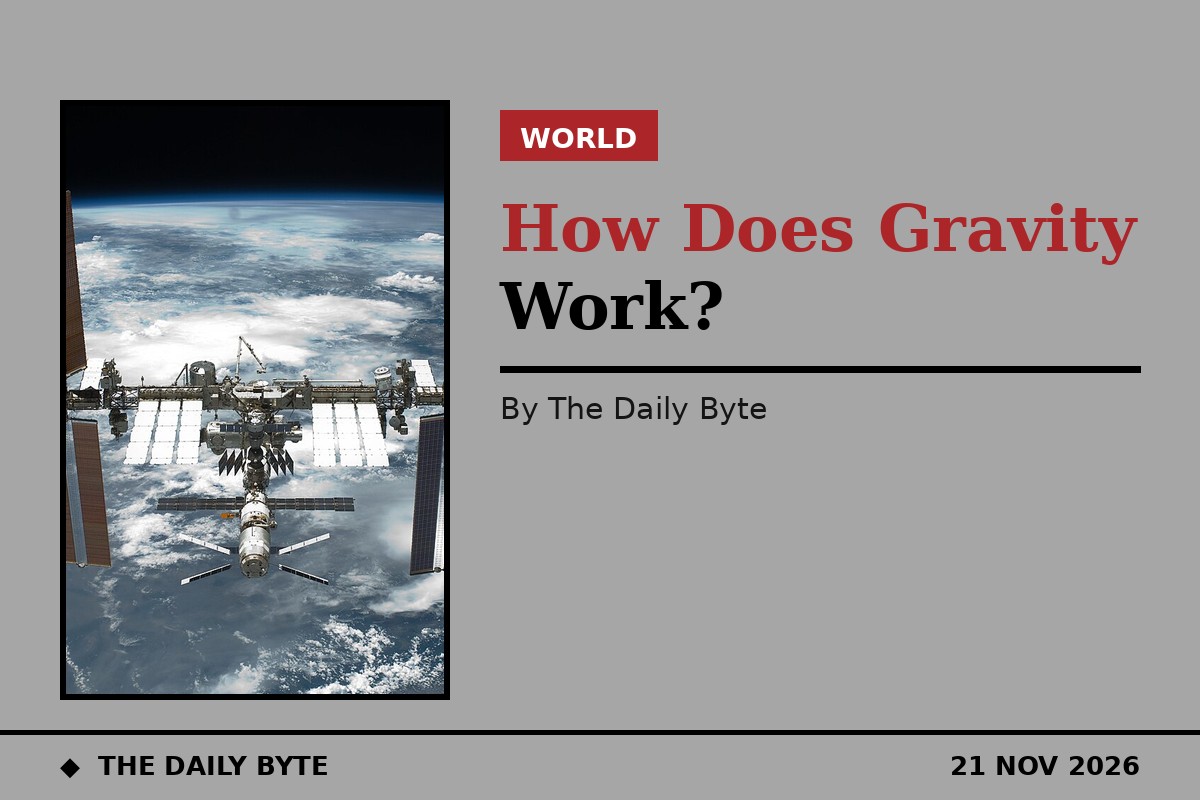
An orbit is not the absence of gravity; it is falling that never lands. The International Space Station circles the Earth at about 27,600 kilometres per hour, and at that speed it is constantly falling toward the Earth while moving forward fast enough that the ground curves away beneath it at the same rate. The astronauts inside are in free fall, which is why they float, and why the station is often described as weightless even though Earth's gravity up there is still about 90 percent as strong as it is at the surface. The Moon does the same thing on a grander scale: it is falling toward the Earth all the time, but its sideways motion keeps it circling instead of crashing down. The same balance holds the Earth in its orbit around the Sun, and the Sun in its orbit around the centre of the Milky Way.
That balance also explains why the Moon raises the tides. The Moon's gravity pulls more strongly on the side of the Earth facing it than on the far side, stretching the oceans into a bulge on both sides of the planet. As the Earth rotates through those bulges, coastal places experience high and low tide roughly twice a day. The Sun contributes too, and when the Sun and Moon line up at new and full Moon, their pulls add together and produce the extra-high spring tides. The tides are a daily, visible demonstration that gravity acts across empty space, between bodies hundreds of thousands of kilometres apart.
| Body | Surface gravity | Compared with Earth |
|---|---|---|
| Earth | 9.8 metres per second per second | 1 (by definition) |
| Moon | 1.6 metres per second per second | About one sixth |
| Standard value (defined) | 9.80665 metres per second per second | Reference value, exact by definition |
The table above shows how much gravity changes from one world to another. The Sun's pull is far stronger than Earth's, because it is enormously more massive, which is why the planets orbit it rather than the other way round. A person who weighs 70 kilograms on Earth would weigh only about 12 kilograms on the Moon, because the Moon's gravity is about one sixth of Earth's. Weight is always local; mass is what travels with you.
Where does gravity become extreme?
The most extreme gravity in the universe is found around black holes, where so much mass is packed into so little space that the escape velocity exceeds the speed of light, and not even light can get out. That is why black holes are black: light falls in and never comes back. Near a black hole, Einstein's effects become dramatic rather than subtle. Time runs measurably slower close to the black hole than far away, and light climbing out of its gravity loses energy and shifts toward the red end of the spectrum. In 2015, the LIGO observatories detected gravitational waves, ripples in spacetime itself, produced by two colliding black holes more than a billion light-years away. Like light, gravitational waves travel at the speed of light, which is one of the predictions of general relativity that has now been confirmed by direct observation.
Gravity is also the reason the universe has structure at all. After the Big Bang, tiny variations in density were amplified by gravity over billions of years, pulling gas together into stars, stars into galaxies, and galaxies into clusters. Without gravity, the universe would be a thin, featureless gas. With it, we have planets, solar systems and everything standing on them. It is the weakest force, and yet it builds the largest things there are.
Frequently asked questions
Is there gravity in space? Yes. Gravity acts everywhere, and it never switches off. Astronauts float not because there is no gravity where they are, but because they are in free fall around the Earth. Do heavier objects fall faster? No. In the absence of air resistance, all objects fall at the same rate, as Galileo observed. A bowling ball and a tennis ball dropped together in a vacuum land at the same instant. Why do we not feel the Earth's gravity pulling us toward the Sun? We do feel it, in the sense that the Earth and everything on it are falling around the Sun together, so there is no relative motion to notice. The Sun's pull is what keeps the Earth in orbit. Can gravity be blocked or switched off? No known material or method can block gravity. It passes through everything, and the only way to escape a body's pull is to move far away from it or fast enough to reach escape velocity.


