How Does Impeachment Work? Hegseth Vote Explained
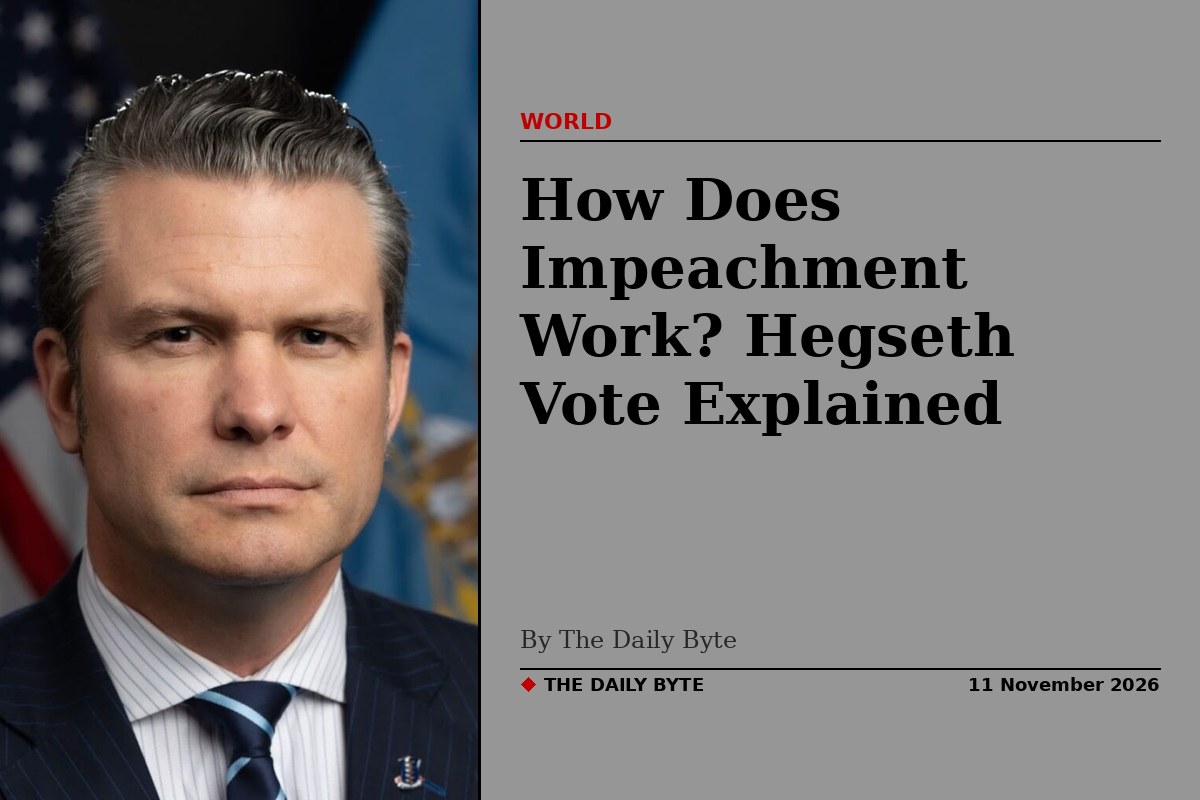
No, Pete Hegseth was not impeached. On Tuesday 10 November 2026, the US House of Representatives voted 211 to 204 to send the eight articles of impeachment against the Defence Secretary to the Republican-led House Judiciary Committee, a procedural move that effectively killed the attempt in the current Congress. Impeachment itself is a two-stage process: the House must first vote to impeach by a simple majority, and the Senate must then convict by a two-thirds majority before an official can be removed from office. Neither vote happened.
What Happened on 10 November 2026?
The impeachment push was led by Representative Thomas Massie, a Republican from Kentucky, who reintroduced eight articles of impeachment against Mr Hegseth on Monday 9 November, the first day of the lame-duck session after the midterm elections. He had first filed the articles in September 2026. Because he brought the resolution as a question of the privileges of the House, the Speaker was required to schedule consideration within two legislative days, which forced the House to act by 12 November. The House took up a procedural motion at 5.30pm on Tuesday 10 November, and the chamber voted 211 to 204 in favour of referring the resolution to the Judiciary Committee. The motion was offered by Representative Darrell Issa of California and was recorded as agreed at 6.02pm as Roll Call 317.
Referral to committee is not a vote on the charges themselves. It means the House chose not to vote on whether Mr Hegseth should be impeached, and instead sent the resolution to a committee where it can sit without further action. Mr Massie had warned that referral would kill the effort, and he was the only Republican to vote against it. All 203 Democrats who voted joined him in opposing the referral, while 210 Republicans and the House's one independent member backed it. Eighteen lawmakers did not vote, including 11 Democrats and seven Republicans. Had all of the absent Democrats voted against referral, the outcome could have been different. Mr Hegseth remains Defence Secretary, and the resolution now sits with the Judiciary Committee.
What Are the Eight Articles About?
The resolution, numbered H.Res.1655, runs to 34 pages and accuses Mr Hegseth of high crimes and misdemeanours across several military operations. The articles are allegations in a political charging document. They are not findings by a court, a military tribunal or an inspector general, and Mr Hegseth has not been charged with any crime. The main allegations are:
- Violating the Constitution and the War Powers Resolution of 1973 by directing the US military to sustain hostilities against Iran without congressional authorisation. Three of the eight articles deal with the Iran war.
- Failing to take required steps to minimise civilian casualties during military operations.
- Authorising strikes on suspected drug-trafficking boats in the Caribbean Sea, which legal scholars have characterised as extrajudicial killings.
- The capture of Venezuelan leader Nicolas Maduro, which is cited among the operations carried out without the authorisation the articles say was required.
- Suppressing free speech and abusing his authority in running the Pentagon.
Mr Hegseth rejected the effort at a Pentagon press briefing on 10 November, calling it a farce and a defeated congressman's attempt at revenge. President Donald Trump praised his defence and has pledged to stand by him. Mr Massie lost his primary earlier this year to a Trump-backed challenger and is due to leave Congress at the end of the year.
How Does Impeachment Work?
Impeachment in the United States is a political process set out in the Constitution, not a criminal trial, and it has two distinct stages. The House of Representatives acts first, and the Senate acts second. The steps are:
- Investigation and articles. The House normally investigates first, through a committee, and then drafts articles of impeachment setting out the charges. In most cases in which an official has been impeached, the House has chosen to conduct an investigation first, according to the Congressional Research Service.
- House vote. The House votes on each article. Impeachment requires only a simple majority of the House, which in a full House of 435 members means 218 votes. If at least one article passes, the official is impeached, but that alone does not remove them from office.
- Senate trial. The House appoints managers to present the case in the Senate, which holds a trial. The Senate can vote by a simple majority to dismiss the charges.
- Conviction and removal. To convict and remove an official, the Senate must reach a two-thirds majority, which means 67 of the 100 senators. That is a deliberately high bar, and it is why impeachment by the House does not usually lead to removal.
Impeachment and removal are therefore two separate fights. An official can be impeached by the House and remain in office if the Senate does not convict. The Constitution provides for impeachment for treason, bribery, or other high crimes and misdemeanours, a phrase that Congress has interpreted through the articles it drafts in each case.
What Is a Privileged Resolution?
Mr Massie did not bring his articles through the ordinary route, which would have sent them to the Judiciary Committee or the Committee on Rules for consideration at the leadership's pace. Instead, he brought the resolution as a question of the privileges of the House, a procedure that forces the Speaker to schedule consideration within two legislative days. That gave the House three options by 12 November: vote to table the resolution, vote to impeach, or vote to send it to committee. The procedure guarantees floor action, but not a vote on impeachment itself, and that distinction decided the outcome. Republican leaders used the third option, referring the resolution to committee, which disposed of it without any lawmaker having to vote on the charges. Mr Massie had used the same device when he first introduced the articles in September, when the Speaker narrowly avoided a floor vote by revising the calendar.
Why Did the 211-204 Vote Go That Way?
The vote was almost entirely along party lines, with one exception on each side of the question. Mr Massie was the only Republican to vote against referral, because referral ended his attempt to force a vote on the articles. Every Democrat who voted opposed referral for the opposite reason: they wanted the articles to reach a floor vote. The 11 absent Democrats included former Speaker Nancy Pelosi, and their absence mattered. If they had voted, the referral motion could have failed, and the House would then have moved towards a vote on the articles themselves, possibly as early as 11 November, with Mr Massie requesting separate votes on each article.
The vote also came a week after voters punished Republicans at the ballot box over the war in Iran, and it was described as a significant defeat for House Democratic leader Hakeem Jeffries ahead of a leadership election, since Democrats could not keep their members in Washington for the vote. Republican leaders, for their part, avoided forcing their members to vote on whether to impeach a cabinet secretary of their own party's administration, which is the political cost the referral was designed to avoid.
What Happens Next?
In the short term, very little. The eight articles remain before the House Judiciary Committee, chaired by Jim Jordan, and nobody knows whether the committee will hold a hearing, mark the resolution up, or simply let it sit until this Congress expires. The 119th Congress ends on 3 January 2027, and an impeachment resolution that has not been adopted by then does not carry over into the next Congress. That means the current effort will lapse when the new Congress sits.
The longer-term picture is different. Democrats take control of both chambers of Congress in January, after their midterm victories, and the impeachment articles, or a version of them, are expected to be among the first items the new majority can take up. A fresh resolution would have to be introduced in the new Congress, and the process would start again. Whether Democratic leaders choose to spend early political capital on impeaching a defence secretary, rather than on other priorities, is a political judgement that has not yet been made. For now, the 10 November vote is a reprieve for Mr Hegseth, not an acquittal, because the House never voted on the charges themselves.
Has a Cabinet Secretary Been Impeached Before?
Yes, but only twice, and neither was removed from office. The House impeached William Belknap, the Secretary of War, in 1876, and Alejandro Mayorkas, the Secretary of Homeland Security, in 2024. In both cases the Senate did not convict. Mr Belknap had resigned shortly before the House vote, and the Senate acquitted him. Mr Mayorkas's case was dismissed by the Senate without a full trial. That history is one reason the two-thirds Senate threshold matters so much: even when the House impeaches, removal requires a broad bipartisan consensus in the Senate that is rarely present. In Mr Hegseth's case, removal would have required 67 Senate votes, and Democrats hold at most 56 seats in the Senate, so they would have needed at least 11 Republicans to join them.
Frequently Asked Questions
Was Pete Hegseth impeached? No. The House voted 211 to 204 on 10 November 2026 to refer the articles of impeachment to the Judiciary Committee. The House never voted on the articles themselves, so Mr Hegseth was not impeached and remains Defence Secretary.
How many votes does impeachment need in the House? A simple majority. In a full House of 435 members that means 218 votes. The 218-vote threshold was never tested in the Hegseth case because the referral motion disposed of the resolution first.
How many Senate votes are needed to remove an official? Two-thirds of the Senate, or 67 of the 100 senators, must vote to convict. The Senate can also dismiss the charges by a simple majority vote.
Can the Hegseth impeachment effort come back? Yes. The current resolution lapses when the 119th Congress ends on 3 January 2027, but Democrats take control of both chambers in January and could introduce a new version of the articles in the new Congress.
What did the eight articles accuse Hegseth of? They allege high crimes and misdemeanours, mainly violations of the War Powers Resolution of 1973 in the war with Iran, failure to minimise civilian casualties, extrajudicial killings in strikes on suspected drug boats, the capture of Nicolas Maduro, and suppression of free speech. These are allegations, not court findings.
Sources: BusinessWorld and Law Commentary.


