How does the UK energy price cap work?
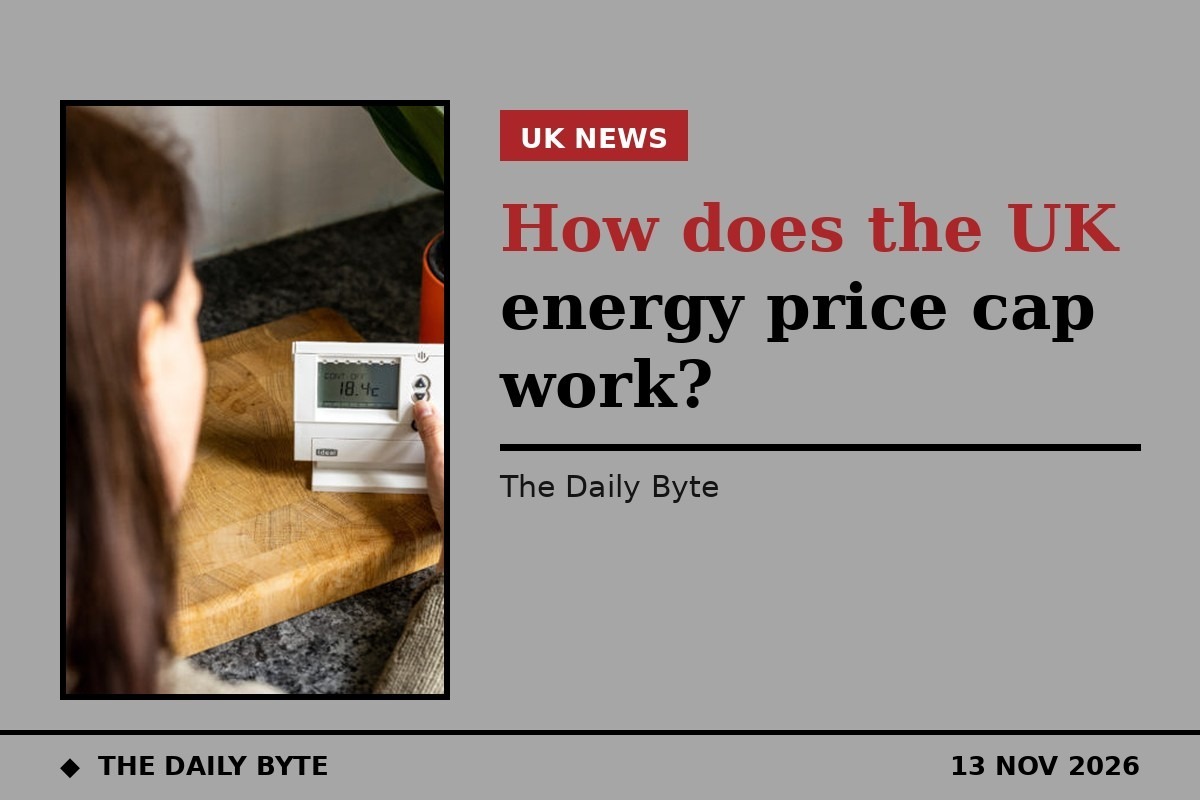
The UK energy price cap is the maximum that suppliers in England, Scotland and Wales can charge households on a standard variable tariff for each unit of gas and electricity, plus a maximum daily standing charge. It is not a cap on your total bill: use more energy and you will pay more, use less and you will pay less. From 1 October to 31 December 2026 the cap is set at £1,723 a year for a typical dual-fuel household paying by Direct Debit, and it is forecast to rise sharply in January 2027.
This explainer answers the question people actually search for: how does the cap work, what does it limit, who is covered, how is the level decided, and what is expected to happen when Ofgem announces the next cap on 25 November 2026.
What is the energy price cap?
The energy price cap, formally the default tariff cap, was introduced on 1 January 2019 by Ofgem, the energy regulator for Great Britain, under the Domestic Gas and Electricity (Tariff Cap) Act 2018. It was brought in because millions of households who never switched supplier were stuck on expensive default tariffs, paying far more than customers who shopped around. The cap sets a ceiling on the prices those customers can be charged, so that a household that does nothing still pays a fair price.
Ofgem describes the cap as a limit on the maximum rate per unit and the maximum standing charge that can be billed for energy use on a default tariff. The cap applies to standard variable tariffs, the default tariffs a household ends up on when a fixed deal expires and nothing is done. It is reviewed and reset every three months, on 1 January, 1 April, 1 July and 1 October, and Ofgem announces each new level roughly five to six weeks before it takes effect.
The cap covers Great Britain, meaning England, Scotland and Wales. Northern Ireland has a separate energy regulator and a different system, so the Ofgem cap does not apply there.
What the cap limits, and what it does not
The single most misunderstood point about the price cap is that it does not cap your bill. It caps two prices: the unit rate, what you pay for each kilowatt-hour (kWh) of gas or electricity you use, and the standing charge, the fixed amount you pay each day simply for being connected to the network, whether you use any energy or not. Your bill is those two prices multiplied by how much energy you use, and there is no ceiling on that total.
For the current period, 1 October to 31 December 2026, the capped rates for a typical household paying by Direct Debit are:
| Unit rate | Standing charge | |
|---|---|---|
| Electricity | 26.32p per kWh | 54.83p per day |
| Gas | 7.97p per kWh | 29.68p per day |
Those figures are national averages published by Ofgem. The actual rates on your bill vary by region, because network costs differ around the country, and by payment method. Ofgem sets separate caps for 14 regions and for Direct Debit, standard credit and prepayment customers. Direct Debit is usually the cheapest method, because it costs suppliers less to administer.
The headline figure of £1,723 a year is not what every household pays. It is what a household using a typical amount of energy would pay if the current rates applied for a full year. Under Ofgem’s current definition, typical use is 2,500 kWh of electricity and 9,500 kWh of gas a year. A household that uses much more, for example a large, poorly insulated home, will pay much more than £1,723 even though every unit is charged at or below the capped rate. A small flat that uses little energy will pay much less.
How does Ofgem decide the level of the cap?
Ofgem does not pick a number out of thin air. It builds the cap from the costs a supplier faces in delivering energy to a typical home, using a published formula. The largest part is the wholesale cost, what suppliers pay to buy gas and electricity on the wholesale market, which Ofgem measures over a fixed observation window in the months before each cap period. For the October to December 2026 cap, the wholesale cost allowance rose by 11% and now makes up 47% of the total cap, according to Ofgem’s summary of changes.
The other parts of the cap are network costs, the cost of running and maintaining the pipes and wires; policy costs, the cost of government schemes such as support for low-carbon energy; operating costs, the cost of running a supply business, including call centres, metering and IT; an allowance for debt, because some customers cannot pay; a small permitted profit margin for suppliers; and VAT. Gas still carries VAT at 5%, while the government cut VAT on domestic electricity from 5% to 0% from 1 October 2026, a temporary measure that reduced the electricity part of the cap.
Because wholesale prices are the biggest and most volatile part, the cap moves mainly with the wholesale market. When wholesale gas prices rise, as they did through the summer and autumn of 2026 amid the conflict in the Middle East, the cap follows. When wholesale prices fall, the cap usually falls too, although it can take a quarter to feed through because Ofgem uses prices from an observation window rather than the price on a single day.
How has the cap changed?
The cap has moved sharply since it was introduced, and its history is a short history of the energy crisis. It rose through 2022 as wholesale gas prices soared after Russia’s invasion of Ukraine, and the headline figure peaked at £3,582 in January to March 2023, before the government’s Energy Price Guarantee limited what households actually paid. It then fell back as wholesale prices eased, but it has risen again in 2026.
| Period | Cap level, typical household, Direct Debit | What happened |
|---|---|---|
| July to September 2026 | £1,663 a year | Confirmed by Ofgem in May 2026 |
| October to December 2026 | £1,723 a year | Up 4%, announced 26 August 2026 |
| January to March 2027 | £1,999 a year (forecast) | Cornwall Insight forecast, 30 September 2026; Ofgem confirms on 25 November 2026 |
The October rise was driven mainly by higher wholesale gas costs, partly offset by the removal of VAT from electricity bills. The figures are not directly comparable with older quarters in every case, because Ofgem updated its typical consumption values in 2026 to reflect the fact that households now use less energy than they did, about 7% less electricity and 17% less gas than at the last review. On the older consumption basis the October cap would have been quoted at a higher headline figure.
Who is covered by the cap, and who is not?
The cap applies if you are on your supplier’s standard variable or default tariff in England, Scotland or Wales, whatever your payment method. It does not apply if you are on a fixed-term deal: your prices are set by your contract, and the cap does not change them. When the fix ends, you move onto the variable tariff and the cap applies from then on.
The level also depends on how you pay. For October to December 2026, Ofgem set the typical annual figure at £1,723 for Direct Debit customers, £1,861 for standard credit customers who pay on receipt of a bill, and £1,678 for prepayment meter customers. Economy 7 customers, who pay different rates at night, have a separate cap level. Households on certain specialist tariffs, such as some green tariffs with specific conditions, may also sit outside the standard cap, and your supplier must tell you if that is the case.
It is worth checking which tariff you are on, because many households are on a capped default tariff without realising it. Your bill or your supplier’s app should say whether you are on a standard variable tariff. If you are, the unit rates and standing charge on your bill should not exceed the capped rates for your region and payment method.
Why is the cap expected to rise in January 2027?
The next cap, for 1 January to 31 March 2027, has not been set yet. Ofgem will announce it on 25 November 2026. But the forecasts published so far all point upwards, because wholesale gas prices stayed high during the Middle East conflict and the observation window Ofgem uses for January runs from 19 August to 17 November 2026, a period that includes the September price spikes.
Cornwall Insight, the consultancy whose forecasts are most often quoted, forecast on 30 September 2026 that the January cap would be £1,999 a year for a typical dual-fuel household paying by Direct Debit, a rise of £276, or 16%, on the current £1,723. Its forecast unit rates are about 30.28p per kWh for electricity and about 9.76p per kWh for gas. The big suppliers’ own forecasts, published in early November, are higher: British Gas and E.ON Next both put the January cap at £2,215, OVO at £2,182 and EDF at £2,167, rises of 26% to 29%. These are forecasts, not the cap, and Cornwall Insight’s own figure moved by £127 in a single update, so the final number Ofgem announces on 25 November could differ from all of them.
What is not in doubt is the direction of travel: a January rise is, in the words of the forecasters, all but certain, because the September wholesale spikes are already baked into the calculation. Households who want certainty about their January bills can compare fixed deals, which are not affected by the cap, but a fix is a contract with its own terms and exit fees, and the right choice depends on the household.
How can you keep your bill down under the cap?
Because the cap limits prices rather than bills, the amount you pay is still largely decided by how much energy you use. Lowering the thermostat by one degree, heating only the rooms you use, and fixing draughts are the most often repeated ways to use less, and they work because heating is the largest part of most household gas use in winter. A smart meter does not cut your bill by itself, but it shows how much you are using and what it costs, which makes it easier to spot waste.
It is also worth checking whether you are getting the support you are entitled to. The Warm Home Discount, the winter fuel payment for eligible pensioners, and supplier hardship funds all exist separately from the cap, and eligibility rules change from year to year, so the position in one winter may not be the position in the next. Citizens Advice and your supplier can explain what is available in your area. If you are struggling to pay, contact your supplier before the debt grows: suppliers are required to offer payment plans and support, and the cap itself includes an allowance for the cost of customers who cannot pay.
Frequently asked questions
Does the price cap mean my bill cannot go above £1,723? No. £1,723 is what a typical household using 2,500 kWh of electricity and 9,500 kWh of gas a year would pay at the capped rates. If you use more than that, your bill will be higher, because the cap limits the price of each unit, not the total.
Does the cap apply to fixed tariffs? No. Fixed tariffs are set by your contract and do not change when the cap changes. The cap applies to standard variable and default tariffs, which is where you land when a fix ends.
When will the next cap be announced? Ofgem will announce the cap for 1 January to 31 March 2027 on 25 November 2026, and the new rates will apply from 1 January 2027. Forecasts put it at about £1,999 to £2,215 a year for a typical household, but the confirmed figure may differ.
Does the cap cover Northern Ireland? No. The Ofgem cap covers England, Scotland and Wales. Northern Ireland has a separate regulator, the Utility Regulator, and a different system for energy prices.
Why did my bill go up if the cap only rose 4%? Your bill depends on how much energy you used as well as the capped rates. Bills usually rise in winter because households use more heating and lighting, even if the rates themselves have barely changed.
Sources: Ofgem; MoneySavingExpert; Cool Power Co on the January 2027 forecasts.