How Does the World Chess Championship Work?
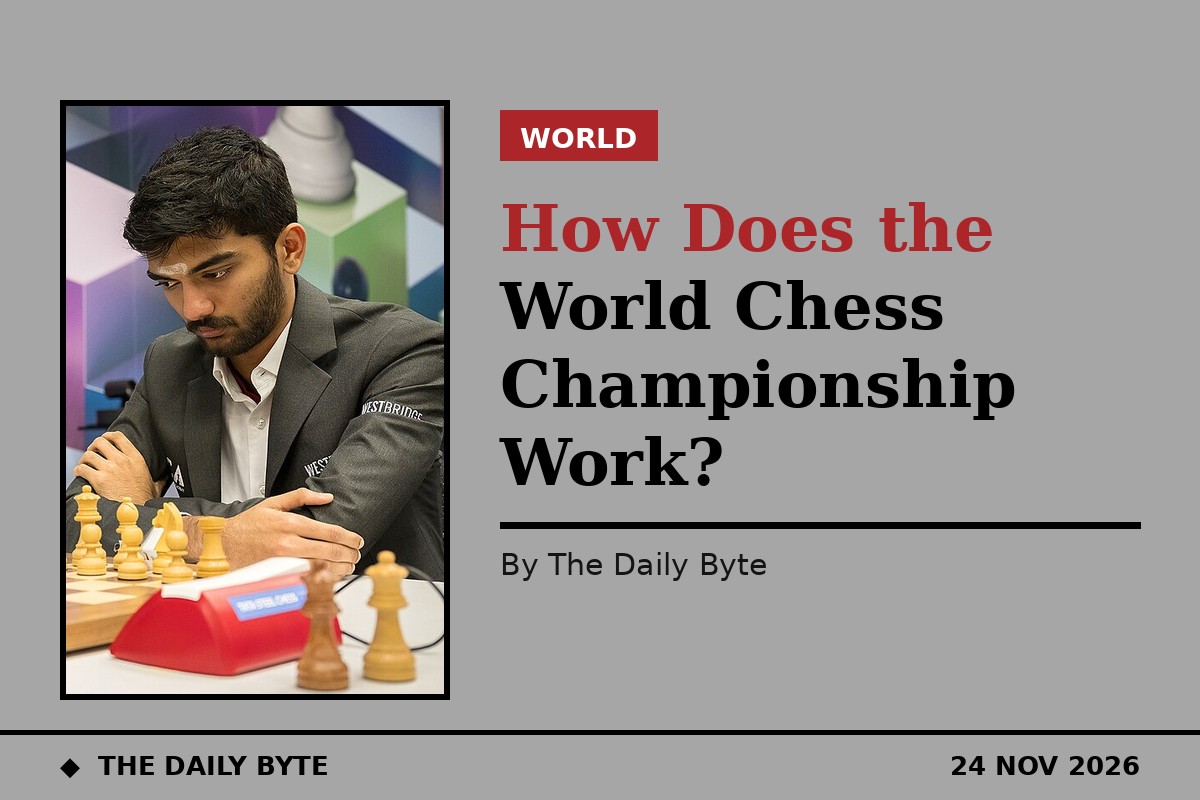
The first game of the 2026 World Chess Championship is played today, Tuesday 24 November 2026, in Geneva, Switzerland. Reigning champion Gukesh Dommaraju of India defends the title against challenger Javokhir Sindarov of Uzbekistan in a head-to-head match of up to 14 classical games. The first player to reach 7.5 points wins the title, and with it a share of a 2.5 million US dollar prize fund. If the score is tied 7-7 after 14 games, faster tiebreak games on 12 December will decide the champion. Both players are 20 years old, making this the youngest World Championship match in the history of chess.
That last fact is the one that has made this match the most talked-about in years. Gukesh became the youngest undisputed world champion in history when he beat Ding Liren in Singapore in December 2024, at the age of 18. Now, two years later, he faces a challenger who is even younger in chess terms: Sindarov won the 2026 Candidates Tournament unbeaten and arrives in Geneva as the higher-rated player. This explainer sets out how the championship works, who is playing, how the winner is decided, and what happens if the match is tied.
The 2026 match at a glance
| Detail | 2026 championship |
|---|---|
| Players | Gukesh Dommaraju (India), defending champion, vs Javokhir Sindarov (Uzbekistan), challenger |
| Venue | Fondation Martin Bodmer, Cologny, Geneva, Switzerland |
| Dates | 22 November to 12 December 2026; Game 1 on 24 November |
| Format | Maximum of 14 classical games; first to 7.5 points wins |
| Start time | 3pm local time in Geneva (2pm UTC) |
| Tiebreaks | 12 December, if the score is 7-7 |
| Prize fund | 2.5 million US dollars |
| Official name | Salesforce FIDE World Championship Match 2026 |
The match is organised by FIDE, the International Chess Federation, which publishes the regulations, the schedule and the prize distribution. Salesforce joined FIDE as title sponsor and technological partner in September 2026, in a multi-year agreement covering the World Championship matches in 2026 and 2028 as well as the Women's World Championship match in 2027.
Who is playing?
Gukesh D, representing India, became the 18th World Champion in December 2024. He defeated Ding Liren 7.5-6.5 in Singapore, winning the fourteenth and final classical game, and at 18 he became the youngest undisputed World Champion in chess history, breaking a record held by Garry Kasparov. His road to the title also included victory at the 2024 Candidates Tournament, which he won at the age of 17, and individual and team gold medals at the 2024 Chess Olympiad. Geneva is his first defence of the title. He has said he does not see it that way. Asked at the pre-match press conference whether defending would be harder than winning in 2024, he replied: "I don't think I'm here to defend anything. I'm here to win it all over again."
Javokhir Sindarov, representing Uzbekistan, qualified for the match by winning the 2026 FIDE Candidates Tournament in Cyprus. He secured first place with a round to spare, finished unbeaten and scored 10 points from 14 games, with six wins and eight draws. That result came less than five months after he became the youngest winner of the FIDE World Cup, in Goa in 2025. He is the first player from Uzbekistan to qualify for a match for the undisputed World Championship title. He became a grandmaster at the age of 12 and has been breaking age records for most of his career. Across his first four major classical tournaments of 2026, he scored 14 wins, 29 draws and just two defeats in 45 games, with an average tournament performance rating of 2837.
The ratings make this match unusual. On FIDE's November 2026 rating list, the challenger is the higher-rated player: Sindarov is world number four on 2782, while Gukesh is world number 26 on 2710, a gap of 72 points and 22 places. That makes Gukesh the lowest-ranked player ever to contest a World Championship match. The ratings describe past results, not the future, and Sindarov himself has been careful not to claim favourite status. At the pre-match press conference he put his chances at "50-50" and warned against reading too much into Gukesh's recent results. The head-to-head record favours the challenger, though: Sindarov leads their classical encounters 2-0, with one draw, having beaten Gukesh at the 2018 Moscow Open and the 2022 Sharjah Masters, while their most recent classical game, at Tata Steel in January 2026, ended in a draw. Gukesh has never beaten Sindarov in classical chess, although he did beat him in a rapid game at the 2026 Grand Chess Tour event in Warsaw.
How the match works
The World Championship is not a tournament. It is a single match between two players, played over a maximum of 14 classical games. Classical chess is the slowest form of the game: each player has hours rather than minutes to think, and a single game can last five or six hours. A win earns one point, a draw earns half a point each, and a loss earns nothing. The first player to reach 7.5 points wins the match and the title immediately, so the match can finish before all 14 games are played. If all 14 games are drawn, the score would be 7-7, and tiebreaks decide it.
The time control is 120 minutes for the first 40 moves, followed by 30 minutes for the rest of the game, with a 30-second increment added from move 41. In plain terms, each player starts with two hours on the clock, must make 40 moves within that time, and then receives another half hour for the remainder of the game, plus 30 seconds after every move from move 41 onwards. That is a generous allowance by modern standards, and it is deliberate: the World Championship is meant to test deep calculation and preparation, not speed.
There is one rule designed to keep the games fighting. Draw offers are not permitted before Black's 40th move. Before that point, a draw may be claimed through the chief arbiter or deputy chief arbiter only in cases of threefold repetition or stalemate. In other words, the players cannot simply agree to split the point early in a quiet position; they have to play. The players take it in turns to have the white pieces, which move first, and the draw at the opening ceremony gave Sindarov white in Game 1 and in every odd-numbered classical game, with Gukesh taking white in the even-numbered games.
The schedule is built around rest. Games are played in blocks of three, with a rest day after every three games: Games 1 to 3 on 24 to 26 November, a rest day on 27 November, Games 4 to 6 on 28 to 30 November, a rest day on 1 December, Games 7 to 9 on 2 to 4 December, a rest day on 5 December, Games 10 to 12 on 6 to 8 December, a rest day on 9 December, and Games 13 and 14, if required, on 10 and 11 December. Every classical game starts at 3pm local time in Geneva.
What happens if the score is 7-7?
If the score is level at 7-7 after the classical games, the title will be decided on 12 December, and the defending champion does not keep the title by default. The tiebreak begins with four rapid games at 15 minutes per player plus a 10-second increment per move. If the score is still level, the players contest two games at 10 minutes plus five seconds per move. If it is still level, they play two blitz games at three minutes plus two seconds per move. Should the tie persist, three-minute-plus-two-second games are played one at a time, with the colours reversed after each draw, until a decisive result is reached. Rapid and blitz chess use the same board and pieces but much faster clocks, so the tiebreak rewards quick thinking and nerve as much as preparation. The closing ceremony follows the tiebreak on 12 December.
How much money is at stake?
The prize fund is 2.5 million US dollars, net of any applicable local taxes. Under the standard distribution set out in the regulations, each player receives 200,000 US dollars for every classical game won, including a win by forfeit, and the remaining balance is divided equally between the two players. That means the final split depends on how many decisive games there are. If the final classical score is 7.5-6.5 with 13 decisive games, or 8-6 with all 14 games decisive, the winner receives 1.3 million dollars and the runner-up 1.2 million dollars. The same 1.3 million to 1.2 million split applies if the match is decided in tiebreaks. A player who wins the match without winning a classical game, by taking the tiebreak after 14 draws, would therefore still take the larger share.
How did Sindarov earn the right to challenge?
The challenger does not get picked. He earns the match by winning the Candidates Tournament, an eight-player event that is itself one of the hardest tournaments in chess. The 2026 Candidates was held in Cyprus, and Sindarov won it with a round to spare, unbeaten, on 10 points from 14 games. FIDE now lists him officially as the challenger in the 2025-26 World Championship cycle. Winning the Candidates is a major achievement in its own right: the field is made up of the strongest qualifiers from the World Cup, the FIDE Circuit, the Grand Swiss and the rating list, and the winner is the only player who gets a shot at the champion. Sindarov also leads the 2026-27 FIDE Circuit, the year-long series of tournaments that offers another route into the next Candidates, so before he has played his first World Championship match he is already building a path to the next one.
Why this match is historic
The first reason is age. Gukesh and Sindarov are both 20 when the match begins, making this the youngest World Championship contest in history. It is also the first World Championship match between two players born in the 21st century, and the two could plausibly remain near the top of world chess for another 15 or 20 years, so Geneva may be the first of several meetings rather than a one-off. FIDE's interim president, Viswanathan Anand, himself a five-time world champion, said: "A World Championship match is not like anything else in our sport. You sit across from the same opponent for three weeks with the world watching."
The second reason is geography. The match brings a World Championship back to Switzerland for the first time since Brissago in 2004, when Vladimir Kramnik defended his classical title against Peter Leko. FIDE considered proposals from several countries, including India, the United States and Cyprus, before choosing Geneva as neutral territory. The venue is the Fondation Martin Bodmer in Cologny, a heritage library and museum founded in 1971 that houses about 150,000 documents in nearly 120 languages, including hundreds of papyri and medieval manuscripts. Its collection has been inscribed on UNESCO's Memory of the World register since 2015.
The third reason is what is missing. Magnus Carlsen, the world's highest-rated player, is not playing, because he voluntarily gave up the classical title. Carlsen chose not to defend the crown he had held since defeating Anand in 2013, saying he lacked the motivation for another lengthy World Championship preparation and match. That allowed Ding Liren to defeat Ian Nepomniachtchi for the vacant title in 2023, and Gukesh then beat Ding in 2024. Carlsen can therefore remain the world's highest-rated classical player without being World Champion, which is one of the peculiarities hanging over the modern title. The Gukesh-Sindarov match matters precisely because both players belong to the generation that has emerged since Carlsen stepped away from the championship cycle.
Frequently asked questions
When is the first game of the 2026 World Chess Championship? Game 1 is on Tuesday 24 November 2026, starting at 3pm local time in Geneva. The opening ceremony and media day took place on 22 November.
How many games are in the World Chess Championship? A maximum of 14 classical games. The first player to reach 7.5 points wins the title, so the match can end early. If the score is 7-7 after 14 games, tiebreaks are played on 12 December.
Who is the favourite, Gukesh or Sindarov? On the November 2026 FIDE rating list, Sindarov is the higher-rated player, at 2782 and world number four, against Gukesh on 2710 at world number 26. But Gukesh has something Sindarov does not: he has already played and won a World Championship match. Sindarov himself called the chances "50-50".
What happens if a player has to withdraw? There is a reserve list. If either player cannot compete, grandmaster Anish Giri is first in line to enter the match, and Fabiano Caruana is next if a second replacement is required.
Where can the match be watched? All classical games start at 3pm in Geneva, which is 2pm UTC, and FIDE publishes the games and the schedule through its official channels. The venue, the Fondation Martin Bodmer, also hosts visitors, with tickets and broadcast coverage arranged through the official event channels.


