How to Check Your MOT History and Tax Your Car Online
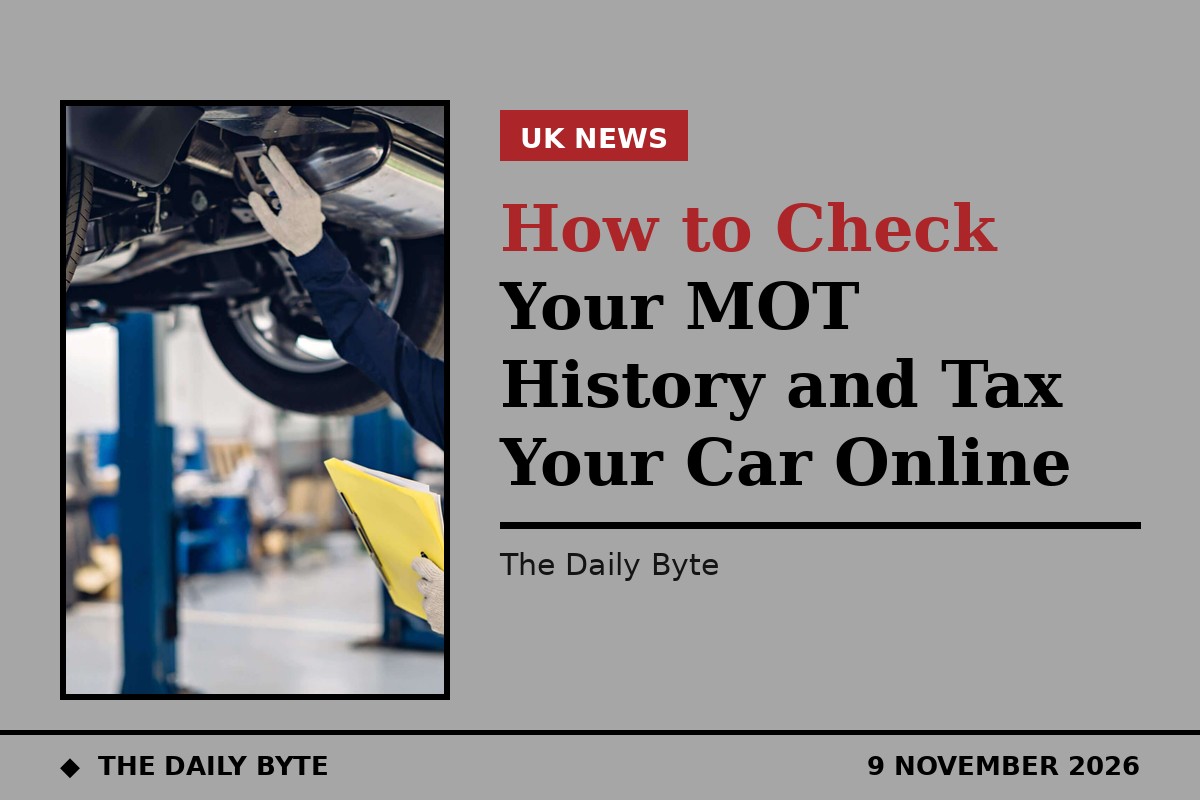
Before you buy a used car, or before your own car is due its annual test, one free check can tell you a great deal. The GOV.UK check MOT history service shows every recorded MOT test for a vehicle, including whether it passed or failed, the mileage recorded at each test and when the next test is due. All you need is the registration number. This guide explains how to use it, what the record shows, what it cannot tell you, and how to tax a car online once you own it.
How to check a vehicle's MOT history
The official service is called Check the MOT history of a vehicle, and it is run on GOV.UK using records held by the Driver and Vehicle Standards Agency, the DVSA. It is free, it does not require an account, and it takes less than a minute. Go to the GOV.UK MOT history page and enter the vehicle's number plate exactly as it appears on the plate. You may be asked to confirm the make of the vehicle, which is a simple check to make sure you have the right car.
Once you enter the registration, the full test history appears, starting with the most recent test. You do not need the V5C logbook or the MOT certificate number to see the basic history. However, if you have the 11-digit number from the vehicle's logbook, the V5C, you can also see where each test was done and download copies of the current and previous MOT certificates. That extra detail is useful if you are buying a car and want to check that the paperwork matches the car in front of you.
Be careful to use the official GOV.UK service. Several commercial websites offer the same information and charge for it, but the government data is free. Any site that asks you to pay for a basic MOT history check is repackaging public information that you can get for nothing on GOV.UK.
What does the MOT history show?
For each test, the record shows the date, whether the vehicle passed or failed, the mileage recorded when it was tested, and when the next MOT is due. For tests carried out in England, Scotland or Wales, you can also see which parts failed at each test and whether any parts had minor problems. The history may also tell you if your vehicle has been recalled for a safety reason, depending on the manufacturer.
The record goes back a long way. For cars, motorcycles and vans, you can get results for tests done since 2005, when digital records became standard. For HGVs, trailers, buses and coaches, results are available for tests done since 2018. If your vehicle was tested in Northern Ireland, results are only available for tests done since 2017, and you cannot download MOT certificates through the service. In Northern Ireland, MOT tests are carried out at government-run test centres rather than at authorised garages, and a duplicate certificate for a valid MOT can be applied for through NI Direct.
The mileage readings are one of the most useful parts of the record. By comparing the mileage at each test, you can see how the car has been used over the years and spot anything that does not add up, such as a reading that goes down between tests. The record also shows advisory items, which are problems the tester noticed that were not serious enough to fail the car but may need attention soon, such as tyres close to the legal limit or slight corrosion.
What the MOT check cannot tell you
An MOT history check is powerful, but it is not a full vehicle history check. It will not tell you whether the car has outstanding finance, whether it has been recorded as an insurance write-off, or whether it has been reported stolen. For those checks you need a separate vehicle history check from a recognised provider, such as HPI, the AA or the RAC. You should also check that the details on the V5C logbook match the car, that the vehicle identification number matches, and that the seller is who they say they are.
The MOT record also only shows the condition of the car on the day of each test. A car can pass its MOT and still develop a fault the next week, and advisories from previous tests may have been fixed or ignored. The check is a starting point for judging a used car, not a guarantee. A pre-purchase inspection by an independent mechanic is still worth considering for an expensive purchase.
Red flags to look for in an MOT history
When you are buying a used car, read the history with care. Repeated failures on the same parts, such as brakes or suspension, can suggest a car that has not been maintained properly. Long gaps between tests can mean the car was off the road, which is not necessarily a problem, but it is worth asking the seller why. A mileage reading that falls between tests is a serious warning sign, because it can indicate that the odometer has been tampered with.
Advisories deserve attention too. An advisory is not a failure, but a list of advisories that appears year after year without being fixed can tell you how the previous owner treated the car. If the most recent test has advisories for worn tyres or brakes, budget for that work soon after you buy. If a car has failed its most recent test and the seller says it has since been fixed, ask to see the retest certificate and check that the failure items were the ones repaired.
When does a car need an MOT?
Most cars, motorcycles and vans need their first MOT when they are three years old, and then need a new test every year. The GOV.UK service will tell you when the next MOT is due, and you can also sign up for free MOT reminders from GOV.UK by email or text message so you do not miss the date. You can have the test done up to a month before the current certificate runs out, minus a day, and keep the same renewal date for the following year.
Driving without a valid MOT is an offence, except when you are driving to a pre-booked MOT test or to a place where the vehicle will be repaired after failing. A small number of historic vehicles are exempt from the MOT, and vehicles that are kept off the road must be covered by a Statutory Off Road Notification, known as a SORN, instead.
How to tax your car online
Once you have checked the MOT history, you will also need to make sure the car is taxed. Vehicle tax can be paid online on GOV.UK, and you need the 11-digit reference number from the V5C logbook or the 16-digit reference from the V11 tax reminder letter. You cannot transfer tax from a previous owner, so a car you buy will need to be taxed by you before you drive it, even if the seller had months of tax left.
To tax a vehicle, it must have a valid MOT and insurance. You can pay for six or twelve months, and you can also pay by monthly Direct Debit. If you keep a vehicle off the road and do not want to tax it, you must make a SORN, which you can also do online on GOV.UK. Driving an untaxed vehicle on a public road can lead to a fine, and the DVLA can clamp an untaxed vehicle, so do not assume a car is taxed just because it was taxed when you bought it.
The tax, MOT and insurance checks all sit on GOV.UK, and they are free to use. As with the MOT history service, be wary of third-party sites that charge for tax reminders or checks that the government provides for free. Rules change, so always check the official GOV.UK pages before you buy, tax or drive a vehicle.