Magyar to Visit Ukraine in Sign of Mending Ties
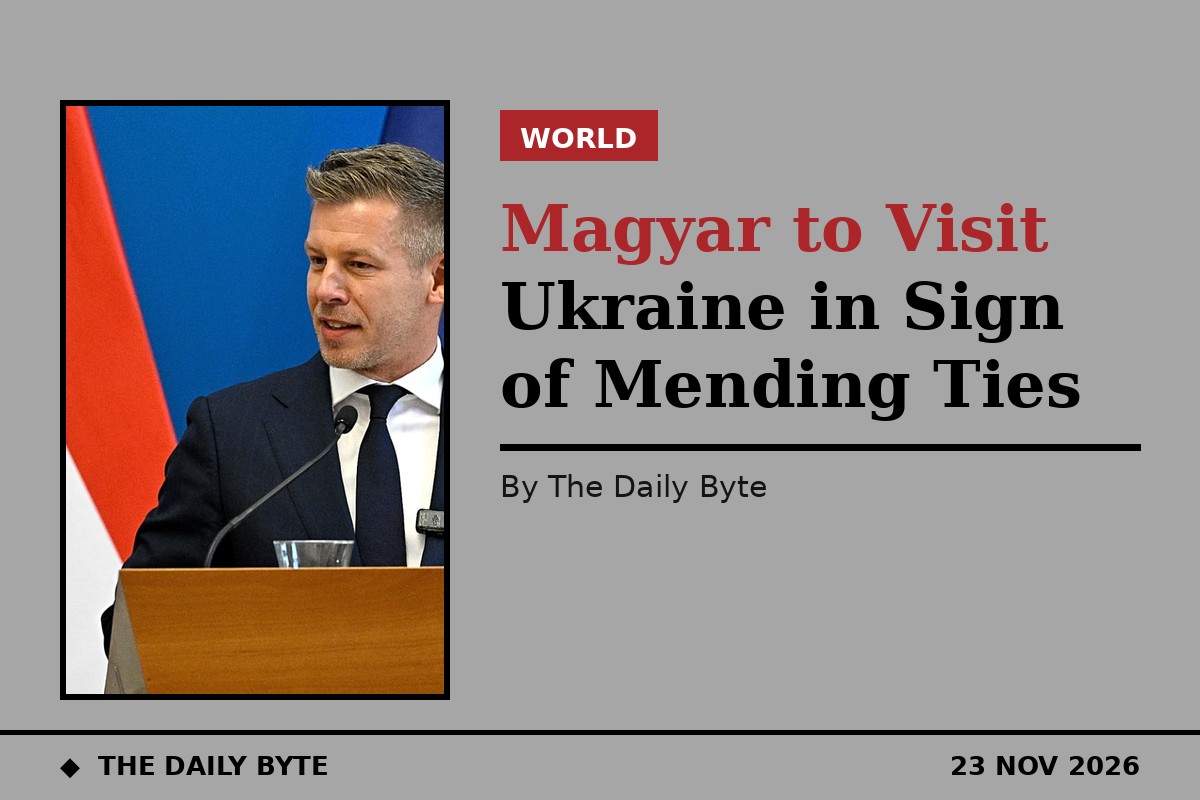
Hungarian Prime Minister Péter Magyar told parliament in Budapest on Monday that he will soon travel to Zakarpattia, the mountainous region of western Ukraine that is home to tens of thousands of ethnic Hungarians. It will be the first visit to the region by a Hungarian head of government since 2015, and the first by any Hungarian prime minister since the war began.
Magyar gave no date for the trip, saying only that it would happen soon. He told lawmakers he would go to Zakarpattia to personally deliver the support of the motherland to the Hungarian community there. He last visited the region in 2024, while still in opposition.
The announcement follows Russian drone strikes on Zakarpattia on 17 November, the first time the area — long regarded as one of Ukraine's safer corners because of its distance from the front — has come under sustained attack. Russian drones hit the region in three waves that morning, with explosions reported around Mukachevo and Uzhhorod. Three Shahed drones reached the region; one struck the Mukachevo community while air defences intercepted the other two. A Russian drone also came down about 300 metres from Mukachevo railway station, forcing the crew of a Hungarian train to disembark, and Budapest suspended rail services with Ukraine for two days.
Magyar was blunt about who was responsible. “I want to make clear what every well-meaning person in the world knows: that Russia is the aggressor and Ukraine, the Ukrainian people, are the victims,” he said. He offered his sympathy “to the Hungarians of Zakarpattia and to the entire Ukrainian people, who for nearly five years have been waging a superhuman struggle for their mere survival,” adding: “We stand by our Hungarian compatriots in Zakarpattia and for the Ukrainian people who have come under attack, even if someone in Moscow doesn't like it.”
The planned visit is the clearest sign yet of how far Budapest's stance has shifted since Magyar's Tisza party won a landslide election in April. Under his predecessor Viktor Orbán, Hungary repeatedly blocked aid to Kyiv and held up European Union sanctions against Russia, while maintaining cordial ties with President Vladimir Putin and depicting President Volodymyr Zelenskyy as an enemy in taxpayer-funded campaigns. Magyar's government has instead designated Russia a national security threat and spoken openly of solidarity with Ukraine.
The thaw has a concrete foundation. In October, Kyiv passed a law long demanded by Budapest that expanded language rights for the Hungarian minority in western Ukraine, and Magyar said that month that he had agreed with Zelenskyy to put bilateral relations on a new footing. A meeting between the two leaders is now being prepared. The treatment of ethnic Hungarians in Zakarpattia — also known in English as Transcarpathia — has been a recurring source of friction between the two neighbours, with Budapest complaining that Kyiv restricts the minority's cultural, educational and language rights.
Magyar also made clear the limits of the shift. He has repeatedly said Hungary will not send arms to Ukraine. And he told parliament he would attend negotiations on the European Union's next seven-year budget later in the week, insisting that the bloc's financial support for Ukraine be handled separately from the budget itself — a position he discussed with his Czech, Polish and Slovak counterparts in Bratislava on Monday. Hungary has said it cannot accept European Council President António Costa's latest budget proposal, published on Saturday. Last December the EU agreed a €90-billion loan for Ukraine; Hungary, Slovakia and the Czech Republic opted out and have signalled they will not take part in a new one.
Zakarpattia sits in the Carpathian mountains and borders four EU member states — Hungary, Romania, Slovakia and Poland. For years its Hungarian community has lived at the intersection of two countries' politics. Magyar's visit, when it happens, will be the first time in more than a decade that a Hungarian prime minister has stood among them.


