IAEA board to face Iran uranium question in Vienna
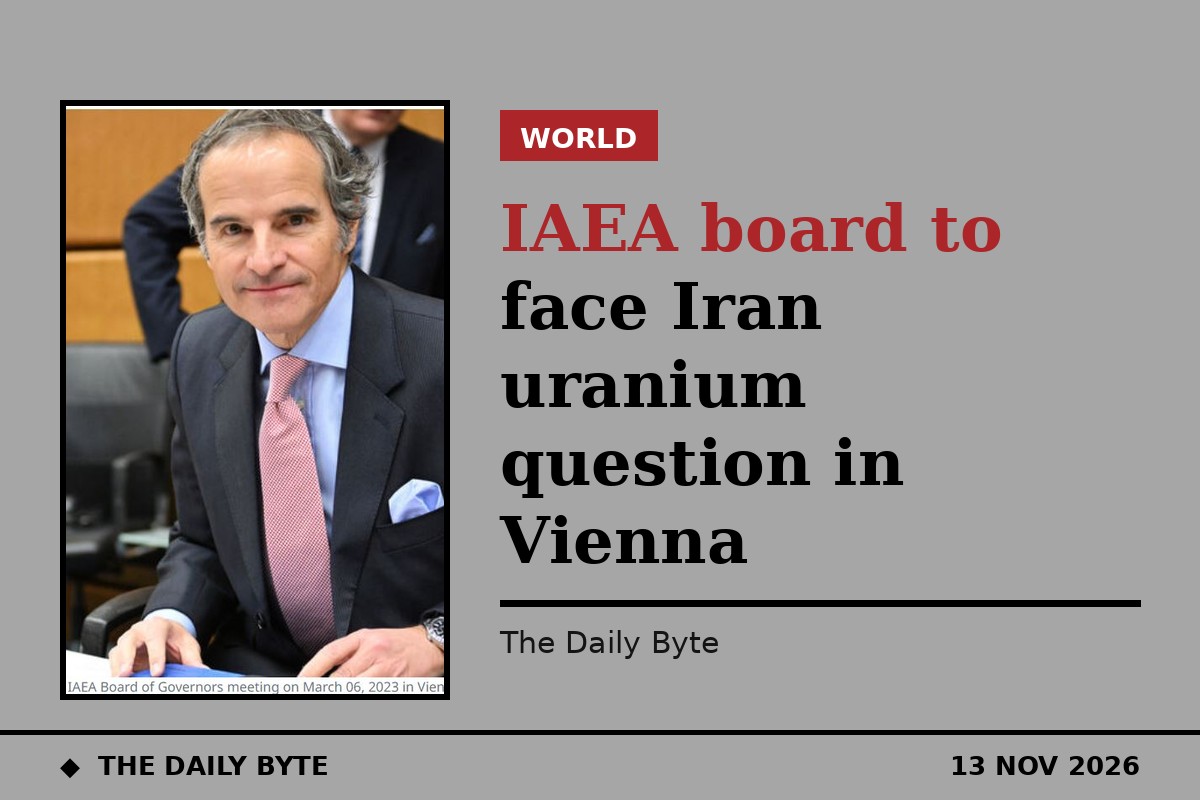
The board of the International Atomic Energy Agency (IAEA) will meet in Vienna next week with one question dominating its agenda: the fate of Iran’s 440.9 kilograms of uranium enriched to 60 per cent, which inspectors have not been able to verify since June 2025?
The IAEA said its Board of Governors will convene its regular November meeting at the agency’s headquarters in Vienna, opening on Wednesday, 18 November, with Iran’s Nuclear Non-Proliferation Treaty (NPT) safeguards file on the agenda.
Director General Rafael Grossi will open the meeting and hold a press conference at 12:30 CET on 18 November.
The 440.9kg question
Uranium enriched to 60 per cent purity is a short technical step from the roughly 90 per cent level generally treated as weapons grade. Before the Israeli and US strikes on Iranian nuclear sites in June 2025, the IAEA recorded that Iran held 440.9 kilograms of uranium enriched to that level, as of 13 June 2025. That figure is the last verified count the agency has, and it has not been able to update it since.
Mr Grossi told the Security Council on 27 October that the agency “has not been able to verify that there has been no diversion of nuclear material” and that it “cannot provide any information on the current size, composition or whereabouts of the stockpile”. The agency describes the situation as a loss of continuity of knowledge: inspectors were withdrawn from Iran for their safety after the June 2025 strikes began, and they have not been authorised to return to the damaged sites.
According to the European Union’s statement to the board, Iran has granted the agency access to only one of its 22 facilities, the Bushehr nuclear power plant. The IAEA’s own yardstick holds that 440.9 kilograms of 60 per cent material, if enriched further, would be enough for about 10 nuclear weapons, according to Reuters. Iran has long maintained that its programme is peaceful.
What the board can and cannot do
The November session is the first regular board meeting since the governors referred Iran to the Security Council on 9 September 2026. That resolution, sponsored by the United States, Britain, France and Germany, passed by 23 votes to three, with eight abstentions. Russia, China and Niger voted against it. It was the first time the board had referred Iran to the Council in 20 years.
The board cannot impose sanctions. That power sits with the Security Council, where Russia and China hold vetoes. What the board can do is adopt resolutions that record findings, set deadlines for access, demand declarations of remaining stocks and require the Director General to report back by a fixed date. It can also choose, as it has done before, to defer action and give diplomacy more room.
Tehran rejects the reinstated Security Council resolutions requiring it to suspend enrichment, saying its safeguards agreement contains no wartime provisions and that the attacks themselves disrupted verification.
The Qatar bridge deal
The most important development ahead of Vienna arrived on 7 November, when the Associated Press reported that Iran is reviewing proposals presented by Qatar, the chief mediator between Washington and Tehran. According to officials from both West Asian countries, speaking anonymously, the two sides have discussed a bridge deal of trust-building measures spread over two days.
Under the reported proposal, the United States would lift its blockade of Iranian ports and release some frozen Iranian funds, and in return Tehran would allow IAEA inspectors into the bombed sites. On the second day, Iran would reopen the Strait of Hormuz under a modified agreement with Oman that the United States has not approved, with extensive talks on the stockpile to follow.
Tehran’s conditions for engaging at all remain steep. The same officials said Iran is unwilling to negotiate on its atomic activities until the US agrees to several core demands: ending the blockade, lifting sanctions, unfreezing assets, paying compensation for war damage and ending hostilities across the region, including Israeli operations in Lebanon. President Donald Trump said on 7 November that mediators’ discussions with Iran continue. “We are talking to Iran. We have been,” he said.
What happens next
The timing matters for Vienna. If inspectors are back inside the bombed sites before 18 November, Mr Grossi would arrive at the board with something concrete to report, and the Western sponsors would have reason to hold off a new resolution. If the bridge deal stalls, the session is more likely to produce a further resolution setting a deadline for access.
Mr Grossi has also asked for access to the Isfahan Fuel Enrichment Plant, a site Iran declared in June 2025 that has never been inspected. Either way, the board’s debate will be read in both capitals as a signal of how much time diplomacy still has.


