IAEA Cannot Locate Iran's Isfahan Enrichment Plant
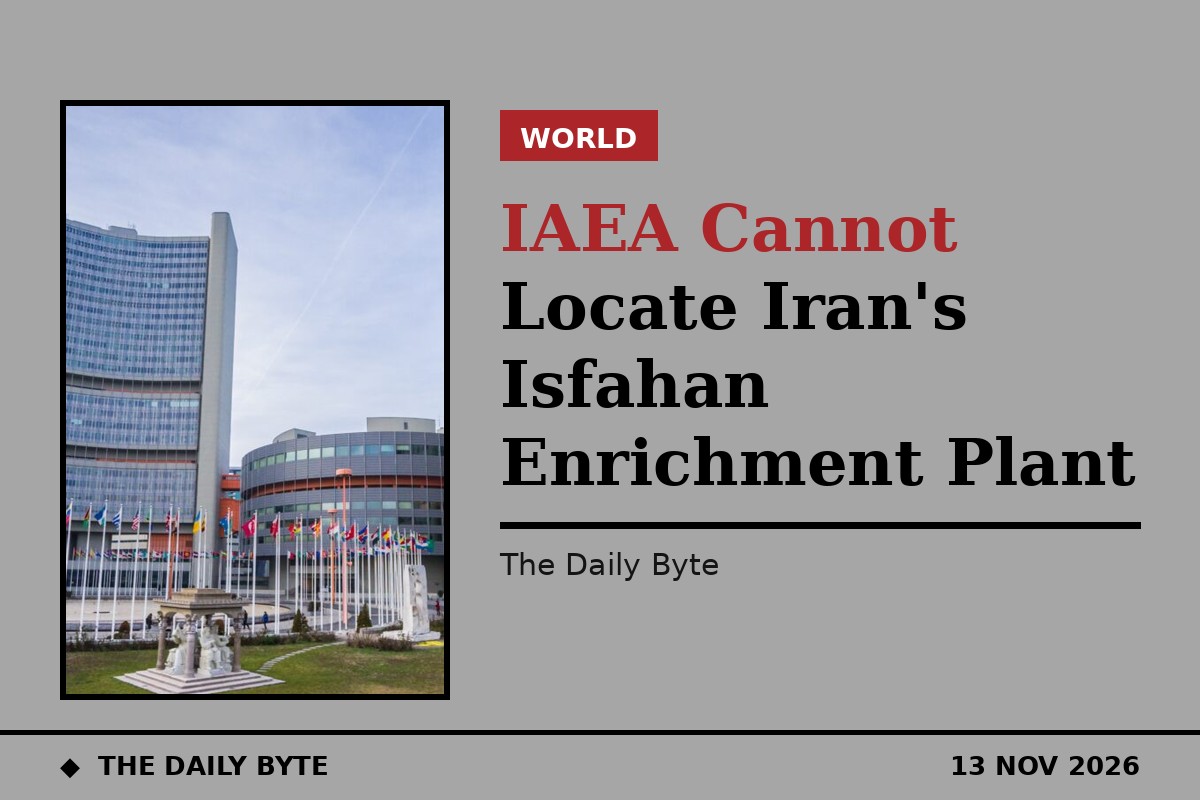
The United Nations nuclear watchdog said on Friday, 13 November 2026, that it does not know where one of Iran's declared uranium enrichment plants is, whether it is operating, or whether it contains nuclear material.
The International Atomic Energy Agency (IAEA) said it was "increasingly concerned" about the Isfahan Fuel Enrichment Plant, known as IFEP, in a confidential quarterly report circulated to member states in Vienna and seen by Reuters.
"The Agency does not know IFEP's exact location, status for safeguards purposes or whether it contains nuclear material," the report said, adding that the agency was also increasingly concerned that Iran had not permitted it to inspect the plant or see its design plans.
A plant declared but never inspected
Iran declared the underground plant to the IAEA on 12 June 2025. The agency had planned to inspect it the following day, 13 June, but a bombing campaign that began that day made the visit impossible, Reuters reported.
Diplomats believe IFEP is situated within an underground tunnel network at Isfahan that was among the targets of the strikes, although a senior diplomat said its precise location and current condition remain unknown. Satellite imagery has since detected vehicle activity near the tunnel complex, according to reports of the IAEA findings.
IAEA Director General Rafael Grossi said in March that his agency believed a significant amount of Iran's most highly enriched uranium was in the tunnel complex at Isfahan.
440 kilograms of uranium enriched to 60 percent
The report also reiterated that Iran should inform the IAEA of the status of its enrichment plants and its stock of highly enriched uranium, and let inspectors return to the bombed sites and account for the enriched uranium.
The agency's last verified figure dates from 13 June 2025: 440.9 kilograms of uranium enriched to 60 percent purity, a short step from weapons grade. The IAEA said it was not able to conclude that there had been no diversion of declared nuclear material in Iran.
"The Agency's lack of information about this nuclear material and access to facilities to verify it is a matter of serious proliferation concern ... and needs to be rectified with the utmost urgency," the report said.
No access since the June 2025 strikes
Iran has not let IAEA inspectors return to any of its nuclear facilities bombed by Israel and the United States in a 12-day campaign in June 2025 that destroyed or badly damaged its other uranium enrichment plants, Reuters reported. Inspectors have visited only one Iranian site since then: the Bushehr power reactor, from 12 to 15 September 2026.
Iran told the agency this month that talks on bringing inspectors back cannot go ahead amid what it described as persistent, explicit and public threats by the President of the United States to attack it again. Grossi urged Iran to consider technical and gradual measures that would let inspectors return, and the agency said it was fully prepared to resume safeguards activities in Iran at short notice.
The dispute has also reached the United Nations Security Council. In September 2026, the IAEA Board of Governors adopted a resolution formally referring Iran's nuclear file to the council over its continued failure to comply with safeguards obligations.
The report made no claim that enrichment is taking place at Isfahan, and offered no evidence that Iran has built a weapon. Its point, as set out in the report, is that the agency cannot establish either way without access.


