ICJ rules Myanmar committed Rohingya genocide
The International Court of Justice has ruled that Myanmar committed genocide against the Rohingya Muslim minority in 2017, the first time the court has held a state responsible for genocide in its 80-year history.
The judgement, delivered in The Hague on Thursday 19 November, was decided by nine votes to six. Presiding judge Iwasawa Yuji read the ruling over nearly three hours, finding that the scale and nature of Myanmar's atrocities showed an intent to destroy a substantial part of the Rohingya group in northern Rakhine State.
The court found that Myanmar's military carried out mass executions of men and boys, widespread rape and sexual violence against Rohingya women, and burned or razed hundreds of villages during so-called clearance operations. It gave particular weight to indiscriminate killings, extreme violence against children, and attacks on Rohingya as they fled in large numbers towards Bangladesh.
Myanmar had argued that its operations were a legitimate counterterrorism campaign against a Rohingya insurgent group. The court rejected that defence, finding that the military did not distinguish between militants and civilians, and concluding that the only reasonable inference from its actions was an intention to destroy the Rohingya population in northern Rakhine State.
Myanmar rejects the ruling as unfair
Myanmar's military-backed government dismissed the verdict on Friday. Government spokesperson Khaing Khaing Soe told a press conference in the capital, Naypyitaw, that the decision was unfair and that the country had been unjustly accused.
"Our country was unjustly accused," she said. "I want to say that this decision is not a unanimous decision by everyone, it is not fair."
The case was brought by The Gambia in November 2019 under the 1948 Genocide Convention. The Gambia welcomed the ruling with what it called profound satisfaction, and urged Myanmar to comply fully and without delay. The United States and Canada had previously declared the atrocities to be genocide.
Reparations and the question of return
The court ordered Myanmar to make reparations to the Rohingya, with the terms to be decided at a later stage. It also ordered Myanmar to allow and facilitate the safe, voluntary and dignified return of refugees to their places of residence, to reunite families, to return property lost or damaged, and to ensure their future protection from discrimination and persecution.
The court's rulings are final and binding, but it has no power to enforce them; its orders go to the United Nations Security Council.
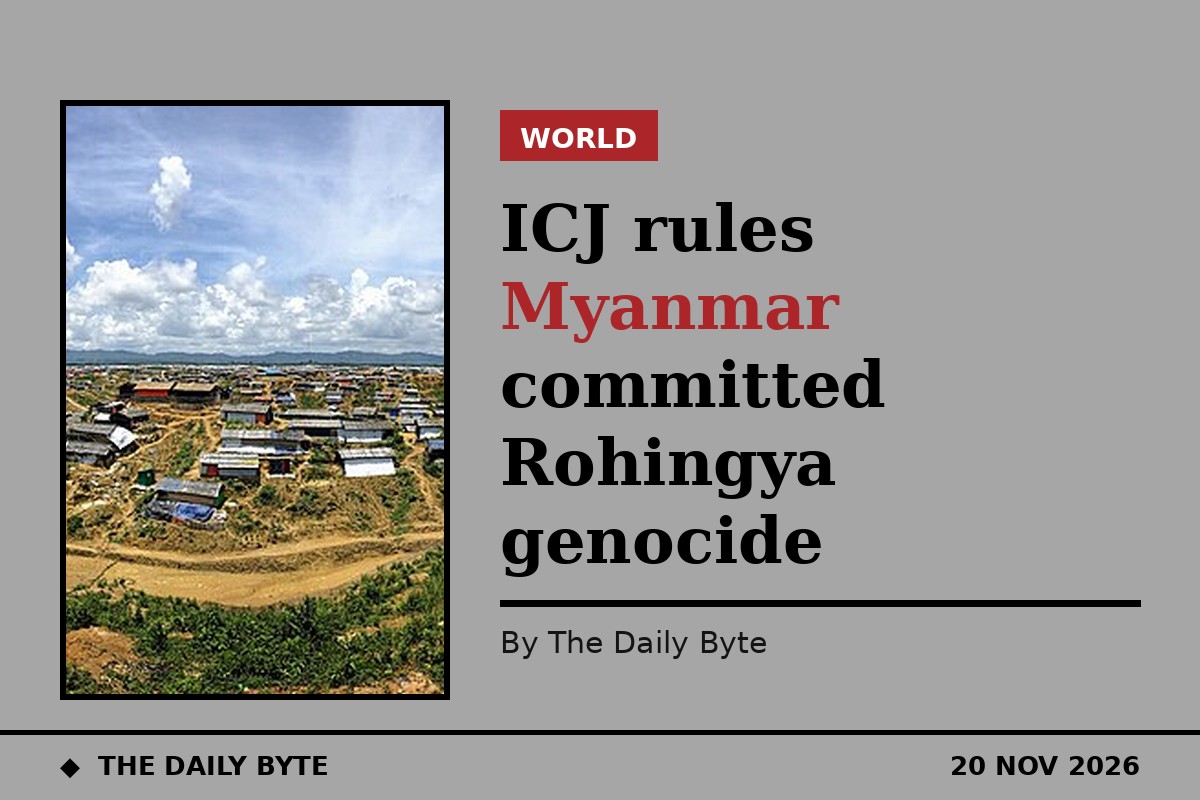
About 750,000 Rohingya fled to Bangladesh during the 2017 campaign. The camps in Cox's Bazar have since become the world's largest refugee settlement, hosting more than 1.2 million people.
Bangladesh welcomed the ruling and said repatriation remained the only viable solution to the crisis. Its state minister for foreign affairs, Humaiun Kobir, told Reuters on Friday that Dhaka would press multilaterally for safe passage for returns within one to one and a half years, while accepting that it would not happen soon. Myanmar said in August that it had verified 308,797 people living in the camps as former residents of Rakhine State, but that repatriation would begin only when security conditions there improved.
What return would mean in practice
What the refugees would return to remains deeply uncertain. The military-backed government does not control most of Rakhine State: the Arakan Army, an ethnic armed group, has seized nearly all of it since renewed fighting erupted in late 2023, and has itself been accused of atrocities against civilians. The military has responded to its territorial losses with airstrikes on civilian markets and hospitals.
For survivors, the verdict itself carried weight even though it changes nothing on the ground for now. Murshid Alam, 22, who fled Rakhine State as a 12-year-old and now leads the Rohingya Youth Union in the Cox's Bazar camps, said the ruling told his community that the world saw its suffering and refused to let it be erased. "The Rohingya do not want to live in refugee camps forever," he said. "We want to return to our homeland in Rakhine state with our rights, our citizenship, and our dignity fully restored."
United Nations human rights chief Volker Türk called the judgement historic, while Amnesty International described it as a rare moment of justice for survivors, victims and their families after years of denial and impunity. The United States said it was studying the decision to assess its implications, stressing the importance of preventing the court from being politicised.
Sources: Reuters, "Myanmar calls ICJ ruling on genocide 'unfair'" and "Reactions as top UN court finds Myanmar guilty of genocide against Rohingya"; CNN, "In historic first, UN top court rules a country committed genocide".


