ICJ to Rule on Myanmar Genocide Case on Thursday
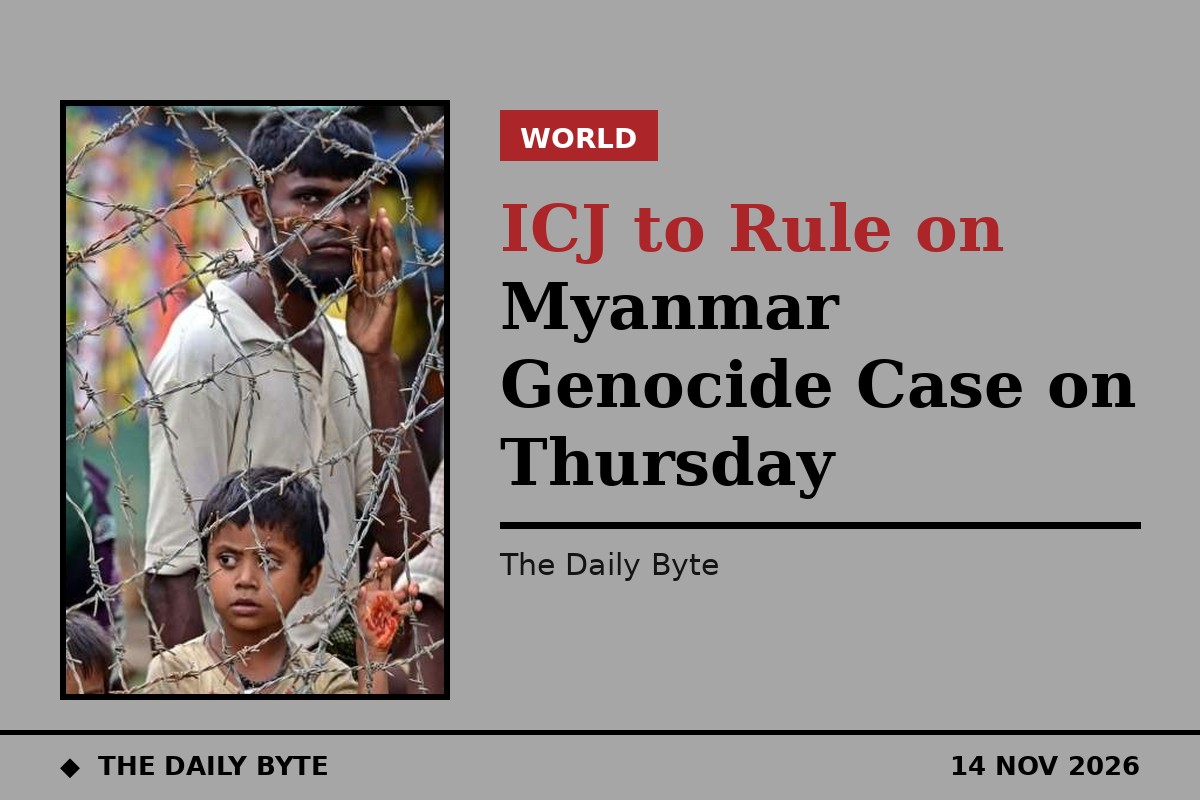
The International Court of Justice will deliver its judgment on Thursday 19 November on whether Myanmar committed genocide against its Rohingya minority, in a ruling that lands in the middle of a week of high-stakes diplomacy over the country's future. The public sitting will take place at 10 a.m. at the Peace Palace in The Hague, where the court's president, Judge Iwasawa Yuji, will read out the judgment.
The case was brought by The Gambia in November 2019 under the Genocide Convention, over a military campaign in 2017 that drove nearly 750,000 Rohingya from Myanmar's Rakhine State into Bangladesh as refugees. The Gambia asks the court to declare that Myanmar breached the convention by committing genocide, conspiring to commit genocide, and failing to prevent and punish it. Myanmar denies committing genocide.
Seven years in the making
The court ordered provisional measures in January 2020, requiring Myanmar to take all steps within its power to prevent genocidal acts against the Rohingya. Public hearings on the merits were held from 12 to 29 January 2026, with witnesses and an expert called by both sides, and judges began their deliberations on 29 January. Eleven states intervened in the proceedings, including the United Kingdom, Canada, Germany, France and the Netherlands.
The judgment will be final, with no appeal. If the court finds that Myanmar committed genocide, it would be the first time the world court has found a state itself guilty of genocide. The ruling will weigh state responsibility, not individual guilt, and the court has no police force of its own to enforce its decisions.
A verdict that shadows the ASEAN summit
The ruling falls in the same week that leaders of the Association of Southeast Asian Nations meet in Manila from 15 to 17 November to debate whether to keep Myanmar's leaders frozen out of summits since the 2021 coup. Rohingya activists say the pending judgment should weigh on leaders' minds. "We are waiting to see what the outcome will be on that day, the judgement for everything we have been experiencing for generations," said a 25-year-old Yangon-based Rohingya activist who asked not to be named for security reasons.
Both questions converge on one man: Min Aung Hlaing, who led the military during the 2017 campaign and was installed as president in April after elections rejected by democracy watchdogs. He has since received red-carpet welcomes in Thailand, Cambodia, Laos and Vietnam, and even Muslim-majority Malaysia hosted him last month. Prime Minister Anwar Ibrahim promised Malaysia would do "whatever is possible" to smooth Myanmar's return to normal standing in ASEAN.
Richard Horsey, senior Asia adviser at the International Crisis Group, said the ruling may have little effect on that momentum. "Governments willing to host him are unlikely to change course over a ruling addressed to the Myanmar state, which places no legal restriction on him personally," he said. Thai Foreign Minister Sihasak Phuangketkeow said on Thursday he did not foresee the ruling disrupting ASEAN's process of "calibrated re-engagement". Independent Myanmar analyst David Mathieson said ASEAN was unlikely to fully embrace Min Aung Hlaing at summit level soon, adding: "But it's only a matter of time."
Sources: AFP and International Court of Justice press release.


