IGAD's New Treaty Takes Effect After Five States Ratify, Replacing 1996 Agreement
By The Daily Byte
·18 Nov 2026
·4 min read
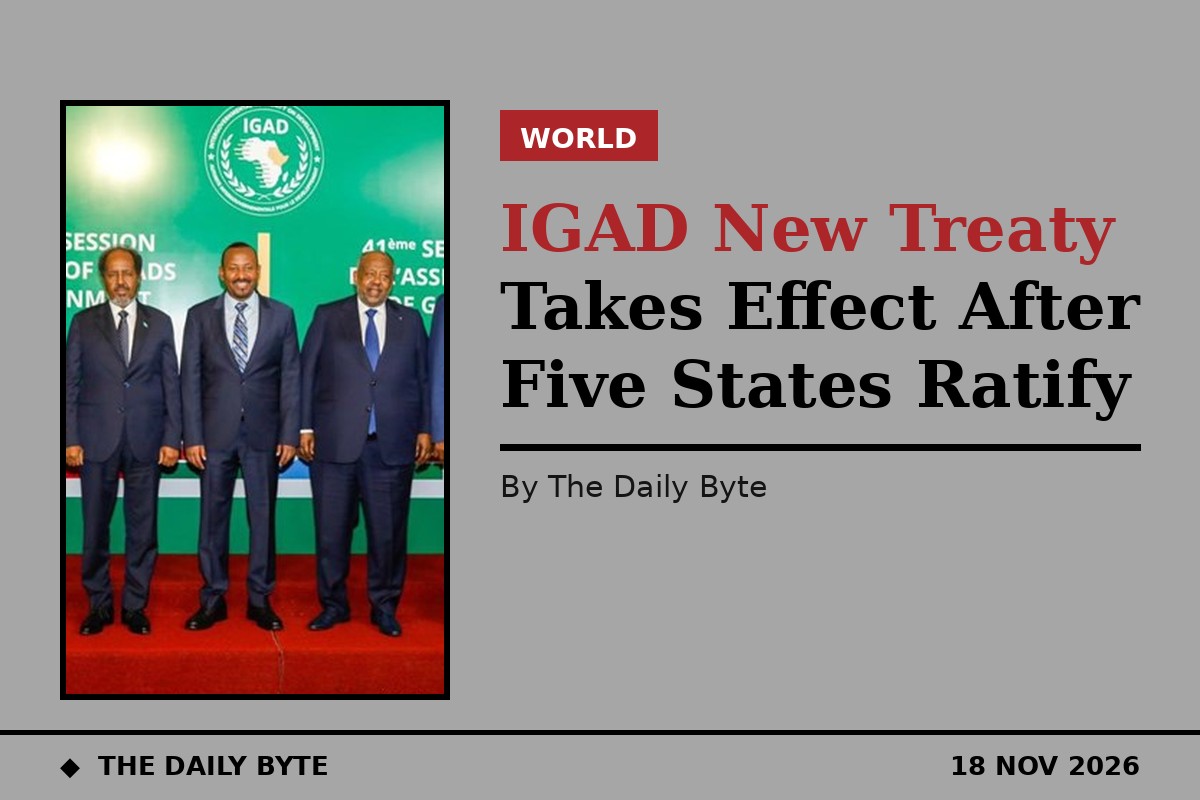
The Intergovernmental Authority on Development (IGAD) has begun operating under a new founding treaty, after the agreement entered into force on Monday, 16 November 2026, replacing the framework that had governed the Horn of Africa bloc since 1996.
Djibouti, which currently chairs IGAD, announced the milestone on Tuesday, describing it as "a decisive turning point" for regional integration. The announcement came in the year IGAD marks its 40th anniversary, and it follows Somalia becoming the fifth member state to ratify the treaty, meeting the required two-thirds threshold.
The treaty gives IGAD what Djibouti called "a modernised legal and institutional framework" to respond to challenges including peace and security, climate resilience, infrastructure, health, trade and social development. Djibouti's statement, carried by the state news agency ADI, added: "In a region facing persistent challenges, where conflicts continue to displace populations, droughts threaten livelihoods and young people aspire to new prospects, strengthening collective action is a strategic necessity."
## How the treaty came into force
The treaty was adopted on 12 June 2023 at the 14th Ordinary Session of IGAD's Assembly of Heads of State and Government in Djibouti. It then remained dormant while member states completed their domestic approval processes.
Under Article 59 of the treaty, it enters into force 60 days after two-thirds of IGAD's member states deposit their instruments of ratification with the Executive Secretary, who acts as depositary. Five of the bloc's seven members have now done so: Djibouti, Ethiopia, Kenya, Somalia and South Sudan. Somalia's House of the People approved the treaty in January 2026, completing the threshold.
At its 74th Extraordinary Session in Djibouti on 15 September 2026, IGAD's Council of Ministers welcomed the attainment of the threshold and endorsed the treaty's formal entry into force. Sudan and Uganda have yet to ratify it. IGAD's Executive Secretary, Workneh Gebeyehu, has urged the two remaining countries to complete their processes. IGAD's own account of the treaty and its entry into force is published on its official site: [IGAD — The 2023 IGAD Treaty](https://igad.int/treaty/).
## What changes — and what does not
With the new treaty in force, the 1996 agreement that established IGAD in its current form no longer has legal force. Existing institutions and decisions continue, with adjustments required to bring them into line with the new framework.
IGAD says the treaty provides a stronger framework for cooperation on easing the movement of people, labour, goods, services and capital, as well as on conflict prevention, food security, climate resilience, health and education. The organisation has been careful to add that these objectives will be achieved through coordinated regional action and national implementation, and are "not automatic entitlements arising on the date of entry into force". In other words, the treaty does not by itself create new travel or work rights for citizens of member states.
That distinction matters in a region where the practical effects of regional agreements often depend on national laws and border arrangements. Entry into force marks the beginning of implementation, not the end of the process, as IGAD itself puts it.
## A bloc built on drought — now facing wider pressures
IGAD was founded in 1986 by six countries — Djibouti, Ethiopia, Kenya, Somalia, Sudan and Uganda — as an authority focused on drought and development.
The bloc's agenda has widened considerably since then. Its members now face overlapping pressures: the civil war in Sudan, renewed fighting in parts of Ethiopia, the long-running fight against al-Shabaab in Somalia, drought and food insecurity across the Horn, and the strain of hosting large displaced populations. The new treaty is intended to give the secretariat a firmer legal footing to coordinate responses that cross national borders.
Whether it does so in practice will depend on the two states that have not yet ratified, on funding, and on whether governments follow through with the national laws and joint programmes the treaty envisages. For now, the entry into force is a legal milestone — the framework is in place, and the work of putting it into effect is only beginning.
## Frequently asked questions
**Which countries have ratified the new IGAD treaty?**
Five of the seven member states: Djibouti, Ethiopia, Kenya, Somalia and South Sudan. Sudan and Uganda have yet to complete ratification.
**When did the treaty take effect?**
It entered into force on Monday, 16 November 2026, 60 days after the required two-thirds of member states had deposited their ratification instruments, as set out in Article 59.
**Does the treaty give citizens new rights to live or work in other IGAD countries?**
No — not automatically. IGAD says freer movement of people, labour, goods, services and capital is an objective to be achieved through coordinated regional action and national implementation, not an entitlement that arises on the date of entry into force.


