IIT Madras to build Thirukkural pico AI language model
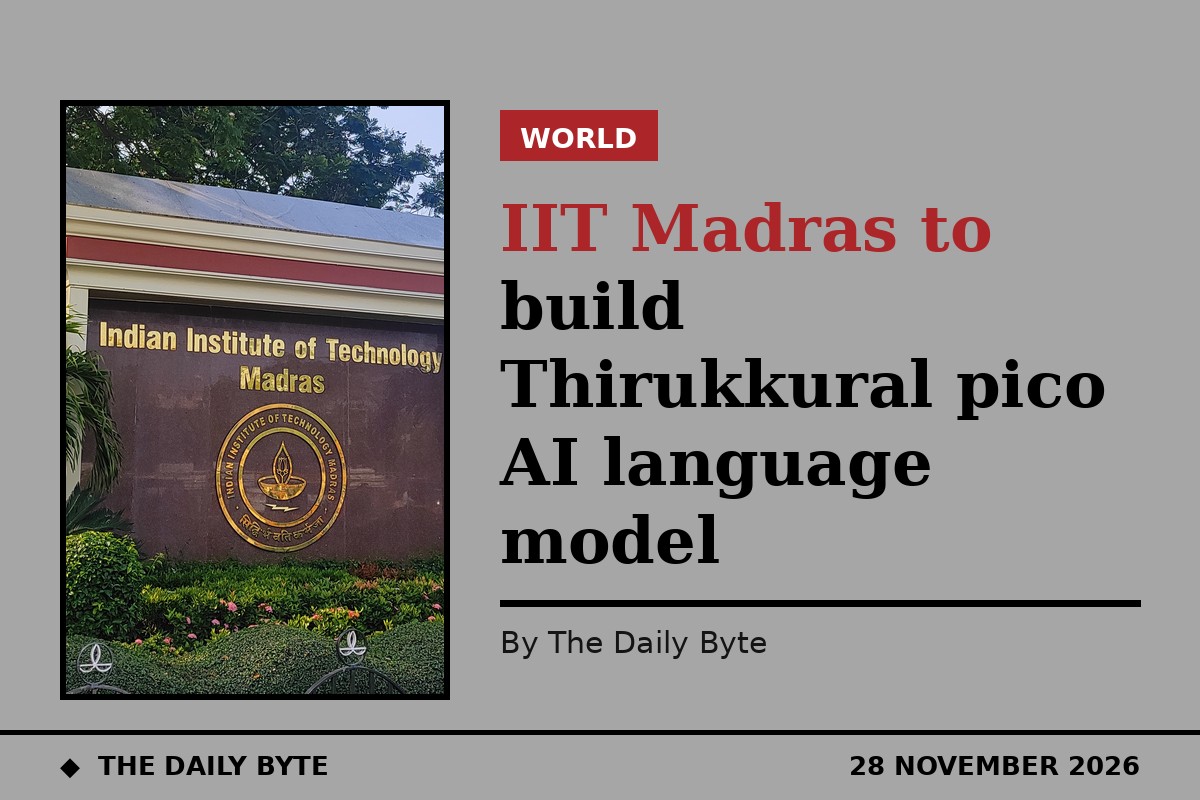
The Indian Institute of Technology Madras (IIT Madras) is developing a new artificial intelligence language model built around the Thirukkural, the classical Tamil text by Thiruvalluvar, to help people understand its teachings and apply them in daily life. Director Professor V Kamakoti told The New Indian Express about the project on 28 November 2026.
Professor Kamakoti described the project as a "pico language model". It will have fewer than one billion parameters, use the transformer architecture that underpins modern language models, and be engineered at the IIT Madras Pravartak Technologies Foundation.
Unlike projects that adapt an existing large language model, the institute plans to build a new, compact model from scratch. The approach echoes other small, Tamil-first efforts such as Murai Labs' open Agaram 2.5B Tamil language model, which was also trained from the ground up rather than fine-tuned from a larger system.
What the model will be trained on
The training data will be a Tamil-language corpus, the Thirukkural itself, and its commentaries and interpretations from different periods. The broader corpus is meant to give the model its linguistic and textual foundation, rather than relying on the 1,330 couplets alone. The aim is a model that can explain Thiruvalluvar's teachings on ethics and principles of life and relate them to present-day situations.
No timeline for the model has been given. The project is at the planning stage: it has been announced, not shipped, and no release date or public demo has been promised.
Part of a wider push for Indian-language AI
Professor Kamakoti said the initiative is part of the institute's broader efforts to promote AI for education and support Indian languages. He added that the Thirukkural-based model complements the focus of Kashi Tamil Sangamam (KTS) 5.0, the cultural festival running from 28 November to 12 December 2026, which aims to popularise the classical Tamil text across the country. For the first time, the festival extends beyond Varanasi to 1,000 higher education institutions.
He also noted that translations of the Thirukkural already exist in several languages, and said AI platforms such as Sarvam AI and BharatGen could support the wider goal of making its teachings accessible to more people. BharatGen recently released Patram 1.5, an open model for reading Indian documents.
The project adds to IIT Madras' growing AI portfolio. The institute's Centre for Responsible AI published a white paper on 19 November proposing a frugal AI framework for India, arguing that institutions should use the smallest model that does the job, and its technology is behind a language model the Comptroller and Auditor General of India plans to launch for public auditors.
The Thirukkural model fits that pattern: a small, purpose-built system for a specific cultural and educational job, rather than a frontier-scale model. If it is built as described, it will be one of the few language models in the world trained from scratch around a single classical text.


