Illumina Wins Virtual Cell Challenge With AI
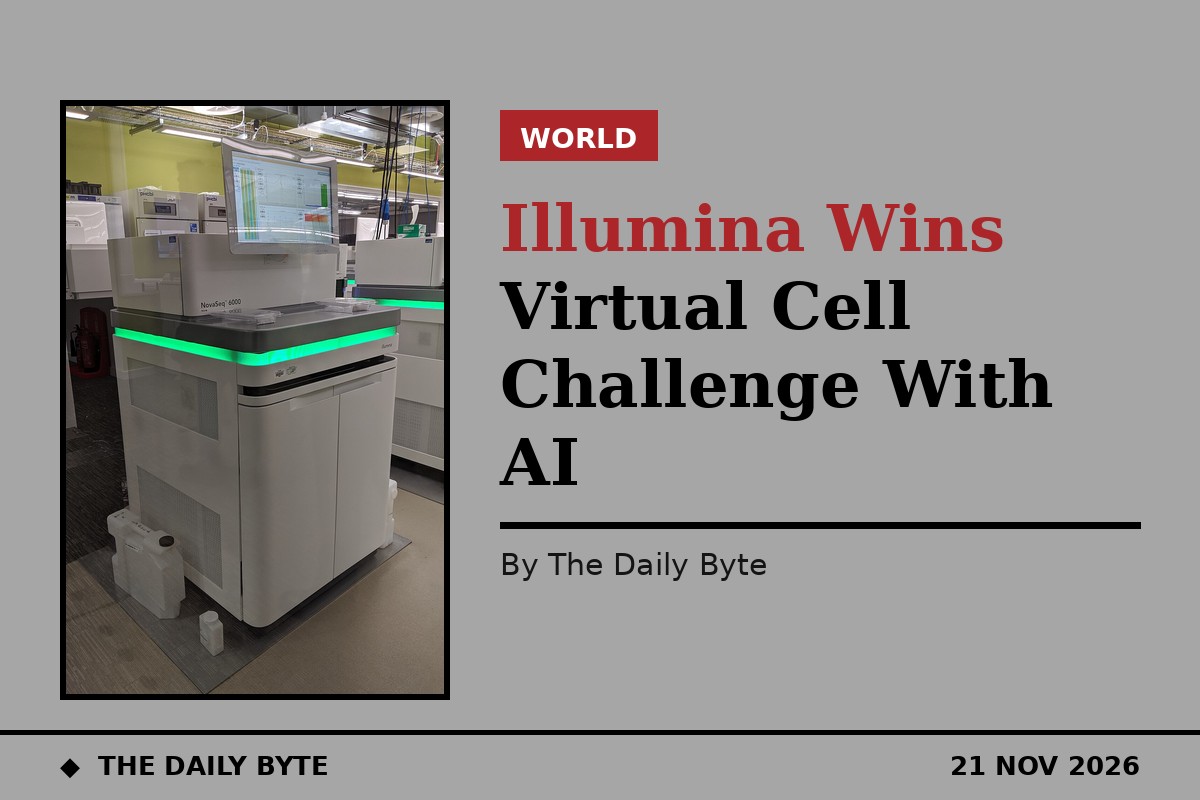
Illumina has won the 2026 Virtual Cell Challenge, the contest run by the Arc Institute to test how well artificial intelligence can predict the behaviour of living cells. The genomics company announced on 19 November that its BioInsight AI Lab took first place out of about 1,500 competitors, using a new algorithm called CellularAI and data from its Billion Cell Atlas.
The challenge asked teams to predict how cells would respond when a gene was knocked down, working only from the cells in their unperturbed state. The predictions were scored against experimental data generated by Arc and kept hidden from the entrants, so the ranking reflects how closely the forecasts matched real laboratory results rather than how large a team's dataset was.
Illumina's winning entry scored 0.440 on the final test. FlowState finished second with 0.3348, and X-team from Xaira Therapeutics took third with 0.3263. The gap between first and second place was the widest on the leaderboard, and Arc said Illumina held first place on both of its scoring boards throughout the final stage.
What CellularAI does
CellularAI is designed to predict how a cell responds to a genetic perturbation, the kind of change produced by editing or switching off a gene. The Billion Cell Atlas supplies the training data: Illumina describes it as the largest genome-wide genetic perturbation dataset in the world, capturing how individual cells respond to changes made with CRISPR gene editing across more than 200 disease-relevant cell lines. The data is being generated by Illumina together with selected pharmaceutical partners.
The combination matters because drug discovery depends on knowing what a genetic change will do in a cell type that has never been tested. If a model can predict that response reliably, researchers can screen targets and test ideas without running every experiment in the laboratory first. Illumina said the atlas and the algorithm together can help validate targets identified from human genetics, model disease-relevant cells and conditions, and work out how drugs produce their effects.
Illumina has released an open-source version of CellularAI alongside the result, so other researchers can examine the method behind the winning entry. The BioInsight AI Lab is run by Kyle Farh, Illumina's vice president of artificial intelligence, and the winning team also included Kishore Jaganathan, Eyal Ben-David, Atreyo Pal and Aniketh Janardhan Reddy.
A step towards predictive biology
Rami Mehio, senior vice president and general manager of BioInsight at Illumina, said: "The Billion Cell Atlas is quickly becoming a foundational dataset that we believe can help advance the field toward a future of predictive biology." He added that the result shows what can be achieved "when the right biological data is coupled with the right models".
The win is part of Illumina's wider ambition to build virtual cell models, computer models that can stand in for real cells when researchers study disease and test treatments. A virtual cell that predicts reliably would let scientists explore far more genetic changes than laboratory work alone allows, and could shorten the early stages of drug development.
There is still a long way to go. A competition win on hidden test data is a strong signal, but it is not the same as a model that works on every cell type, every disease and every genetic change. The open-source release means independent researchers can now test CellularAI on their own data, and that scrutiny will show how far the approach generalises beyond the challenge. For now, though, the result puts Illumina's combination of large-scale sequencing data and AI at the front of a field that many drug companies are watching closely.


