IMF: ASEAN Trade Reforms Could Add 4.3% to GDP
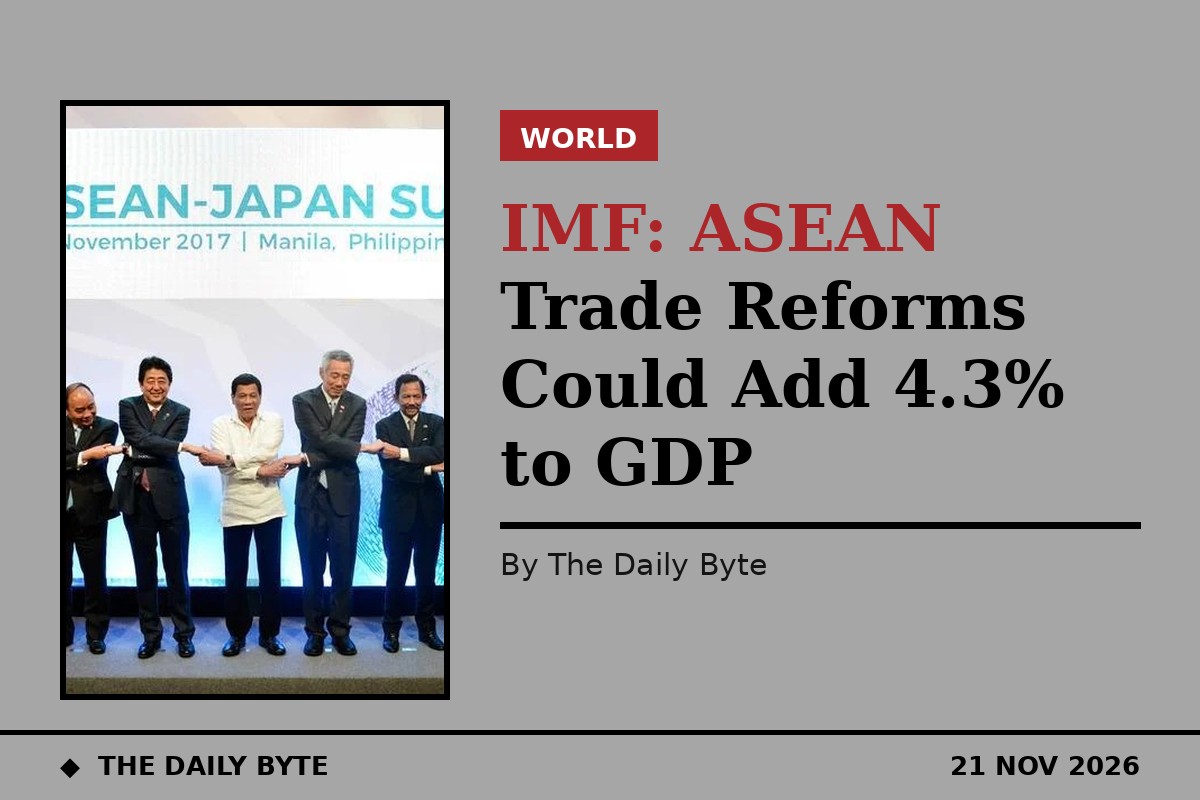
Southeast Asia could add 4.3 percent to its economy and create four million jobs by tearing down the barriers that stop its countries trading with each other, the International Monetary Fund has said, urging the region to turn its own market into its next engine of growth.
IMF Managing Director Kristalina Georgieva made the case on the sidelines of the 49th ASEAN Summit in Manila, telling the Philippine News Agency that the ten-member bloc’s economies still trade far more actively with the rest of the world than they do among themselves. “ASEAN still has enormous potential to trade more within ASEAN. These are open economies. They trade actively with the rest of the world but not so actively among themselves,” she said.
The IMF’s calculation is that eliminating non-tariff barriers across the Association of Southeast Asian Nations would lift the bloc’s combined gross domestic product by 4.3 percent over the long term, with services trade reforms alone contributing two and a half percentage points. With smart labour market policies alongside, the Fund estimates the reforms could create four million additional jobs.
Georgieva said accelerating regional integration was the priority of the Manila summit, describing it as a source of growth and of higher living standards across the region. “I am very impressed by the achievements in this year’s summit,” she said, singling out the Digital Economy Framework Agreement signed in Manila on 14 November as “a tremendous plus for ASEAN” and the key to accelerating trade, especially trade in services.
Why services trade matters most
The digital pact sits at the heart of the IMF’s argument. It is designed to improve digital connectivity and make cross-border business easier, with faster transactions, lower costs and companies able to operate more efficiently across ASEAN markets. Because services account for the largest slice of the projected gain, the agreement’s rules on digital trade are, in Georgieva’s words, “going to be very, very positive” for the region.
The Fund has long noted that trade within ASEAN makes up only just over a fifth of the bloc’s total trade, mostly in intermediate goods, compared with about 60 percent inside the European Union, where final goods dominate. Closing even part of that gap is the prize: the IMF has described the 4.3 percent boost as equivalent to adding more than a third of Malaysia’s current economy to the bloc.
The push comes against a difficult global backdrop. Georgieva told the summit that ASEAN faces fiscal and sustainability challenges as it pursues deeper integration in a fragmented and shock-prone world economy, but she called the region a bright spot, growing at 4.9 percent against a global average of 3.1 percent. The IMF says it remains committed to supporting the bloc as it upgrades the ASEAN Trade in Goods Agreement, frees up trade in services and deepens financial integration.
What it means for the Philippines
For the Philippines, the summit’s host, closer ties with its neighbours could strengthen its ability to withstand external shocks while opening new opportunities for investment, trade and employment. Georgieva pointed to the country’s advantages, including a young population, a creative workforce and people who adapt quickly to emerging technologies.
“So, on the ground of what we see here, I’m quite optimistic that accelerated integration in ASEAN is now a reality,” she said. The test now is whether the agreements signed in Manila turn into the freer movement of goods, services and data that the IMF’s numbers depend on — and whether the four million jobs the Fund projects follow.


