India makes digital citizenship certificates default
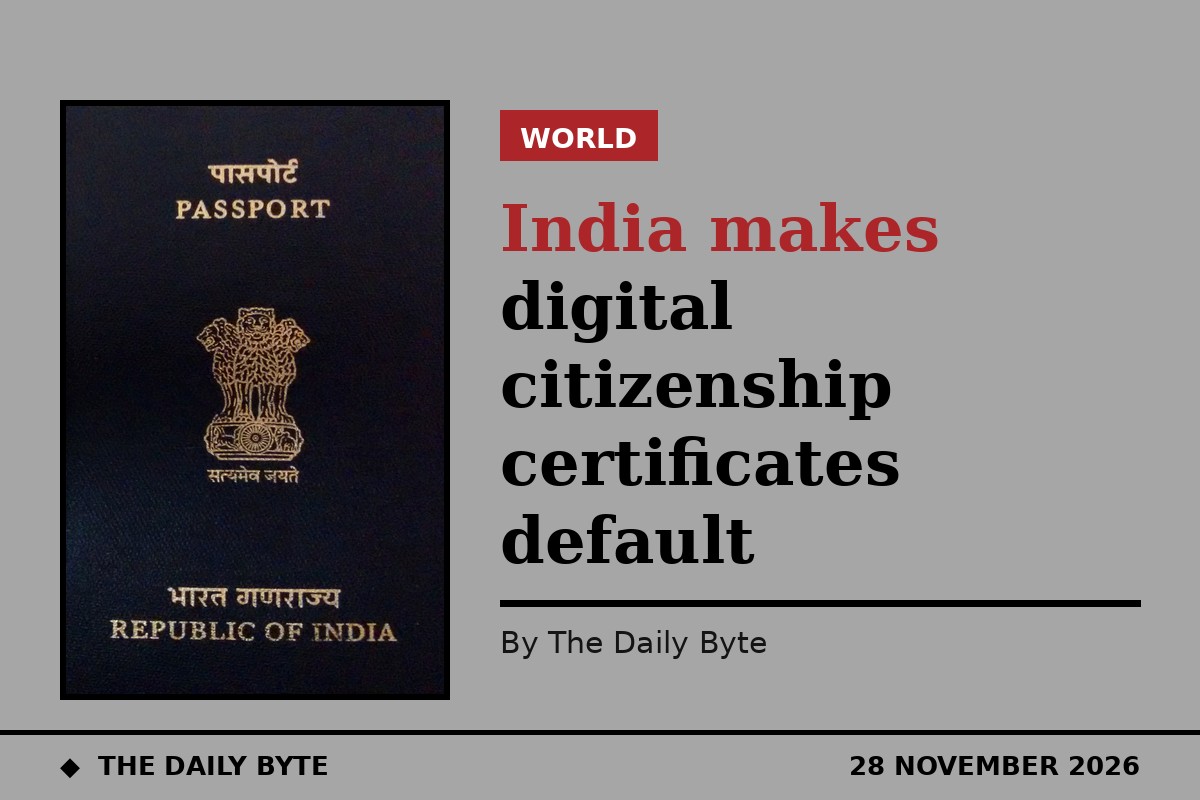
People who acquire Indian citizenship by registration or naturalisation will now receive a digital certificate as standard, under new rules notified by the Union home ministry on Friday. A paper certificate will be issued only if the new citizen asks for one.
The Ministry of Home Affairs has amended the Citizenship Rules, 2009, through the Citizenship (Fourth Amendment) Rules, 2026. The change makes digital certificates the default proof of citizenship for people who become Indian citizens later in life, rather than being born Indian citizens.
What changes
Under the amended rules, every person registered as a citizen of India will be issued a digital certificate of registration, in Form X, digitally signed or signed by an officer not below the rank of Under Secretary to the Government of India, or by an officer authorised by the central government.
The same approach applies to naturalisation. People who acquire citizenship through naturalisation under Section 6(1) of the Citizenship Act, 1955, will be issued a digital certificate of naturalisation in Form XII, signed by an officer authorised by the Centre. If they want a printed copy, they must place a specific request.
Applicants apply and follow the progress of their case through the home ministry's Indian Citizenship Online portal, and can obtain a hard copy of the application form if needed. The government says the digital-first approach is intended to make issuing citizenship documents faster and simpler, and to make the certificate easier to store and share.
Who it covers
The amendment covers applicants under Section 5(1)(a), (c), (d), (e) and (f) of the Citizenship Act. That includes persons of Indian origin who have been ordinarily resident in India for seven years, people married to an Indian citizen and ordinarily resident in India for seven years, minor children of Indian citizens, and people whose parents are registered as Indian citizens.
It also covers Overseas Citizen of India (OCI) cardholders who have held the card for five years and lived in India for 12 months before applying. OCI status itself is not citizenship: cardholders get a lifelong multiple-entry visa and parity with non-resident Indians in many economic matters, but cannot vote or hold constitutional office.
What does not change
The amendment changes how citizenship is proved, not who can acquire it. The conditions for registration and naturalisation, and the rights of a new citizen, remain as set out in the Citizenship Act. It also does not apply to citizenship by birth or descent, which is not covered by the new digital-certificate rule.
The next step to watch is how the change works in practice. Passport offices, banks and employers will need a reliable way to confirm that a digital certificate is genuine, and applicants with weak internet access or low digital literacy may find it harder to download, store or present the document. The government has not yet said whether a public verification check, such as a code on each certificate, will be offered. Until offices routinely accept the digital version without asking for paper, new citizens who need proof in person may still find it simpler to request the hard copy.


