India Launches Homegrown Chariot-1 AI Models
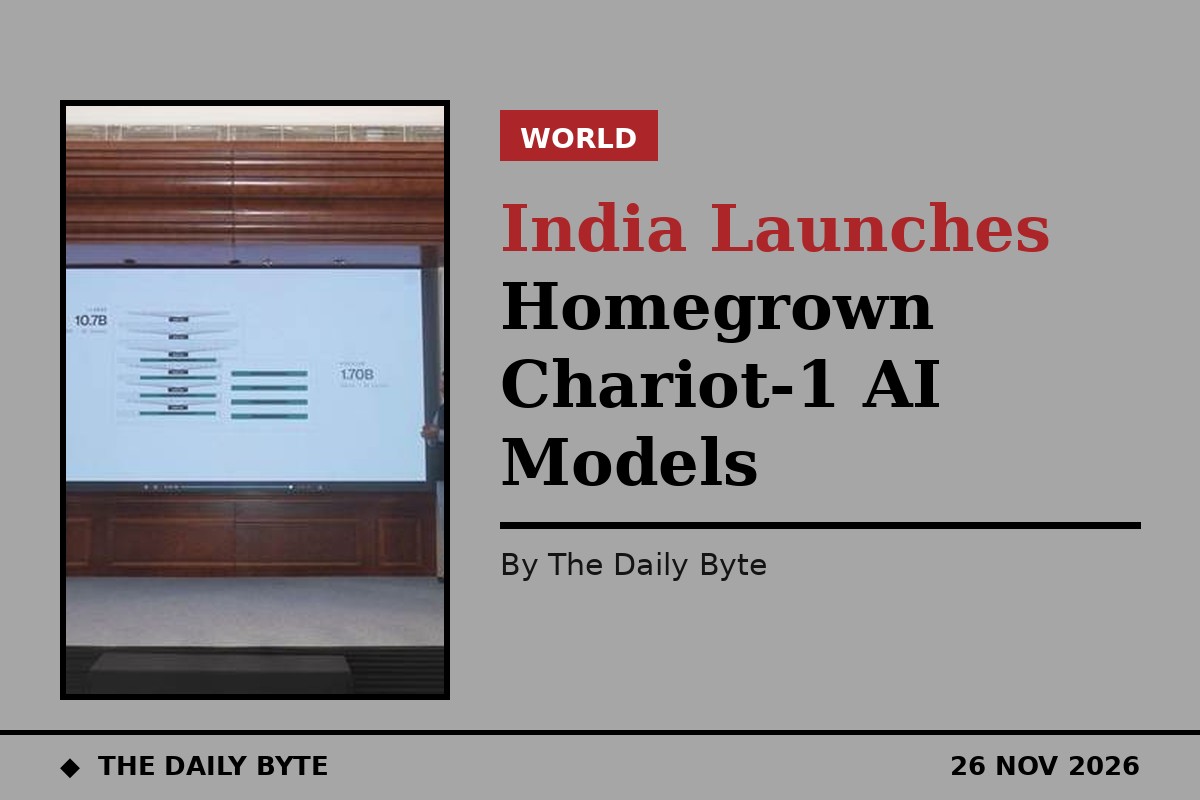
India has launched Chariot-1, a set of homegrown artificial intelligence foundation models built from scratch under the IndiaAI Mission, in a new step towards sovereign AI technology developed inside the country.
The launch was inaugurated by S. Krishnan, Secretary of the Ministry of Electronics and Information Technology (MeitY), at Bharat Mandapam in New Delhi on 25 November, with the official announcement published on 26 November. The models were developed by Chariot Artificial Intelligence Pvt. Ltd., one of the first four teams selected under the IndiaAI Mission to build sovereign foundation models.
The Chariot-1 suite comprises two models: a large language model and a text-to-speech model, both pre-trained from scratch in India rather than adapted from foreign base models. The government said the launch showed India’s growing capability to develop AI through homegrown research, and to reduce dependence on externally developed technologies.
What Chariot-1 contains
The Chariot-1 language model is an 11-billion-parameter mixture-of-experts design, with 4 billion parameters active per token. It is available in three sizes, at 10.7 billion, 1.7 billion and 745 million parameters, so it can be deployed in different settings, from data centres to laptops, smartphones and edge devices.
Alongside it, the Chariot-1 text-to-speech model generates speech in English and ten Indian languages: Hindi, Bengali, Marathi, Tamil, Telugu, Kannada, Malayalam, Gujarati, Punjabi and Odia. The speech model is designed to understand context and decide how numbers, dates, currencies, units, web addresses and abbreviations should be spoken aloud, which the developers say makes the output sound more natural.
On the government’s own pronunciation benchmark, the speech model recorded more than 97 percent verbalisation accuracy across 1,029 real-world sentences and 2,251 instances of non-standard text in 42 categories. It also recorded a Hindi character error rate of 7.60 percent and an average of 6.47 percent across nine other Indian languages, the lowest among the systems evaluated in the reported tests.
Three research ideas behind it
The launch showcased three research innovations built into the training of the Chariot-1 models. The first, IndicShift, is an open-source approach that introduces a shared alphabet for Indian scripts, covering 1,012 characters across 12 Indian scripts through 350 letters. According to the release, it uses up to 2.5 times fewer tokens on Indian text than OpenAI’s GPT tokeniser, and reports a 5 to 8 percent improvement in model performance on Indian languages on the same computing budget, while maintaining performance in English and code.
The second, Nested Training, trains all three model sizes at once through a single training run and one set of weights, instead of training each size separately. The release says this delivers a reported 62 percent improvement in training speed.
The third, Mixture of Vocabularies, divides the model’s vocabulary into 11 groups and scores only the relevant group at a time. That cuts the number of vocabulary entries scored per word by 5.7 times and delivers a reported 38 percent improvement in training speed on the same graphics processors, with negligible change in model loss.
Why it matters
Krishnan congratulated the Chariot team and described the launch as a significant achievement for India’s technology ecosystem, noting that the IndiaAI Mission was designed to nurture such talent. The two founders, Parth Sarthi and Suvrat Bhooshan, are Stanford graduates who returned to India to build the technology, and the event also featured a fireside conversation between Vishal Dhupar, managing director for South Asia at NVIDIA, and Bhooshan.
The launch comes as the government prepares its next steps on AI regulation. Asked on the sidelines of the event about the upcoming AI regulation papers, Krishnan said they were in the final stages and would be released shortly, according to The Hindu BusinessLine.
Chariot-1 is one of the first releases from the IndiaAI Mission’s sovereign foundation model programme, and its reception will be watched as an early test of whether government-backed funding for homegrown models can produce technology that developers and businesses actually use.


