India police use water cannon on Congress Meta protest
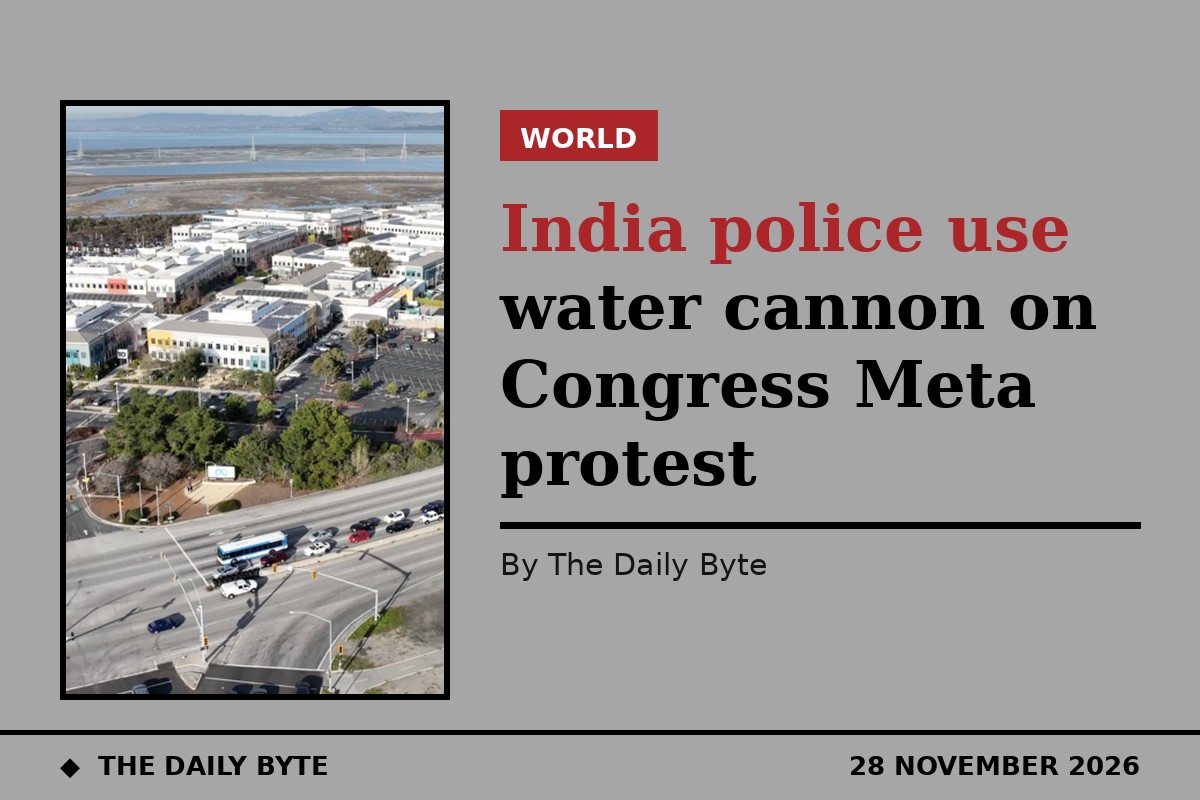
Police in the northern Indian state of Haryana used water cannon to disperse activists from the main opposition Congress party who were protesting outside the offices of Meta, the parent company of Facebook and Instagram, over allegations that the company is censoring opposition voices.
The protest took place on Saturday, 28 November, outside Meta's office in Gurugram. Activists from the Congress party's youth wing, the Indian Youth Congress, said they were hit with water cannon and drenched with what they described as filthy water. Police detained a few party supporters, but they were later released, according to a Reuters witness.
The youth wing has accused Meta of acting in the interests of Prime Minister Narendra Modi's Bharatiya Janata Party. Meta says it restricts content in India in accordance with local laws, and in a closed-door meeting with Congress leaders it said it remains neutral towards all political parties, according to people familiar with the matter. The company has not commented publicly on the protests.
The dispute is one of the most serious challenges Meta has faced in India, its largest market by number of users, with more than 500 million users. The demonstrations are not confined to Gurugram: Youth Congress workers have also staged protests outside Meta offices in Hyderabad and Mumbai.
From street protest to the courts
The row began after Instagram blocked the accounts of senior Youth Congress officials, including its chief, Uday Bhanu Chhib. Those accounts have since been restored, but the group clashed with police outside the company's offices and warned it would continue its campaign unless its leaders' accounts were reinstated.
The youth wing then took the fight to court. On 25 November it filed a case in the Delhi High Court, naming Meta and the Indian government as respondents. The petition challenges an automated takedown system that the party says is removing lawful political posts, including posts that carry the name or photograph of party leader Rahul Gandhi.
According to the filing, the posts at issue include a birthday greeting between party workers, a wedding invitation handed to Rahul Gandhi and a tribute to his father. The party says the only common element among them is Gandhi's name or photograph, and that posts blocked between 29 September and 23 November fall into this category. Each notice, it says, described the restriction as the result of an automated system implemented under legal requirements, without citing a court order or government direction.
The party argues that the restrictions threaten to cut it off from voters just as state elections approach in early 2027, when Facebook and Instagram are expected to play a central role in campaigning. Congress says the content restrictions put it at a disadvantage ahead of those elections. The BJP has not commented on the lawsuit, but it has described the protests as vandalism.
The rule behind the row
At the centre of the case is an amendment to India's information technology rules that came into force on 20 February. Under the revised rules, platforms must remove content deemed unlawful by an authority within three hours, rather than 36. Large platforms must also use automated tools to find and remove content exactly identical to material already flagged. The rules call for appropriate human oversight and periodic review of those tools for accuracy and bias, and platforms that fail to comply risk losing safe harbour, the legal protection that shields them from liability for user posts.
The effect on Meta's figures has been dramatic. The company restricted 5.44 million items in India in the first half of 2026, compared with 41,357 in the previous six months and nearly 70,000 across the whole of 2025. Meta attributes the jump to the automated detection of identical copies required under Indian law, rather than to a rise in the number of legal requests.
The Congress party is asking the court to strike down the automated takedown mandate, to order Meta to restore the blocked posts and to require the company to disclose the criteria it uses for blocking. Hearings are expected to begin in the coming days. How the Delhi High Court rules, and whether the government revisits the rule, will determine how far automated enforcement can go before it begins to restrict legitimate political speech.


