Delhi smog overwhelms pollution monitors as PM2.5 soars
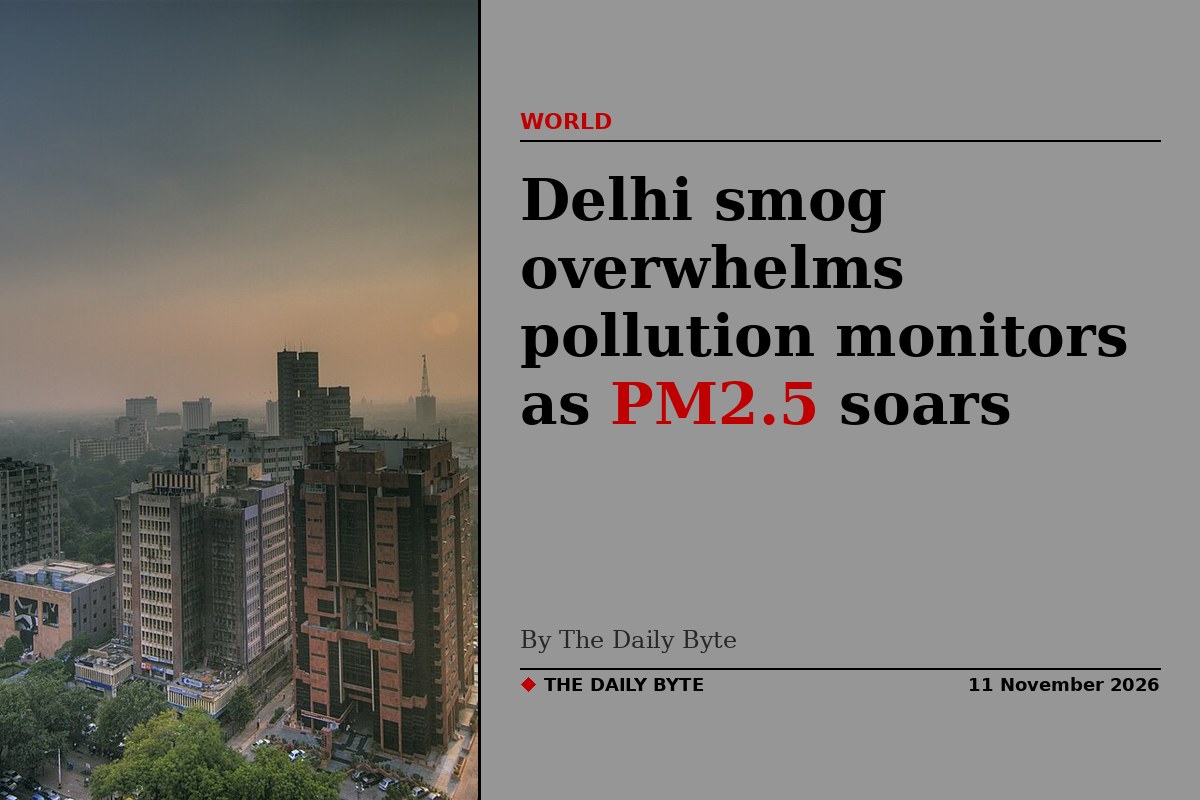
India's Central Pollution Control Board has said its air monitors in Delhi stopped recording at the worst of the Diwali smog because pollution rose beyond the range the instruments were built to measure. The board gave the explanation late on Tuesday after opposition politicians accused it of allowing gaps in official readings overnight on Sunday into Monday, just as fireworks for Diwali reached their peak.
The missing hours meant official data failed to capture the full scale of the pollution at its worst. The board rejected accusations of deliberate underreporting, saying the gaps reflected differences in how pollutant concentrations are measured rather than any attempt to conceal the scale of the problem.
Why the monitors went blank
The particulate matter analysers were installed when the National Air Quality Index was introduced in 2015 and were calibrated to measure concentrations of up to 1,000 micrograms per cubic metre. The World Health Organization recommends a daily maximum of 15 micrograms per cubic metre for PM2.5, the fine particles that can penetrate deep into the lungs, so the instruments' ceiling sits at about 66 times that recommended limit.
The board said its automated validation system treats hourly readings beyond the calibrated range as outside range, and such readings are not used in the calculation. It added that during extreme episodes, such as the bursting of Diwali firecrackers, this may appear as a data gap at the station concerned.
What the missing hours showed
Although thick smog filled the streets early on Monday, the scale of the pollution only became clear when monitors resumed reporting, around eight hours after the fireworks peaked. Readings then reached 879 micrograms per cubic metre in the Mandir Marg locality, according to monitoring organisation IQAir, citing data from a city government station. That is more than 58 times the WHO daily limit.
Delhi's own pollution control committee later released the missing hourly figures, which showed PM2.5 reaching 3,744 micrograms per cubic metre, more than 60 times India's national 24-hour standard of 60. By 1am on Monday, 36 of the city's 59 monitoring stations had gone blank in the central board's database.
Row over the gaps
Opposition leaders criticised the missing data. Saurabh Bharadwaj, the Delhi president of the Aam Aadmi Party, questioned in a video posted on X how a government that shuts down air quality monitoring on Diwali night could be trusted. Congress lawmaker Ajay Maken asked who would answer for the Diwali night PM2.5 figures missing from the record, while his colleague Pawan Khera said the missing data did not mean the pollution had disappeared.
The board said older instruments are being replaced and the monitoring network is being continuously expanded to avoid data lapses during extreme pollution episodes.
A familiar winter problem
New Delhi is one of the world's most polluted capitals, where winter smog from vehicle emissions, farm fires and industry chokes millions of people each year. Diwali fell on 8 November this year, and the city's average air quality index reached 376 on the day, its highest festival-day reading since 2021. Emergency curbs under Stage III of the Graded Response Action Plan have been in force since 6 November, restricting construction, older vehicles and industrial activity across Delhi and neighbouring districts.


