India third in Asia Power Index as Modi ranks second
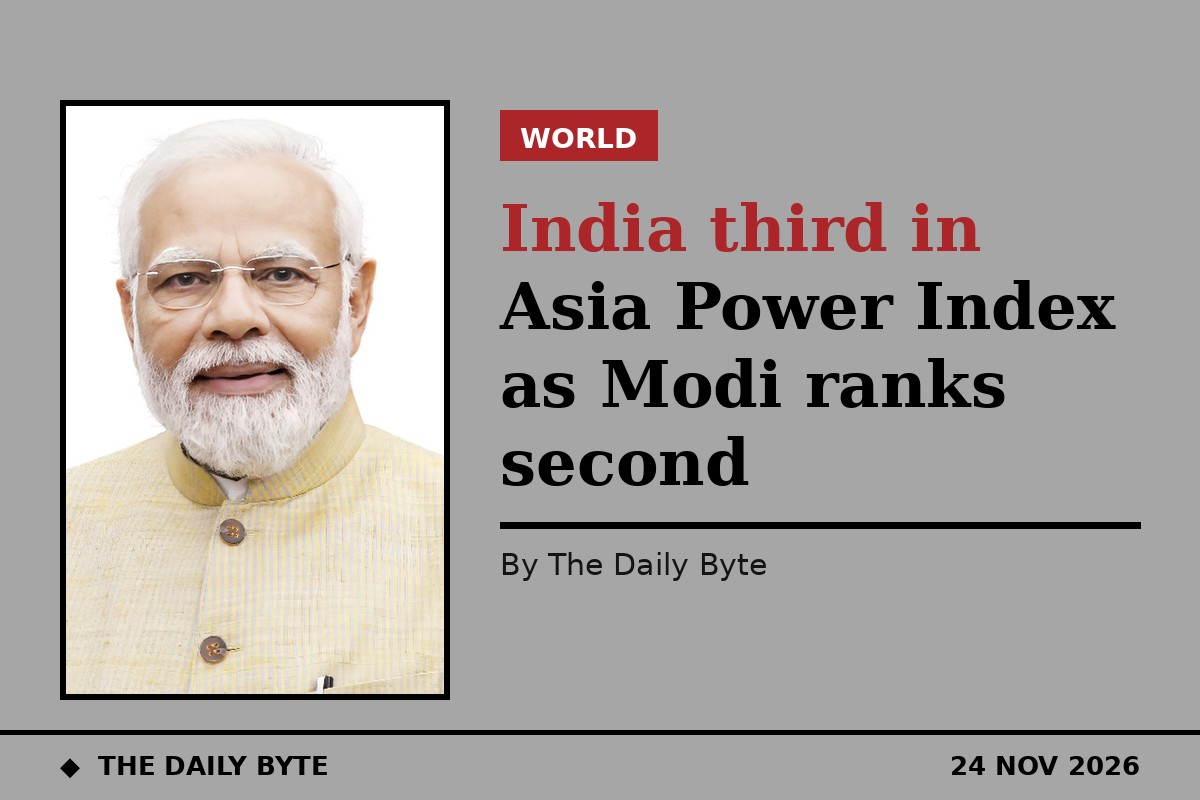
India has held on to third place in the Lowy Institute's Asia Power Index 2026, scoring 40.5 points and narrowing its gap with China to the smallest since the index began in 2018. The Sydney-based think tank describes India as a "major power" in Asia, a tier it reaches by scoring 40 points or more, and places it ahead of Japan on 38.6 points.
The United States and China remain well clear at the top, and the index calls both countries "superpowers in Asia" for 2026. The United States leads on 78.9 points, with China second on 73.6. The 5.3-point gap between them is the narrowest since the index was launched in 2018, and the gap in military capability is also at its narrowest on record.
India's improvement was modest in headline terms, up 0.5 points on last year, but the direction matters. The report says the gap between India and China is now at its narrowest since 2018, even though China's overall power remains about 80 per cent higher than India's. The index ranks 27 countries and territories across 131 indicators and eight measures of power, from economic and military capability to diplomatic influence and cultural reach.
Defence was the main driver of India's advance. Its defence networks score rose 2.1 points to 18.6, lifting it two places to ninth, which the Lowy Institute links to greater regional defence engagement and sales of BrahMos missiles to Southeast Asia. Military capability rose 0.5 points, and future resources improved 1.2 points to 56.2, supported by a stronger economic outlook and growth potential.
Diplomatic influence remains India's strongest area, scoring 70.3 points and unchanged from last year. The report says that score held up as experts rated Prime Minister Narendra Modi the second-most effective regional leader in Asia, behind only Chinese President Xi Jinping. Mr Modi climbed three places in that leadership ranking, scoring 79 points against 100 for Mr Xi. The index adds, however, that India's low profile during the Gulf conflict weighed on views of Mr Modi's global leadership.
Cultural influence recorded India's biggest gain, up 2.3 points to 43.8. Economic capability was its weakest movement, falling 0.7 points to 26.4, although India still ranks third in that category. The Lowy Institute attributes the fall in part to a weaker rupee and to changes in the International Monetary Fund's method for measuring economies. Scores for resilience and economic relationships were unchanged.
The report's broader message is that Asia's balance of power is still dominated by two countries. "Despite upheaval, the regional balance of power remains markedly bipolar. The US and China still dominate, and neither a middle power bloc nor growing authoritarian alignment is displacing them," said Hunter Marston, director of the Southeast Asia Program and Asia Power Index.
That dominance is not unchallenged in every measure. United States diplomatic influence fell six points to 76.7, its largest drop on record and its fourth consecutive annual decline. The report links the fall to the Iran war, punitive tariffs and calls to scale back military exercises with South Korea. Even so, Washington's overall lead over Beijing narrowed rather than widened.
The findings were welcomed in New Delhi, where Bharatiya Janata Party MP Ravi Shankar Prasad cited the report on 23 November to highlight India's strategic standing, economic prospects and diplomatic reach. The index itself is an assessment of influence rather than a simple league table of economic size, and its authors stress that a rising score does not remove the large gap that still separates India from the two superpowers above it.
For India, the 2026 edition tells a mixed story: stronger defence ties, steadier diplomacy and growing cultural reach on one side, and a softer economic capability score on the other. Holding third place while closing the gap with China is the headline, but the report's detail suggests the next step up will depend as much on economic performance as on diplomacy and defence.


