Indonesia Fires Could Cost 30.9 Billion in Losses
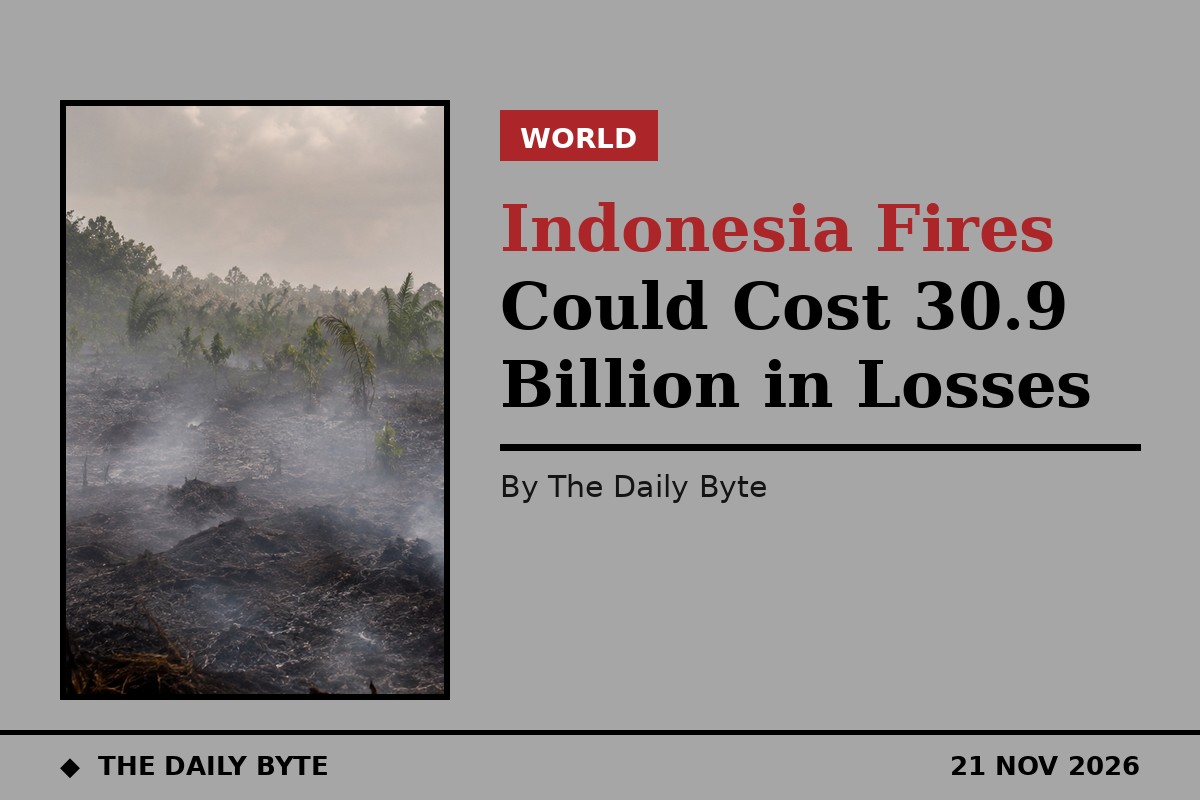
Indonesia's 2026 forest and land fires could cost the country as much as 565.03 trillion rupiah — about 30.9 billion dollars — in economic and health losses, according to an October estimate by the Jakarta-based Centre of Economic and Law Studies, known as CELIOS. The figure is the top of a range rather than a final bill: the think tank put total losses at between 359.58 trillion and 565.03 trillion rupiah, depending on how the health effects of smoke are counted.
The direct economic damage alone is estimated at 340.38 trillion rupiah, equal to 2.69 percent of Indonesia's gross domestic product. The wood and forestry sector accounts for an estimated 262.33 trillion rupiah of that total, about 77 percent, followed by manufacturing. CELIOS also estimated that the fires could reduce potential local tax revenue by as much as 4.06 trillion rupiah.
A range, not a single bill
The wide range in the total comes mostly from the health calculations. CELIOS put health costs at 19.20 trillion rupiah for people diagnosed with acute respiratory infections. When people experiencing symptoms were also counted, potential health costs rose to 224.65 trillion rupiah, including indirect costs such as work and income lost when people are sick or must stay indoors.
CELIOS put the number of people at risk of, or experiencing, acute respiratory infection symptoms at 17.4 million across 12 provinces. Indonesia's Health Ministry recorded more than 50,000 fire-linked respiratory infections in July and August, including more than 12,000 cases among children under five. The Centre for Research on Energy and Clean Air estimated that fire smoke had contributed to more than 5,250 deaths and about 400,000 respiratory infections in Indonesia.
Nearly three million hectares burned
Fires had burned an estimated 2.88 million hectares between January and October, according to the independent monitor Nusantara Atlas — an area about 18 times the size of London. A separate estimate from the Copernicus Atmosphere Monitoring Service said fires had produced nearly 200 million tonnes of carbon emissions by 15 November, the third-highest annual total in its record dating to 2003, though still below the record set in 2015, when emissions approached 400 million tonnes.
West Kalimantan recorded its highest cumulative fire emissions for the matching period since Copernicus began tracking them in 2003. A separate analysis by Pantau Gambut estimated that 263,558 hectares of protected peatland burned from January to September, with about half of the burned area in peat hydrological units lying in areas designated for peat ecosystem protection.
Why the fires were so severe
Strong El Niño conditions brought a severe lack of rain. An analysis by World Weather Attribution found that El Niño reduced rainfall from July to October by about 50 percent in parts of Sumatra, Kalimantan and Java, while human-driven global warming raised August to October temperatures by about 1.6 degrees Celsius.
Land use made the fires harder to stop. Indonesia has about 20.6 million hectares of tropical peatland, around 10.8 percent of its land area. Peat made up about 20 percent of the area burned in one estimate, but produced about 80 percent of the carbon emissions, because the waterlogged soil stores large amounts of carbon. Researchers estimated that peatland burned in 2026 could take about 400 years to recover under ideal conditions.
What happens next
CELIOS has called on the government to declare the 2026 fires a national disaster, provide safe evacuation and medical support, review permits for plantations and mining in affected areas, and create a task force for ecosystem recovery. Enforcement is already under way: a November announcement covered eight companies facing withdrawal or denial of land rights over more than 42,000 hectares, while three more companies were under inspection.
The scale is not without precedent. A 2021 study estimated that Indonesia's 2015 fires caused 28 billion dollars in losses, and found that restoring peatland could have saved 8.4 billion dollars across six major fire events between 2004 and 2015. The 2026 estimate, if it holds, would pass that total — and the fires were still burning when the figures were compiled.


