Indonesia Passes Asset Forfeiture Law After 18 Years
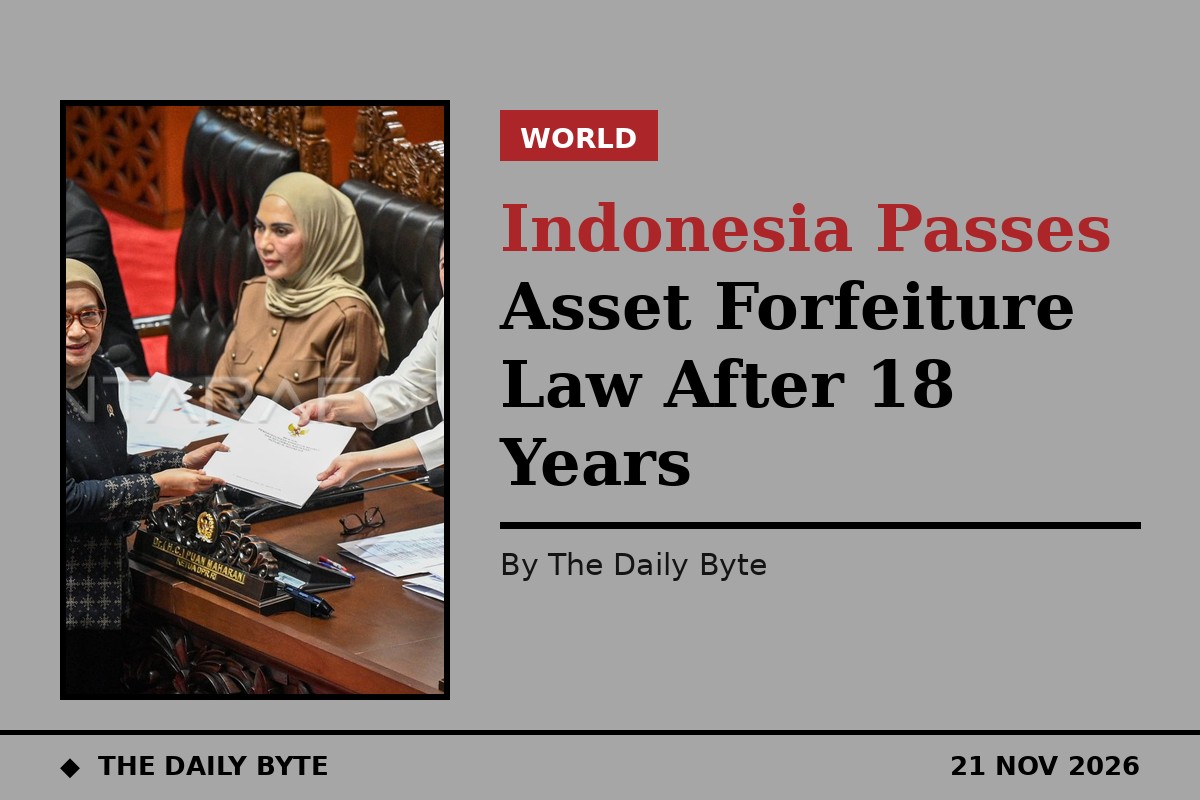
Indonesia's parliament has passed a long-awaited asset forfeiture law, giving the authorities new powers to seize suspected criminal proceeds in some cases without first securing a criminal conviction. The House of Representatives approved the bill in a plenary vote on Thursday, 19 November, ending a debate that had run for 18 years.
The legislation passed during a session chaired by House Speaker Puan Maharani, after the government formally endorsed it on behalf of President Prabowo Subianto. Administrative and Bureaucratic Reform Minister Rini Widyantini delivered the president's final remarks on the bill, saying existing asset recovery rules were scattered across different laws and hampered by procedural obstacles and a reliance on criminal convictions.
Seizure without a conviction
Under the new law, authorities may seek the forfeiture of assets worth at least one billion rupiah, about 54,885 US dollars, without a criminal conviction in specified circumstances, including when an offender has died, fled, suffers from a permanent illness, or cannot be identified or located. The authorities may also freeze and seize suspected criminal assets before a court decides whether they should be forfeited, according to a parliamentary presentation shown during the vote.
The law primarily targets corruption, but also covers drug offences, terrorism, human trafficking, arms smuggling and large-scale fraud, including fraudulent investment schemes and Hajj and Umrah travel scams. It also applies to crimes linked to cryptocurrency and online gambling schemes, according to local media reports cited by Reuters. Tax crimes were removed from the scope of the law before it passed.
A shift from prison to recovery
House Commission III chairman Habiburokhman, who presented the commission's report, said the law marked a shift in law enforcement towards recovering losses suffered by the state and victims, rather than focusing solely on imprisoning offenders. He said the legislation addressed cases in which perpetrators of fraudulent investment schemes chose imprisonment while keeping trillions of rupiah obtained from victims, leaving the stolen funds unrecovered.
The bill gained new life after Prabowo publicly backed it as part of his anti-corruption drive, endorsing it in May 2025. An August demonstration preceded a parliamentary pledge to approve the bill by 15 December, a deadline the House has now beaten by almost a month. The law comprises 74 articles and will take effect 12 months after its promulgation. It will apply only to offences committed after it comes into force, and its implementation depends on establishing an asset management agency and an independent supervisory body.
Civil society warns on safeguards
Civil society groups that long campaigned for the law welcomed its passage but warned about how it will be used. The Legal Aid Institute of Indonesia said the legislation could help fight corruption and recover criminal proceeds, but warned that it granted extensive powers to freeze, seize and manage assets without sufficiently strong safeguards against abuse. Habiburokhman said the public had raised the same concern during consultations and that oversight protocols had been strengthened to make the law very difficult to abuse. The latest draft of the law had not been made public at the time of the vote.