Indonesia's Prabowo apologises to Singapore and Malaysia over wildfire haze
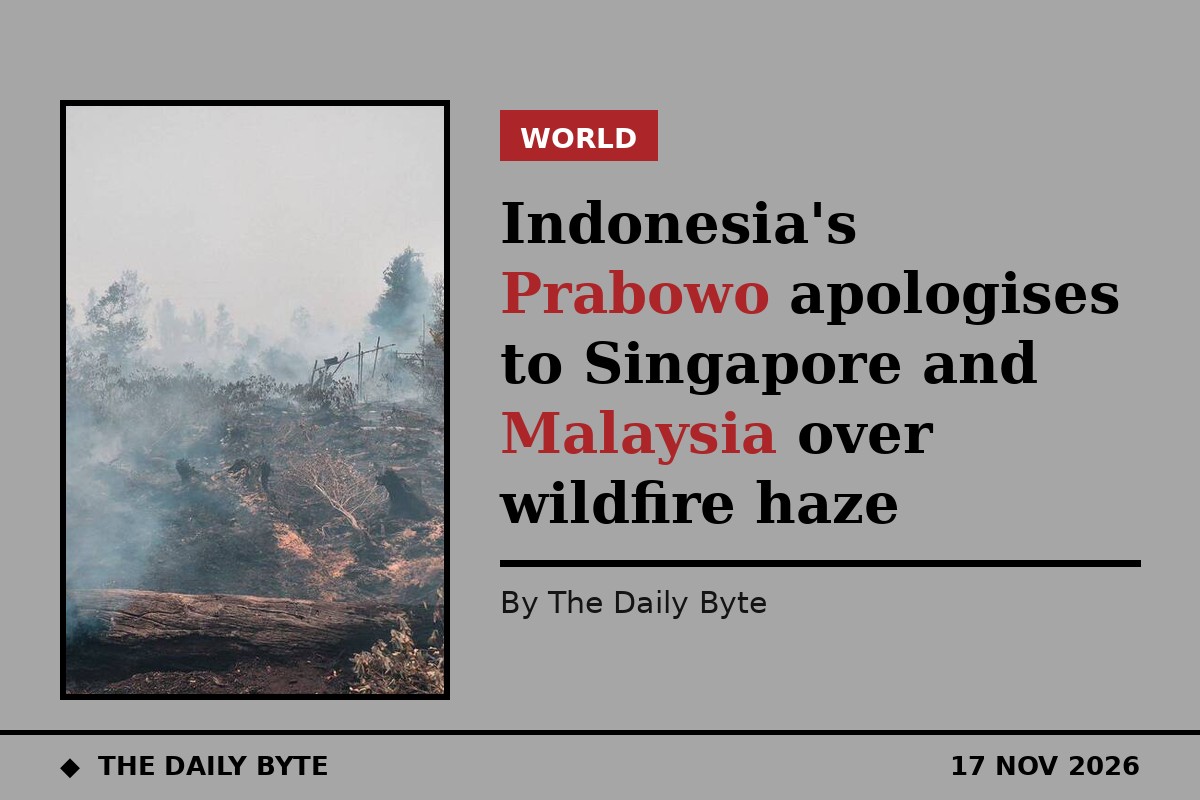
Indonesian President Prabowo Subianto has apologised to Singapore and Malaysia for the haze that drifted across their borders from months of forest and land fires in Indonesia. He delivered the apology at the ASEAN summit in Manila on Sunday, 15 November, and said his government would take firm action against companies linked to the fires.
Speaking on behalf of the Indonesian government and people, Prabowo said the fires had taken nearly four months to bring under control. He acknowledged that smoke had reached both neighbouring countries, while maintaining that his government had done its best to contain the blazes. “The haze travelled to Malaysia and to Singapore. It is not our fault, but once again, we apologise. But we have done our best,” he said, according to reports of his remarks.
A costly firefighting operation
Prabowo described an extensive firefighting effort. About 71,000 personnel were deployed, 16 of them died and others were injured, and two helicopters were lost during the response. The scale of the operation underlines how long the fire season lasted and how difficult the fires were to control once they had taken hold in dry forest and peatland.
Health services in the affected areas also came under pressure. By 2 November, Indonesia’s health ministry had recorded 401,586 cases of acute respiratory infection across seven affected provinces, including 91,913 cases in children aged five or younger. Those figures record infections in the affected areas; they do not by themselves establish that smoke caused every case.
Action against companies
The president said his government had a “zero-tolerance policy” for any company contributing to the blazes and would continue to take strict action. He said Indonesia had revoked 17 corporate concessions, that 11 companies had been charged, a further 23 were on a list to be charged, and 104 were under investigation by police.
Those categories were not set out as separate, non-overlapping groups, so the figures should not simply be added together. An investigation or a charge is not a conviction, and the figures do not establish responsibility for any particular fire. What they do show is the breadth of the enforcement effort the government says is under way.
Prevention, not just firefighting
Prabowo also called for a change of approach, with more emphasis on preventing fires rather than concentrating on extinguishing them and dealing with their effects. Indonesia is preparing a new agency and programmes intended to strengthen prevention, although the announcement does not mean the proposed body has already been established, or that its powers and operating timetable have been settled.
The haze has also prompted a push for closer regional work. Singapore and Indonesia agreed in October to establish a joint task force to improve information sharing and cooperation, alongside a hotline between their foreign ministries. At the Manila summit, Singapore’s Prime Minister Lawrence Wong proposed broadening that work into an ASEAN-wide platform, so countries could share information and evidence about those responsible for haze-causing fires. That was a proposal for wider cooperation, not an announcement that such a platform had already been adopted.
A recurring regional problem
Transboundary haze is a recurring problem in Southeast Asia, returning most years when dry conditions coincide with forest and land fires. During October, moderate to dense transboundary haze was observed on several days over parts of Sumatra, Peninsular Malaysia, Singapore, Kalimantan and western Sarawak. Increased showers and a reduction in detected hotspots led to a downgrade of the southern ASEAN regional haze alert on 29 October.
The countries already have a framework for cooperation. The ASEAN Agreement on Transboundary Haze Pollution was signed in 2002 and came into force the following year. It covers monitoring, prevention, preparedness and responses to forest and land fires. Indonesia ratified the agreement in 2014.
The immediate developments are the president’s apology, the official account of enforcement and the proposed shift towards prevention. The outcome of the investigations, the details of the planned agency and any decision on a wider regional platform remain to be established. For now, the apology itself matters: it is a rare public acknowledgement by an Indonesian president that fires at home caused suffering abroad, and it sets a public test for the tougher enforcement and prevention that Prabowo has promised.
Frequently asked questions
What did President Prabowo apologise for?
For haze from months of Indonesian forest and land fires that drifted into Singapore and Malaysia, delivered at the ASEAN summit in Manila on 15 November.
What action has Indonesia taken against companies?
According to the president, 17 concessions have been revoked, 11 companies have been charged and others are under investigation, under a stated zero-tolerance policy.
Source: London Daily News. Also reported by Al Jazeera and by Bernama, Malaysia’s national news agency, via PJM TV.


