Indonesia sets out plan to answer US AI chip curbs
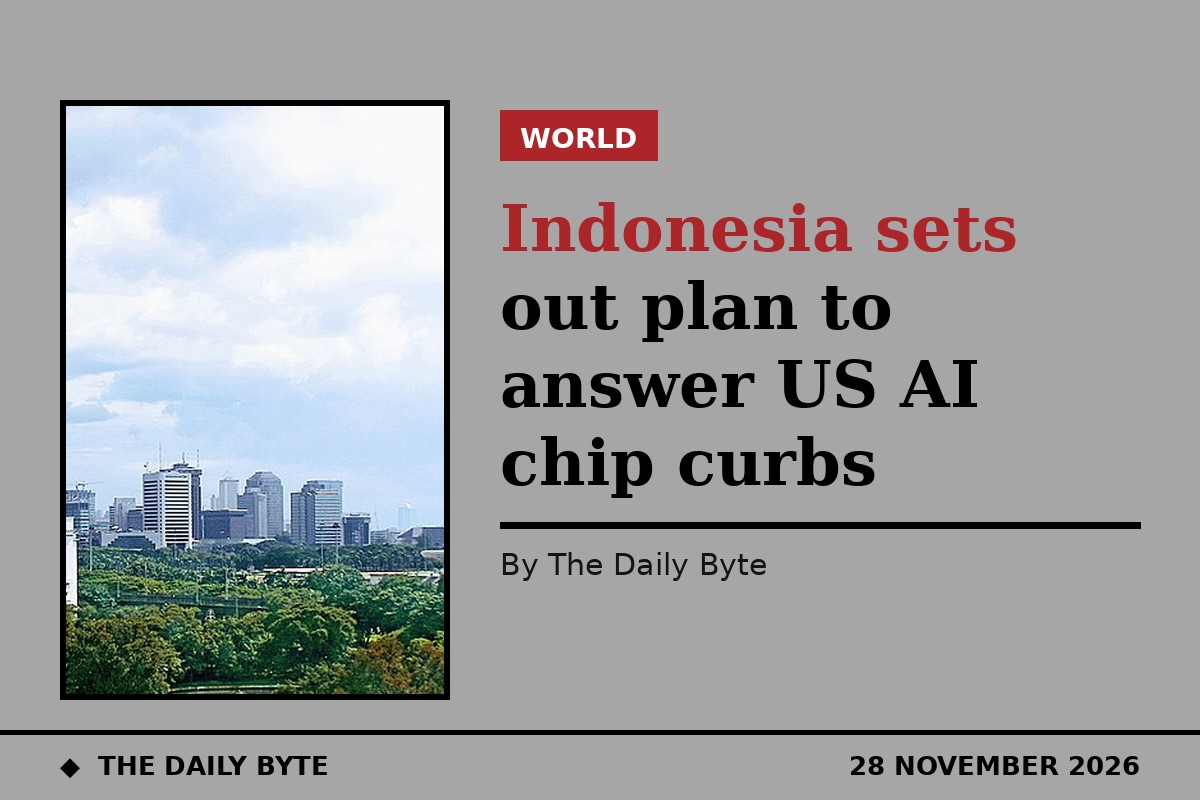
Indonesia has set out a three-step response to new United States controls on exports of artificial intelligence chips and servers, choosing coordination and dialogue with Washington over retaliation. Communications and Digital Affairs Minister Meutya Hafid outlined the plan in a statement received and confirmed in Jakarta on Friday.
The plan answers an Interim Final Rule issued by the US Bureau of Industry and Security on 16 November, which took effect on 19 November. The rule requires licences for exports of certain AI chips and servers to Indonesia, Malaysia, Singapore, Thailand and Brazil. It also adds a worldwide data-centre end-use control, under which a data centre supplying more than 12 million aggregate total processing performance of computing power to entities in Macau or designated countries needs a licence. The rule is a licensing regime, not an outright ban, and it replaces an earlier framework that was never enforced.
Under the first step, ministries and agencies will coordinate so that Indonesia presents a single, common position to Washington. The government argues that one voice will carry further than several competing ones while the new licensing arrangements are still being worked out in practice.
The second step is to keep enforcing the law and to strengthen oversight of digital infrastructure, including data-centre operators. Hafid said Indonesia does not tolerate the misuse of digital infrastructure in the country, and she urged operators to know who their customers are and what they use computing resources for. Those two duties are known as Know Your Customer and Know Your Customer's Workload, and operators are expected to apply them so that computing capacity cannot be diverted to unauthorised users.
The third step is direct engagement with the US government. Jakarta wants to clarify how the rule will be applied in practice and what conditions will govern the granting of licences, so that Indonesian companies that comply with the rules can continue to obtain the technology they need. Hafid said Indonesia had chosen the path of dialogue, adding that Indonesia and the United States have a strategic and constructive partnership.
Hafid acknowledged that the rule may create short-term uncertainty for companies building AI infrastructure and data centres, but she said Indonesia's AI ecosystem still has a strong foundation. She also noted that most AI services used by the public, including services that recommend content or products, fall outside the scope of the rule.
The announcement also addressed reports that Nvidia had halted shipments of AI server hardware to four Southeast Asian countries, including Indonesia. The report was first published by the Financial Times, and manufacturing partners including Dell and Supermicro were reported to have told clients in Malaysia, Singapore, Thailand and Indonesia that their server orders would not be shipped. Hafid's ministry said it had not received direct official notification from the companies concerned, but it will coordinate with relevant ministries, agencies and industry players to assess the impact on the ground. It remains unclear whether any halt to shipments will be permanent or temporary.
For now, Jakarta's message is one of calm management rather than confrontation. By tightening oversight of its own data centres and opening talks with Washington, Indonesia is aiming to keep data-centre construction moving and to preserve access to advanced chips for companies that can show they will use them lawfully.


