INEC to Test BVAS in 598 Delta Polling Units on 28 Nov
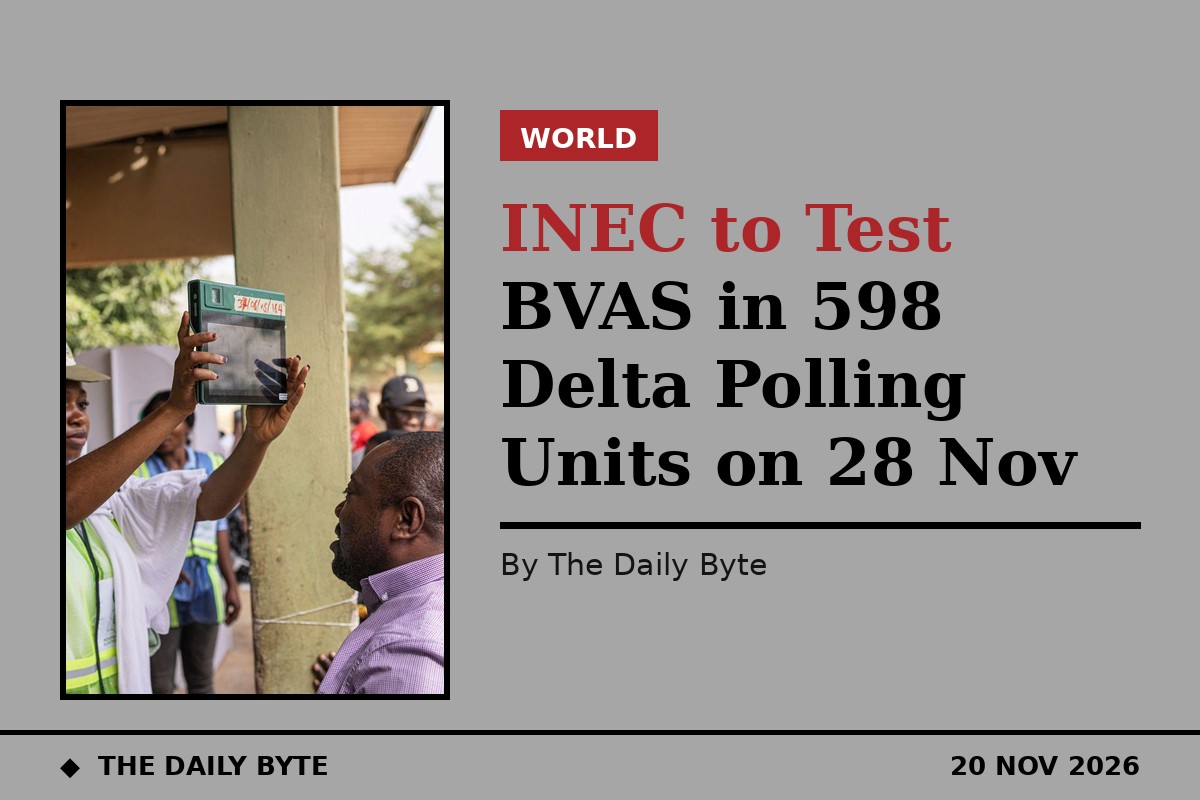
Nigeria’s Independent National Electoral Commission (INEC) will conduct a mock accreditation and result-upload exercise in 598 polling units across Delta State on Saturday, 28 November, to test its election technology ahead of the 2027 general elections. The exercise will focus on the Bimodal Voter Accreditation System (BVAS) and the electronic transmission of polling-unit results.
The Delta State Resident Electoral Commissioner, Sir Etekamba Umoren, announced the exercise at a press briefing in Asaba on Friday. He said it would allow the commission to identify technical problems before the general elections and correct them in good time.
How the 598 polling units were chosen
The 598 polling units were selected from across Delta State’s 25 local government areas and 299 registration areas, with two polling units chosen in each registration area. Umoren explained the arithmetic simply: 299 registration areas multiplied by two gives 598 polling units.
Registered voters in the selected polling units will be asked to present their Permanent Voter Cards for accreditation during the exercise. Polling units will open at 7.30am, and accreditation will run from 8am to 2.30pm.
Umoren stressed that the exercise is strictly a simulation and not an actual election. No winners or losers will be declared. Instead, the commission wants to see whether its systems have been properly configured and whether they are ready for election day.
What INEC will be testing
The main purpose of the exercise is to test how BVAS performs under different environmental and operational conditions, and to check that polling-unit results are transmitted accurately to INEC’s Result Viewing Portal, known as IReV. Umoren was responding to questions about electronic transmission and the commission’s plans to ensure that uploaded results reflect the outcome of voting.
“It is for us to look at whether we have properly set the system to work that way. If there is any technical issue, that will be corrected,” he said. “These are the likely situations we want to identify. The exercise will give us a clear picture, and then we will know whether we have properly configured the system and whether it is ready for the election.”
Beyond the technology, the exercise will also assess the preparedness of electoral officials, the handling of election materials, voter accreditation procedures, result management and logistical arrangements. Electoral officers across the local government areas have been directed to hold meetings with stakeholders to inform them about the exercise and the polling units selected, and details will also be communicated to residents through the electoral officers.
Preparations for the 2027 elections
INEC had already announced the exercise in a press release dated 17 November, signed by its Administrative Secretary, Davis O. Eldred, urging eligible voters in the selected polling units to take part. The commission said the test would let it evaluate BVAS performance before deploying the technology for the 2027 elections.
The mock exercise is part of a wider programme of preparation for the 2027 general elections, in which the credibility of accreditation and result transmission will be under close scrutiny from political parties, civil society organisations and voters. Umoren urged political parties, security agencies, civil society organisations, community leaders and the media to support the exercise and promote peaceful participation.
He said the outcome would help INEC identify operational gaps, improve staff performance and strengthen its preparations for the polls. The commission will be watching closely for any sign that BVAS machines, result uploads or logistics need adjustment before the real voting begins.


