Institutional Complicity, Digital Extortion, and Socio-Economic Precarity: A Criminological Analysis of Gender-Based Crimes in Punjab
"Justice delayed is justice denied, but justice forgotten is a tragedy repeated."
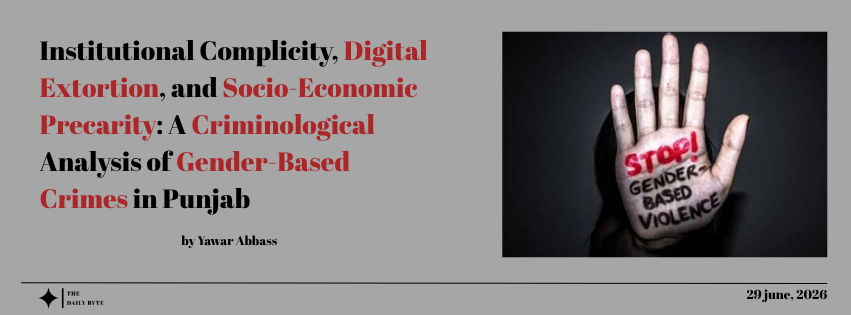
Pakistan has once again awakened to a nightmare it knows all too well. Recent high-profile cases have exposed systemic patterns where structural power, economic precarity, and digital media are weaponized against marginalized populations. The perpetration of sexual violence by state actors undermines the foundational integrity of the criminal justice system, while the emergence of technology-facilitated gender-based violence (TFGBV) introduces novel mechanisms of coercion, luring, and subsequent blackmail.
1. The Pathologies of Custodial Abuse: The Case of Okara
The alleged sexual assault of a female laborer by a policeman named Zeeshan (deputed at Police Station A-Division Okara) illustrates the intersection of class vulnerability and state-sanctioned authority. According to the First Information Report (FIR), the suspect established a relationship with the victim under a false promise of marriage, subsequently assaulted her in a nearby village, and later reneged on his commitment. When the victim sought legal recourse, she was subjected to dire threats by the officer.
In a highly stratified society, police officers possess significant discretionary power and social leverage, which can be weaponized to suppress complaints and intimidate victims. The victim's status as a laborer further compounds her vulnerability, rendering her marginalized within both the socio-economic hierarchy and the legal apparatus.
Systemic Patterns of State-Agent Violence
To understand this custodial pathology, parallels must be drawn to other documented historical incidents of police sexual violence in Punjab:
Faisalabad (Nishatabad Police Station): Sub-Inspector Shujat Ali Malhi and Sub-Inspector Ghulam Rasool illegally detained and sexually assaulted women to coerce confessions. The district police actively resisted judicial orders from Additional Sessions Judge Nadeem Gulzar to register the rape charges.
The Natasha Case: A minor was repeatedly gang-raped during illegal detention by police officials in Labb Thathu and subsequently sent to Adiala Jail on fabricated charges, demonstrating how state actors deploy their authority to silence victims.
Shah Lateef Town Custody: Head Constable Arif Sharr and Constable Mohammad Ashraf recorded the sexual assault of a minor, Zeeshan Budd, and distributed the footage to local internet cafes to extort bribes from his family.
Procedural Failures and Investigative Negligence
Procedural failures in the Okara A-Division Police Station reflect broader patterns of investigative negligence and bias. In a separate arrest involving a local citizen, Chand Shamaun, and his brother Zeeshan, the A-Division Police under Sub-Inspector Haider Ali and DSP Yousaf faced criticism for failing to utilize call data records (CDR) and location-tracking data. This highlights a systemic reluctance to employ objective forensic verification when handling sensitive local disputes.
This structural deficit in investigative diligence directly affects how cases of sexual violence by police officers are processed, as the agency responsible for gathering objective forensic proof is the very institution harboring the perpetrator. The administrative landscape of Okara, which has transitioned through various bureaucratic leaderships under past Deputy Commissioners such as Dr. Muhammad Zeeshan Hanif and Ahmed Usman Javaid, continues to struggle with local police accountability, particularly within municipal subdivisions like the A-Division station.
2. The Cyber-Physical Predation Model: Gujjarpura Employment Scam
The gang-rape case registered at the Gujjarpura Police Station in Lahore highlights a different predatory mechanism: the use of digital platforms to exploit economic distress. The victim, a resident of Okara, was contacted on Facebook by a suspect named Khalil Amir, who misrepresented himself as the manager of a pharmaceutical firm and offered her employment. Economic precarity often forces rural or semi-urban women to seek employment in urban centers, making them vulnerable to online predators operating under corporate guises.
The Operational Model of Predation
The investigative response to this crime was initiated after the Inspector General of Police (IGP) Punjab, Amir Zulfiqar Khan, took formal notice and directed field teams to track the culprits using advanced methods like call data records (CDR) and geo-fencing. The operational path transitions rapidly from online luring to real-world containment and exploitation.
Digital Weaponization and the "Honour" Code
This case highlights how digital media can be used to enforce victim silence. In traditional physical crimes, the trauma is localized; however, digital recording introduces the threat of perpetual, viral public shaming. In Pakistani society, where cultural codes of "honour" are disproportionately mapped onto female modesty, the threatened dissemination of explicit media is often viewed by victims as a form of social death. This psychological leverage explains why the Gujjarpura victim, along with many others, suffered in silence before the police initiated investigations based on the online circulation of the video.
The geographical area of Gujjarpura and the adjacent Karol Ghati have repeatedly been associated with high-profile sexual violence, notably the September 2020 Lahore-Sialkot Motorway gang rape. When that incident occurred, the lead investigator, CCPO Umer Sheikh, engaged in public victim-blaming, criticizing the survivor for traveling late at night without checking her fuel levels—a narrative shift that highlights the institutionalized misogyny entrenched within Punjab's law enforcement culture.
Furthermore, the area has seen extreme law enforcement actions. For instance, Adnan, a primary suspect in a separate Gujjarpura gang-rape case involving a recorded blackmail video, was killed in an armed encounter with the Crime Control Department under DSP Rashid Ameen Butt after allegedly attempting to escape custody. These dynamics illustrate a criminological reality where police responses swing between investigative negligence, victim-blaming, and extrajudicial encounters.
3. Legal, Forensic, and Procedural Underpinnings
The prosecution of these offenses relies on a combination of traditional penal statutes and specialized digital forensics legislation. However, gaps in statutory alignment and enforcement mechanisms often impede the delivery of justice.
The interaction of these statutes reveals a structural problem within Punjab's judicial system. For instance, Section 365-B of the PPC, which handles kidnapping for forced marriage or illicit sex, accounts for a massive 63.5% of all reported gender-based crime cases in Punjab (amounting to 15,569 out of 24,514 cases in a single annual cycle). However, this category suffers from significant interpretative distortion, as families frequently register kidnapping charges under 365-B against women who choose their partners autonomously, complicating the tracking of genuine abductions.
Furthermore, the efficacy of PECA is hampered by the strategic use of criminal defamation and digital harassment counter-claims. Perpetrators regularly register cases under Sections 499 and 500 of the PPC, or Sections 20 and 21 of PECA, alleging that the survivor's public or formal accusations have defamed their social standing. This legal maneuver forces survivors to simultaneously defend themselves against criminal charges while pursuing their primary case of sexual assault, creating a chilling effect that deters others from seeking legal redress.
4. Macro-Level Data and Provincial Performance Metrics
A quantitative analysis of sexual offending in Punjab reveals a severe disconnect between the reporting of crimes and successful judicial outcomes, illustrating a cycle of low conviction and high impunity.
These statistics point to a process of systemic attrition at every stage of the legal process. First responders often lack the training or equipment to secure DNA evidence, fingerprint data, and digital trails. Delays in conducting medico-legal examinations frequently lead to the degradation of physical evidence, which directly contributes to low conviction rates.
More than Statistics:
The numbers tell a disturbing story.
The quantitative metrics reflect an environment where structural hurdles filter out cases before they can reach a meaningful judicial conclusion.
Total Documented GBV Cases (Punjab): 24,514 cases (annual compile) representing a highly saturated landscape of reported gender-based crimes across the province.
Kidnapping (PPC 365-B) Proportion: 15,569 cases (63.5% of total dataset) reflecting the high frequency of social disputes over marriage choice labeled as kidnapping.
Domestic Violence (Documented): 1,074 cases indicating massive underreporting; the Human Rights Commission of Pakistan (HRCP) estimates 70% to 90% of actual cases never enter the formal system.
Judicial Conviction Rate for Rape: Below 5.0% (averaging 0.4% to 5.0%) signaling systemic failures across the police-prosecution-judicial chain, leading to a high rate of acquittals.
Dar-ul-Aman Budget Allocation: PKR 10 million to 15 million per shelter annually illustrating a severe funding deficit that limits standard care and protection for survivors.
Required Resource Standard (Dar-ul-Aman): PKR 2 billion (provincial aggregate) representing the funding necessary to implement international quality standards for survivor rehabilitation.
Virtual Women Police Station Complaints: 82,639 cases processed in 3 months demonstrating high demand for accessible, anonymous digital reporting channels.
Virtual Station Reconciliation Rate: 72,322 cases resolved via mediation indicating high reliance on out-of-court settlement and familial reconciliation rather than prosecution.
5. Structural and Policy Reforms
In response to the endemic crisis of gender-based violence, the Government of Punjab and the Punjab Police have initiated several structural and technological reforms.
Virtual Policing and Technological Redress
The launch of the Virtual Women Police Station and the Virtual Center for Child Safety under the leadership of Inspector General of Police Dr. Usman Anwar and Chief Minister Maryam Nawaz Sharif represents a shift toward technology-driven, survivor-centric law enforcement. These platforms allow women to register complaints, track case progress, and communicate with female officers via dedicated helplines, the Punjab Police smartphone application, and live video portals.
This digital infrastructure addresses several systemic barriers:
Anonymity and Safety: Survivors can initiate reports anonymously, bypassing the immediate threat of physical intimidation by perpetrators or local police staff at traditional stations.
Reduction in Procedural Friction: The virtual system records interactions digitally, reducing the ability of local officers to refuse the registration of an FIR or classify sexual violence as a private domestic matter.
Real-Time Tracking: By allowing complainants to monitor their cases in real time, the platform enhances transparency and accountability, helping to rebuild public trust in law enforcement.
According to provincial performance metrics, the Virtual Women Police Station received 82,639 complaints from women within a three-month period. Out of these, 72,322 cases were resolved through reconciliation, while 6,536 formal FIRs were registered. While the virtual platform has successfully bypassed local-level barriers to filing complaints, the high reconciliation rate of 87.5% raises criminological concerns. It suggests that the system continues to rely heavily on informal mediation, potentially pressuring survivors to accept out-of-court settlements rather than pursuing formal prosecution.
Shelter Infrastructure and Funding Deficits
While digital reporting mechanisms have expanded access to justice, the physical infrastructure designed to protect survivors remains severely underfunded. Dar-ul-Amans (provincial shelter homes) provide critical, temporary refuge for women fleeing violence. However, operational assessments reveal a large gap between existing resources and international safety standards.
Currently, the provincial government allocates between PKR 10 million and 15 million annually per shelter home. Criminological and costing evaluations conducted in collaboration with international bodies indicate that to establish comprehensive, survivor-centered support—incorporating professional psychological counseling, legal aid, vocational training, and child protection services—the province requires an aggregate investment of approximately PKR 2 billion. Without this funding, survivors are often forced to choose between remaining in unsafe domestic environments or facing social destitution.
Strategic Policy Pathways
To address the root causes of low conviction rates and institutional impunity for gender-based crimes in Punjab, the following structural reforms are urgently required:
Mandatory Institutional Accountability: Implement strict disciplinary procedures, up to and including dismissal and criminal prosecution, for law enforcement personnel who refuse to register FIRs in gender-based violence cases, engage in custodial misconduct, or issue threats to complainants.
Digital Evidence Preservation Protocols: Establish specialized, rapid-response digital forensics units at the district level to ensure the immediate preservation of cell site data, social media communication logs, and multimedia evidence in cases involving online luring or blackmail.
Sustained Investment in Protection Infrastructure: Transition Dar-ul-Amans from basic containment facilities into fully funded, rehabilitative centers by increasing provincial budgetary allocations toward the PKR 2 billion target.
Judicial and Prosecutorial Specialization: Expand the network of dedicated Gender-Based Violence Courts and ensure that all judges, prosecutors, and investigating officers undergo mandatory, continuous training on trauma-informed interrogation and survivor-centric legal practices.
Reform of Defamation Counter-Statutes: Amend PECA and the PPC to introduce strict legal thresholds that prevent accused perpetrators from utilizing criminal defamation laws as a tool to silence or intimidate survivors during active investigations.
What Justice really means:
Justice for one is hope for countless others.
The introduction of modern virtual reporting infrastructure offers a glimpse of access, yet years after repetitive legislative and technological revisions, deep-rooted structural blockages continue to stall progression. True justice cannot be found in high mediation volumes or extrajudicial custodial ends. It remains bound to deep structural changes, transparent forensic accountability, and a completely resourced, protective support framework for the survivors.