Intel 18A Yield Hits 70% as Microsoft Signs EMIB Deal
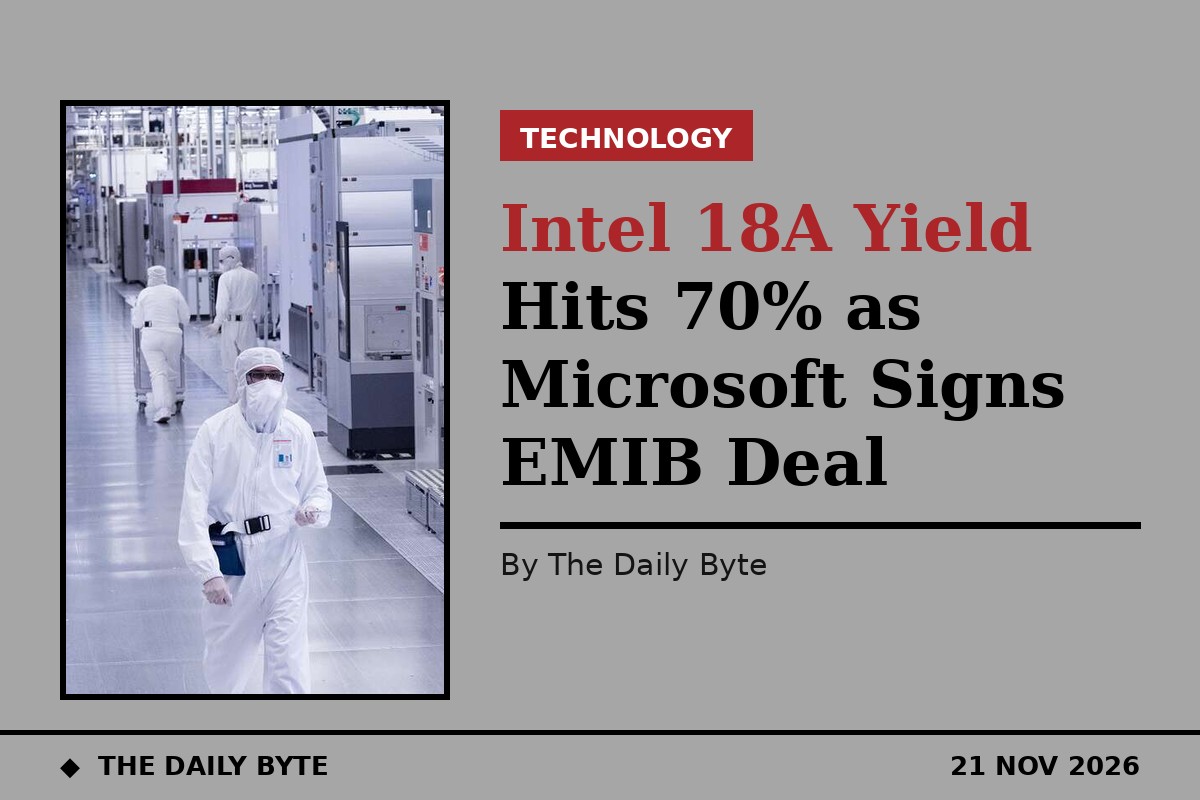
Intel says yields on its most advanced chipmaking process have reached 70 percent, and Microsoft has become the first company to announce publicly that it will use Intel’s advanced packaging technology for its own silicon.
Intel chief executive Lip-Bu Tan gave the yield figure at the TomorrowX Summit in Austin on Thursday 19 November. “When I took over [as CEO in March, 2025], 18A yield was horrible; now we are at 70%,” he said, according to reports of his remarks. The figure is the clearest public marker yet of how far Intel’s foundry turnaround has come — and how far it still has to go.
18A is Intel’s 1.8-nanometre-class manufacturing process, the technology at the centre of its attempt to win chipmaking work from outside customers and challenge Taiwan’s TSMC, the world’s dominant contract chipmaker. Tan did not say which kind of yield he meant, and that matters. A functional yield — the share of chips that work at all — is not the same as the share that can be sold at the speeds and power levels premium customers demand, and Intel’s economics depend heavily on the second measure.
At the same event, Tan said Intel had signed its first outside customer for 18A, without naming the company. Intel technology chief Pushkar Ranade later clarified on X that the deal covers 18A-P, an upgraded version of the process that entered risk production in June. Intel has already begun volume production of compute tiles for its Core Ultra 300-series processors, codenamed Panther Lake, using 18A.
Microsoft signs up for Intel packaging
The Microsoft deal is the more concrete of the two announcements. Under a long-term agreement announced by the two companies, Microsoft will use Intel’s EMIB technology — Embedded Multi-die Interconnect Bridge — to package silicon it designs in-house for its Azure cloud service. EMIB connects several chips inside a single package, a technique that has become central to building the large, complex processors used for artificial intelligence.
Microsoft is the first company to announce publicly that it will use EMIB for its own chips. The agreement also covers multi-year supply of Intel Xeon server processors, including the next-generation Diamond Rapids chips, and joint work on Compute Express Link memory expansion, QuickAssist acceleration and Trust Domain Extensions security. Neither company disclosed the value of the deal, the volumes involved, or a timetable.
The announcement does not say whose wafers Microsoft’s chiplets will be cut from, and it does not confirm that Microsoft is the unnamed 18A customer. Microsoft committed to an 18A data-centre chip back in 2024, and it is not clear whether the new packaging deal is connected to that earlier commitment. In October 2025, reports linked Microsoft’s next-generation Maia 2 AI processor to Intel’s 18A process, but neither company has confirmed that.
Why the timing matters
The deals land as demand for AI hardware stretches the industry’s manufacturing capacity. TSMC’s advanced packaging capacity, known as CoWoS, is in heavy demand, and large chip buyers have been looking for second sources. Intel shares rose about 5 percent on the day of Tan’s remarks, a sign that investors see the announcements as evidence the foundry business is finally winning outside work.
Tan also put a date on catching up with TSMC, telling the summit he sees Intel reaching parity with the Taiwanese company by late 2027 or 2028. That is an ambitious target: TSMC still makes the most advanced chips for Apple, Nvidia and AMD, and Intel’s foundry arm has lost money for years while it built up its technology and customer base.
There are also signs of wider interest in Intel’s packaging. Reports in Taiwan have linked MediaTek to using EMIB technology for Google’s ninth-generation TPU AI chips, with mass production targeted for early 2028, although that has not been confirmed by the companies involved.
For now, Intel has two things it did not have a week ago: a named, public customer for its packaging technology and a headline yield number for its flagship process. What it still lacks is a named customer for 18A itself, and proof that 70 percent means chips it can sell at a profit. Until those details emerge, the turnaround remains a promise with its first pieces of evidence attached.


