Intel rebounds 5% but chip supply limits gains
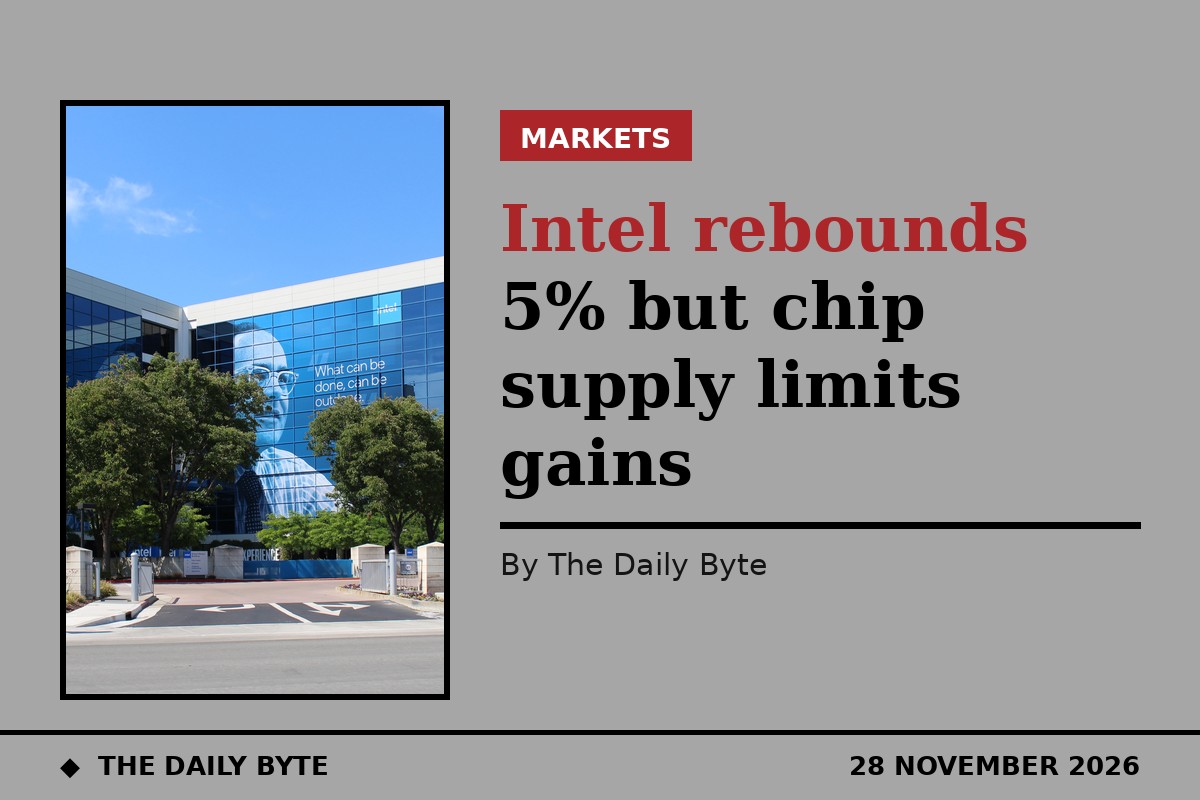
Intel shares closed at $57.40 on Friday 27 November, up 5.38 per cent in a holiday-shortened session as chip stocks rebounded, but the gain did little to repair a difficult autumn. The stock is up 56 per cent over the past year yet sits 59 per cent below its closing high of $139.63 on 30 June, after an October outlook showed how much the company still leans on personal computers.
The server business is the bright spot. Revenue rose 25 per cent to $16.1 billion in the second quarter, with data centre and artificial intelligence sales up 59 per cent. In the third quarter, reported on 29 October, data centre and AI revenue rose 78 per cent to $7.3 billion. The company reported earnings per share of $0.52 for the quarter, beating the $0.41 consensus, on revenue of $16.51 billion, up 20.9 per cent from a year earlier.
The constraint is supply. Chief executive Lip-Bu Tan said in October that the immediate priority was to unlock additional supply to meet extraordinary demand for the Xeon server chip family. Rival AMD has stepped into the gap: its data centre revenue hit a record $8.5 billion in the third quarter, up 97 per cent, on its EPYC server processors and new Instinct graphics chips. AMD shares rose 4.56 per cent on Friday and are up 98 per cent over the past year.
Intel is moving some PC capacity to server chips, but Tan has conceded it cannot shift supply as freely as AMD can. The PC group, still Intel's biggest business, slipped 5 per cent to $8.1 billion in the third quarter, and finance chief David Zinsner has said the PC slowdown will continue at least through the first half of next year as memory shortages push up laptop prices.
The outlook disappointed investors. Intel guided fourth-quarter revenue to between $15.0 billion and $16.0 billion, against a $17.07 billion consensus, and non-GAAP gross margin to 38 per cent, from 44.1 per cent. An explosion in October at Fab 28 in Israel will cost about $300 million of revenue and roughly two points of margin, and Intel expects a similar revenue hit in the first quarter.
At about 39 times forward earnings, Intel is priced for a recovery its biggest business has not yet started. That is below its five-year average of 51 times, but well above AMD at about 27 times. Citi cut its price target to $100 from $130 on 2 November, and Bank of America cut its target to $80 from $100 on 12 November. Analysts on average rate the stock a hold, with a consensus target of $96.93.
There are reasons for optimism. Tan said on 18 November that Intel had signed its first outside customer for its 18A manufacturing process, without naming it, and Microsoft became the first named customer for its EMIB packaging technology. Jensen Huang's return as Nvidia chief executive on 23 November puts the champion of the joint x86 chip project back in charge at Nvidia, which invested $5 billion in Intel, although its regulatory filing shows it held 161.1 million Intel shares on 30 September, down from 214.8 million.
Tan has also put his own money behind the recovery, buying 150,000 shares on 2 November at an average price of $64.73, a purchase of about $9.71 million. A court hearing is scheduled for 10 December in a Delaware shareholder case over the terms of the US government's equity stake, and a securities class action carries a 12 January 2027 deadline for a lead plaintiff. Intel's fourth-quarter report, expected in late January, needs revenue inside its guided range, a gross margin near 38 per cent and a clear reading on the Fab 28 hit to the first quarter before the current valuation looks earned.


