Investors hunt for bottom as US sell-off deepens
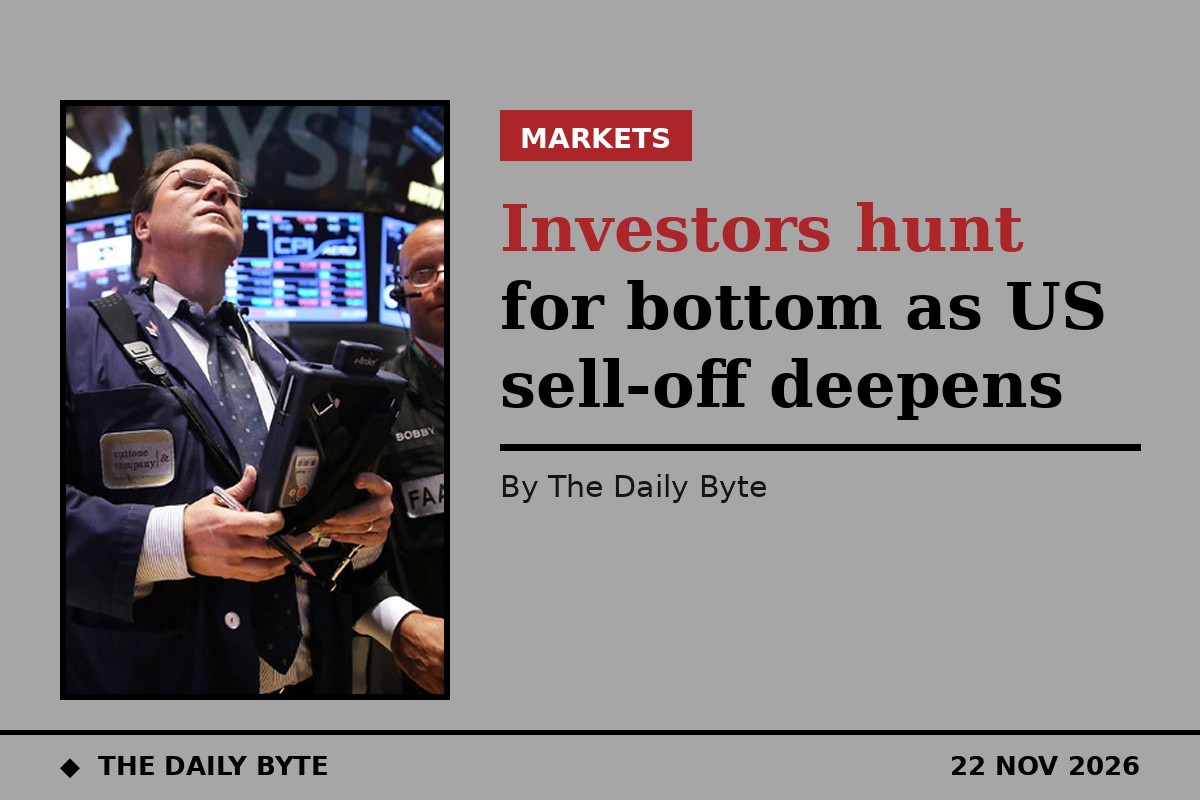
Investors are scouring the market for signs that the sell-off in United States stocks is nearing an end, but they remain concerned that negative momentum could drive shares into an even deeper slide, Reuters reported on Sunday.
Stocks tumbled again on Friday, ending the week sharply lower and sending the S&P 500 down 11.6 percent from its all-time high on 6 October. That exceeds the 10 percent decline that confirms a correction for the benchmark United States stock index, for the first time since March 2025, when trade tensions roiled markets.
For investors used to buying declines during the four-year-old bull market, a bottom could be a rare chance to buy cheaply. Some indicators were close to signalling one on Friday, but investors were wary of calling an end to the declines.
Seven straight falls and a correction
The S&P 500 fell 3.7 percent on Friday to 6,910.39, TipRanks reported. The Nasdaq sank 5.61 percent to 25,028.98, while the Dow Jones Industrial Average fell 1.93 percent to 48,147.33.
For the week, the S&P 500 fell 8.6 percent, its worst weekly loss in more than 18 months, while the Nasdaq 100 dropped 10 percent and the Dow lost 8 percent, TipRanks reported. The S&P 500 has now fallen for seven straight sessions, its longest daily streak of declines since the onset of the coronavirus pandemic in 2020, while marking its biggest weekly drop in over a year, Reuters reported.
The Nasdaq is now down 2.7 percent in 2026, and the Cboe Volatility Index, Wall Street's fear gauge, jumped to 35.89, TipRanks reported.
Strategists see buying signals, with caution
Sentiment is very fragile at the moment, said Angelo Kourkafas, senior global investment strategist at Edward Jones, but there is a point where the drawdown is big enough to attract some buyers, Reuters reported.
The sell-off has reset valuations to more attractive levels, while weakening investor sentiment metrics to levels that often historically have been signals to buy, said Mark Hackett, chief market strategist for Nationwide.
Analysts are now turning to technical indicators and market internals for signals of a possible bottom. Michael Arone, chief investment strategist at State Street Investment Management, said he was watching the declines of individual S&P 500 stocks from their respective 52-week highs, and the extent to which stocks were moving in tandem, with those metrics moving closer to oversold levels but not yet reaching extremes.
Bruce Zaro, managing director at Granite Wealth Management, said one indicator tracking New York Stock Exchange stocks at 52-week highs against those at lows was signalling a bottom, while a second, the share of stocks above their 50-day moving averages, was close but had not yet turned. We are getting close to a great dip-buying point, Zaro said.
The AI doubts behind the slide
The market's six-week slide, featuring a steep fall for heavyweight technology shares, has come amid growing doubts about the AI trade, including mounting questions about the sustainability of heavy spending on data centres that has driven both profit and economic growth, Reuters reported.
Nvidia has led the decline, with fresh regulatory concerns adding to the turmoil surrounding the AI chip giant, TipRanks reported. The broader market also came under pressure from rising interest rate fears, even as Anthropic made its long-awaited Wall Street debut in one of the largest initial public offerings in history.
A short week ahead
Wall Street heads into a shortened trading week. United States markets will be closed on Thursday, 26 November, for Thanksgiving, while trading on Friday, 27 November, will end early at 1 p.m. Eastern Time, TipRanks reported.
The Federal Reserve's next policy meeting is scheduled for 8 to 9 December, leaving investors focused on fresh economic data and comments from central bank officials. The 10-year United States Treasury yield ended the week near 4.91 percent, down from roughly 5.15 percent a week earlier, as investors moved towards government bonds, TipRanks reported.