Iowa Lead Blast All-Clear as No Airborne Lead Found
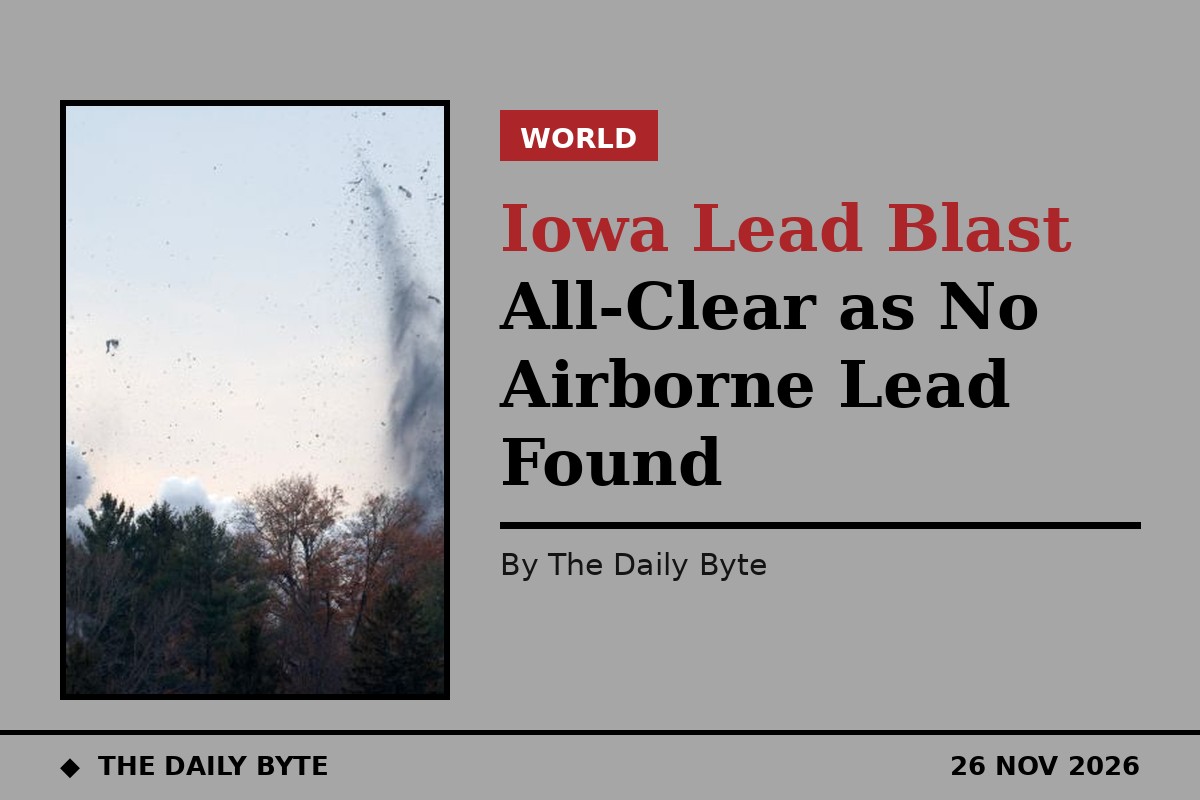
The US Army has given the all-clear after detonating nearly five tons of deteriorating lead azide at an ammunition plant in Iowa, with air monitors showing no detectable lead in the hours after the blast, although soil and surface testing is still to come.
The controlled detonation of 68 barrels of the unstable explosive took place at about 9am local time on Wednesday 25 November 2026 at the Iowa Army Ammunition Plant in Middletown, after days of delay and a last-minute court battle. Two hazy plumes rose over the plant, and a loud boom was heard at the scene.
The Army announced the all-clear for residents just after 6.30pm Eastern time, saying government mapping had detected zero airborne lead. A joint release from federal agencies later that evening said the shelter-in-place order had been lifted and people in the affected area could safely resume normal activities. The agency had offered lodging to those who chose to leave through Friday.
"The Army's controlled, mitigated detonation exceeded all expectations and was a HUGE success. The threat of an uncontrolled spontaneous detonation has been eliminated," Acting Secretary of the Army Adam R. Telle said. He added that the Army was watching the Environmental Protection Agency's sensor array closely, with no readings above 0.0.
Zero airborne lead, but testing goes on
The EPA said all of its real-time air monitors reported zero detection of airborne lead before, during and after the blast. EPA Administrator Lee Zeldin said staff would keep monitoring air, land and water. About 300 EPA personnel and contractors were on site collecting 1,200 samples before the detonation, and sampling continued through the afternoon.
Major General Eric Shirley, commanding general of the Army Sustainment Command, said the mitigation measures had been very effective, there was no infrastructure damage in or around the installation, and overhead coverage showed all of the lead azide barrels had been definitively removed. "I believe absolutely that we reduced as close to zero as is absolutely humanly possible the risk to health and human safety," he said.
Residents within 20 miles of the plant had been advised to stay indoors with windows closed, and people near the plant were told to evacuate to avoid exposure through breathing in lead dust or touching it on surfaces. More than 90 minutes after the blast, Middletown was reported quiet, with no visible dust, no lingering smell and no reports of broken windows or structural damage.
Air readings are not the final answer
But officials and scientists were quick to say the air readings are not the final answer. Surface and soil testing is still under way, and lead can settle on soil and surfaces even when air monitors show nothing. There is no safe amount of lead in the human body, particularly for children and pregnant people.
"There needs to be surface testing, soil testing. All those other testing have to be rolled out in the coming days to weeks to really be reassured," said Dr Dan McCabe, medical director of the Iowa Poison Control Center. Researchers at the University of Iowa and the University of Nebraska are independently collecting soil and dust samples to have them checked by certified laboratories.
About 350 farms across south-east Iowa and north-east Missouri could be affected, according to the US Department of Agriculture, and farmers have been advised to monitor livestock and wash down barns, fencing and water tanks once dust has settled.
Why the Army said it could not wait
The Army said the material had to be destroyed now, before cold weather further degraded the lead azide, which had been stored at the plant since 2009, some of it several decades old. Moving it was not an option, officials said, because it was too volatile and could have been set off. The EPA issued a permit on 13 November authorising the controlled detonation to manage what it called an imminent threat to the community and the environment.
Environmental groups challenged the plan in court and briefly paused it, but the detonation went ahead under an emergency exemption. The Army had cancelled a contract to explore chemical neutralisation, saying crystallisation made the barrels dangerous to open.
The episode has already prompted calls for accountability. Iowa governor-elect Rob Sand said the lead-up "should never have been so chaotic and unclear" and demanded immediate transparency about how the stockpile was allowed to deteriorate. Senator-elect Josh Turek promised investigations and hearings once he takes his seat in January.
The plant, a Second World War-era site covering about 19,000 acres, has made ammunition for more than eight decades. A 20-year clean-up there costing almost $140 million had only just finished in June.


