Iowa Lead Azide Blast Succeeds, Army Says
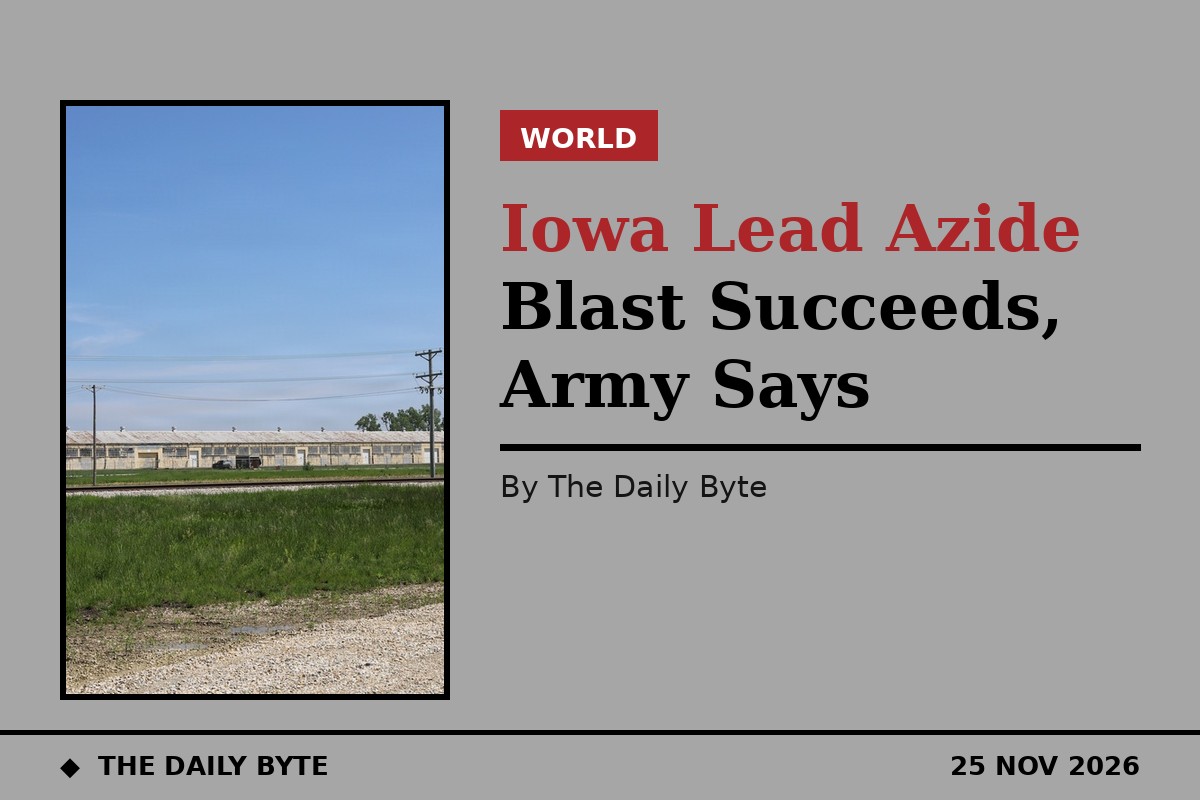
The United States Army detonated about five tons of deteriorating lead azide at the Iowa Army Ammunition Plant in Middletown on Wednesday, 25 November, and said the controlled blast had gone better than planned. The detonation of 68 barrels of the unstable explosive took place at about 9 a.m. local time, producing a loud boom and a cloud of smoke over the plant in south-east Iowa, after days of delay and a last-minute court battle.
Acting Secretary of the Army Adam R. Telle called the operation a huge success. He said the threat of an uncontrolled spontaneous detonation had been eliminated. Maj. Gen. Eric Shirley, speaking in an Army update after the blast, said all of the lead azide barrels had been definitively removed and described the mitigation measures as tremendously successful. He said there was no infrastructure damage, and that the blast had been driven into the ground as planned.
The Environmental Protection Agency said its real-time air monitors showed no detection of airborne lead an hour after the detonation, with readings at 0.0 micrograms. Two hours after the blast, the monitors were still showing 0.0, according to the Army. EPA Administrator Lee Zeldin said monitoring would continue until the environment was confirmed safe, with sampling to be completed by the end of the day on Thanksgiving.
Middletown quiet as damage checks begin
More than 90 minutes after the detonation, Middletown was relatively quiet, according to a reporter from the Des Moines Register. Damage appeared minimal, with no known reports of broken residential windows or structural damage. There was no visible dust or remnants of the plume on the streets, and no lingering odour. A soldier and an emergency official went door to door, and firefighters sprayed down play equipment at a Middletown park.
Residents within 20 miles of the plant were told to shelter in place until given the all-clear. The Iowa Department of Health and Human Services advised people to keep windows, exterior doors and other openings closed for 24 to 48 hours after the detonation. Residents were also advised to clean surfaces with water, wash hands before eating, and remove shoes at the door. The Army has been releasing hourly maps of the projected plume, which was expected to drift south-west from the plant into northern Missouri.
The US Department of Agriculture estimated that about 350 farms across south-east Iowa and north-east Missouri could be affected by the plume. Agriculture Secretary Brooke Rollins said more than 140 USDA offices within a 100-mile radius of the blast site were assisting farmers, and that Under Secretary Richard Fordyce had been deployed to Iowa to support producers in the area.
Why the Army said it could not wait
The Army said the lead azide had been stored at the plant since 2009, with some of it several decades old, and had degraded to the point where it was unstable. Officials said cold weather would have deteriorated it further, and moving it was not an option because it was too volatile. An emergency request to halt the detonation was denied by a court on Monday, 23 November.
The decision to detonate rather than neutralise the material chemically has drawn criticism. Former congresswoman Marjorie Taylor Greene questioned why the Army had cancelled a contract to explore chemical neutralisation. The contractor, MuniRem Environmental, had signed a contract with the Army in March to provide information about a possible alternative, but the contract was cancelled in May because of safety concerns. The Army has said neutralisation would not work because of crystallisation on the barrels, making it dangerous to open them. MuniRem chief executive Valentine Nzengung said chemical neutralisation might have been a possibility until the Army opened the doors to the magazines to bring in detonation equipment, exposing the barrels to colder weather and increasing their volatility.
Questions remain after the blast
Iowa governor-elect Rob Sand said he was grateful to those who had worked to make the detonation as safe as possible, but called the lead-up chaotic and unclear and demanded immediate transparency about how the situation had developed. Democratic US senator-elect Josh Turek said the material should never have been allowed to degrade to this point, and promised investigations and hearings once he takes office in January.
The blast also raises questions about the future of the plant itself. A clean-up lasting 20 years and costing almost $140 million at the site had only just completed in June. Until this year, the plant was the only property in Iowa on the EPA's National Priorities List, and the remediation included addressing depleted uranium contamination left over from weapons making. The Corps had planned to transfer long-term stewardship of the plant to the Department of Energy in 2031, but the detonation throws that plan into limbo.


