Iran Backs Nuclear Treaty as Hardliners Push for Bomb
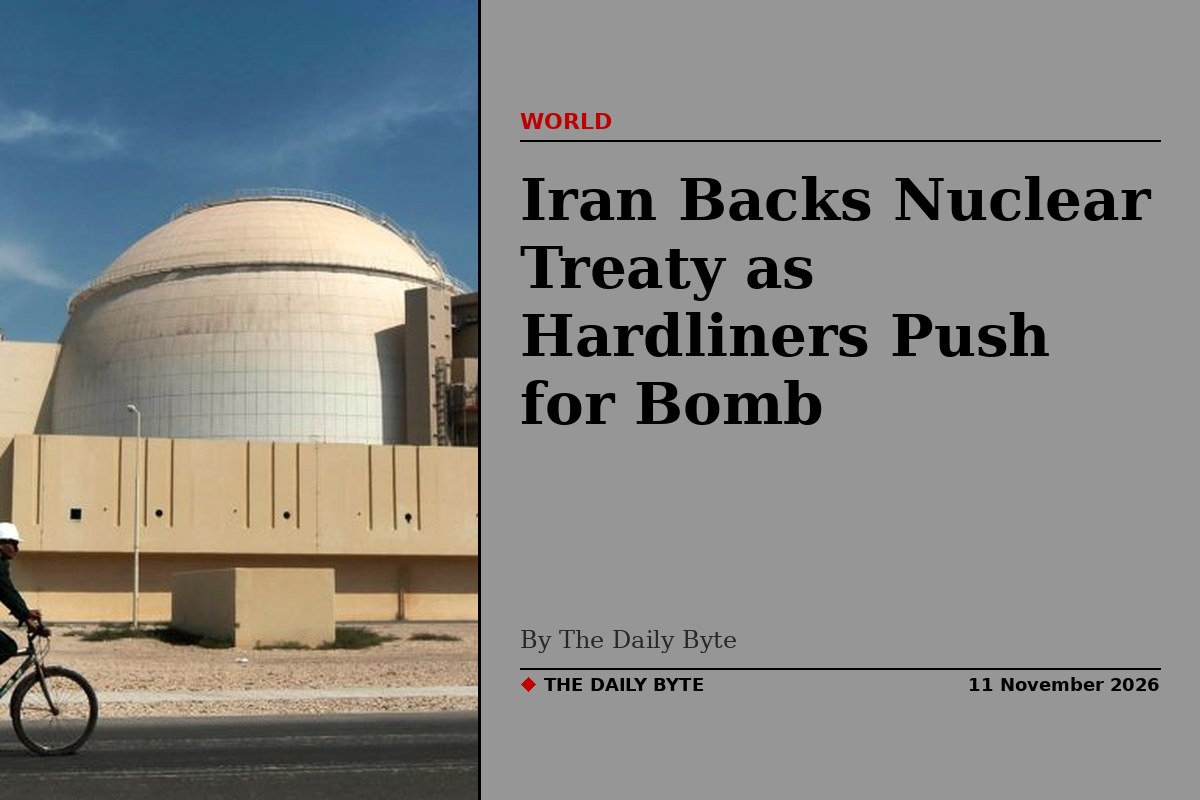
Iran has said it remains committed to the Treaty on the Non-Proliferation of Nuclear Weapons, even as senior figures in Tehran openly press for the country to leave the treaty and develop a nuclear bomb.
Foreign ministry spokesman Esmaeil Baghaei told reporters in Tehran on Monday that Iran had not suspended its commitments under the treaty, known as the NPT, despite sharply limiting cooperation with the International Atomic Energy Agency (IAEA), the United Nations nuclear watchdog.
Baghaei blamed the restrictions on the attacks by the United States and Israel on Iran's nuclear facilities, saying they had created problems for meeting its safeguards obligations. He added that as long as the situation continued, Iran could not cooperate with the agency as it would in normal circumstances, while renewing Tehran's criticism of the IAEA's director, Rafael Grossi.
Inspections resume at Bushehr only
Baghaei confirmed that new IAEA inspections had taken place days earlier at the Bushehr nuclear power plant, the electricity generation plant built with Russian cooperation in southern Iran. It is the only facility still open to the agency, because it was not directly bombed during the war, although US warplanes attacked its perimeter several times and caused damage that prompted a partial evacuation of Russian staff.
Grossi told the UN Security Council in late October that the IAEA was unable to verify Iran's nuclear material because Tehran had not provided the information and access it had requested. The agency has had no access to the bombed sites at Natanz, Fordow and Isfahan, which remain the most sensitive part of the programme.
Ali Vaez, deputy director of the Middle East and North Africa programme at the International Crisis Group, said Tehran was keeping one foot inside the NPT and the other near the exit. He described allowing inspections at Bushehr as a low-cost gesture designed to keep diplomacy alive and hardliners at bay, while preserving leverage over the underground nuclear sites that matter most.
Hardliners demand a new nuclear doctrine
The pressure to change course has grown steadily since US and Israeli attacks on Iran's main nuclear facilities and the killing of senior leaders. Under the assassinated Supreme Leader Ali Khamenei, nuclear weapons were officially forbidden, but that position is now openly challenged inside Iran.
Security chief Mohsen Rezaei has publicly raised the possibility of abandoning the treaty on several occasions. Hossein Mohebbi, a spokesman for the Islamic Revolutionary Guard Corps, said earlier this week that the organisation would make the necessary preparations if the country decided to change its nuclear doctrine.
The push has also gained ground in parliament, where lawmakers have called for withdrawal from the NPT and the development of an atomic bomb. Reports in early November said ten proposals to leave the treaty had been registered, and a prominent cleric described reconsidering the nuclear doctrine as a national demand. President Masoud Pezeshkian has continued to deny that Tehran seeks a nuclear arsenal, and the senior leadership has not formally authorised a change of policy.
President Donald Trump's threats to attack the underground Pickaxe Mountain complex near Natanz and other sensitive sites have only strengthened the hardliners' argument that membership of the treaty has failed to protect Iran from attack.
Talks continue through mediators
Mediated talks aimed at ending the war with the United States are continuing, with Qatar and Pakistan relaying messages between the two sides. Tehran has said it will not allow its highly enriched uranium to be taken out of the country, but remains open to diluting it under international supervision inside Iran. It has also said it will not abandon enrichment altogether, but could accept a limit on enrichment as it did under the 2015 nuclear deal that Trump abandoned in 2018 during his first term.
Seyed Hossein Mousavian, a visiting researcher at Princeton University and a former Iranian nuclear negotiator, said Iran's position reflected a distinction between honouring its NPT commitments and permitting inspections of facilities that have been bombed. He said the IAEA had no established inspection protocol for nuclear facilities damaged by military attacks, and that Tehran feared inspectors' findings could be shared with the US and Israel and used in future attacks.
Analysts warn that restoring meaningful transparency over Iran's nuclear programme will require a wider bargain covering enrichment, stockpiles and sanctions relief, as well as a settlement over the Strait of Hormuz, where shipping remains disrupted. For now, Iran is holding its position: inside the treaty, but with the door to leaving it left visibly open.


