Iran Braces for Worst Case as War Economy Nears Collapse
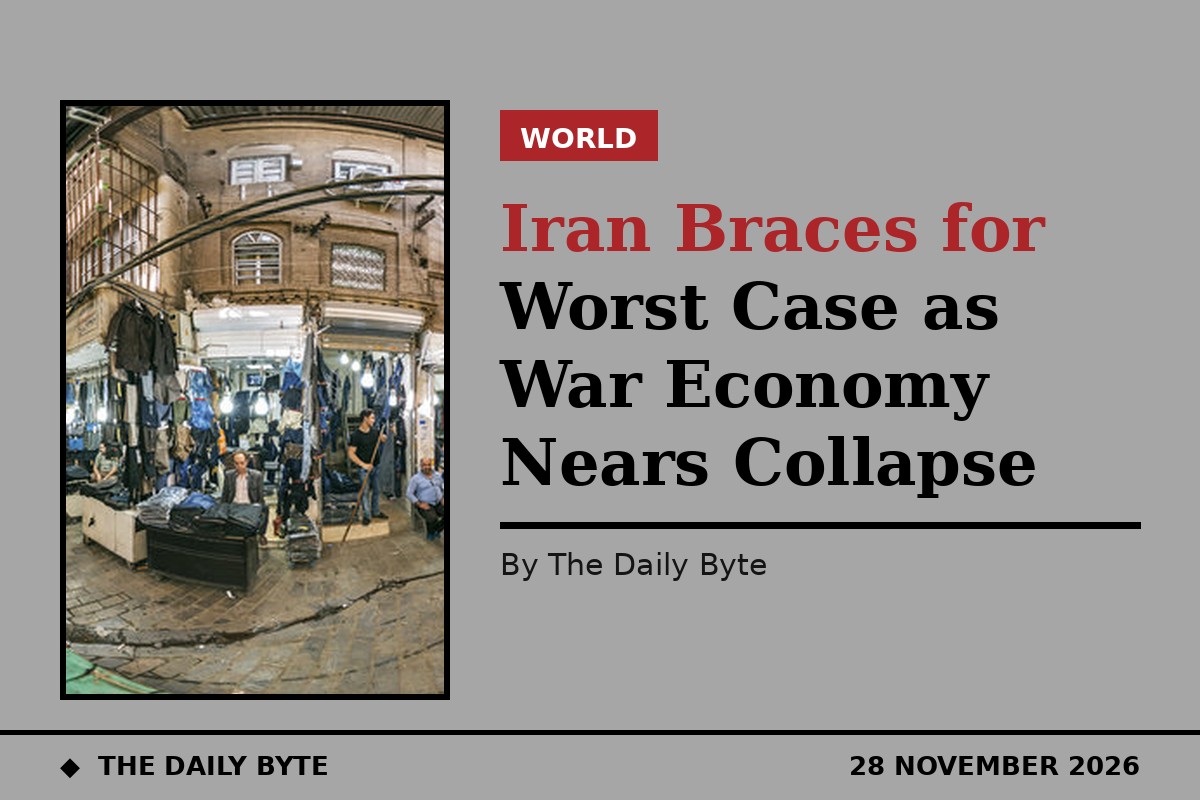
Iran must prepare for the worst-case scenario, one of the country's most senior officials said on 28 November, as nine months of war and a United States naval blockade push its economy towards breaking point.
First Vice-President Mohammad Reza Aref told a meeting reviewing stocks of essential goods and medicines that the government had to plan for the worst while keeping the public calm, Iran International reported. "This is a wartime administration. None of the previous administrations were directly at war with the United States," Aref said.
He insisted that reserves of essential goods were in very good condition. Two days earlier he had ordered basic goods prices held for at least three months.
The rial slides towards 3 million
Almost every gauge of the economy says otherwise. The dollar rose 1.71 per cent on Tehran's open market on 28 November to 2,992,500 rials, closing in on the 3 million mark, as the rial resumed its slide after a month of relative calm. The trigger was a new round of US Treasury sanctions on 23 November on exchange houses, overseas trading firms and the Iran Currency and Gold Exchange Centre.
The dollar fetched about 1.6 million rials in early April, so the rial has lost about 45 per cent of its value since then. Central Bank Governor Abdolnaser Hemmati conceded the strain in an open letter to Iranians on 27 November. "We know how heavily high prices and instability weigh on your lives," he wrote, adding that "the foreign currency constraints are real" while rejecting talk of an imminent collapse and saying the central bank had supplied more than $32 billion for imports through official channels.
Consumer prices were 88.7 per cent higher in the Iranian month to 22 October than a year earlier, and food, drink and tobacco prices were up 113.4 per cent, according to the Statistical Centre of Iran. October was the ninth month in a row in which food cost more than twice as much as a year before.
Wages left far behind
Wages have been left far behind. The basic monthly minimum wage was raised by about 60 per cent to 166 million rials for the Iranian year that began in March, worth about $55 at the 28 November open-market rate, and even when it was set it covered less than 40 per cent of the 429 million rials a worker's household was estimated to need for basic necessities. Tehran house prices have risen more than 130 per cent in a year.
Official figures show gross domestic product fell 10.1 per cent year on year in the first quarter of the Iranian year, from 21 March to 20 June. The International Monetary Fund expects the economy to shrink 7.6 per cent in 2026, while US Treasury Secretary Scott Bessent has predicted a contraction of more than 25 per cent in the year to March 2027.
Oil, the state's main source of hard currency, has all but stopped flowing. Tracking estimates put seaborne crude exports at about 50,000 barrels a day in August and September, against 1.5 million to 2 million barrels a day before the war, according to Capital Economics, and Washington says the blockade it reimposed on 14 July has prevented more than $25 billion of Iranian crude sales. The Plan and Budget Organization is drafting next year's budget for a zero-oil scenario, with salaries, pensions and debt service ranked ahead of all other spending.
Power cuts start on 29 November
Rolling power cuts of about two hours a day start on 29 November. "Given the country's fuel supply conditions, the electricity sector will be forced to impose distribution restrictions," Mohammad Allahdad, head of the state grid company Tavanir, told state television. About 86 per cent of Iran's electricity comes from gas, and the gas is running out. Government spokeswoman Fatemeh Mohajerani said the shortfall could reach 430 million cubic metres a day this winter, against about 300 million in previous years, with 11 of the country's 31 provinces facing supply problems.
Power shortages have already cost about 600,000 jobs as factories cut output, politicians say, and MP Nasrollah Pejmanfar warned on 21 November that more than 1 million workers could be laid off if gas shortages continue. Aref's plan to bring goods in overland is also running into a second, quieter blockade: Iraq closed two more crossings with Iran on 26 November, Sheikh Saleh in Kermanshah province and Bashta in the Kurdistan region, after the US Treasury asked Baghdad to keep only two of its crossings open. About 300 lorries carrying goods and building materials were stranded at Sheikh Saleh alone.
President Masoud Pezeshkian told investors on 21 November that Iran was facing a "silent economic war" that was "tougher than a war with missiles".


