Iran Plans Budget With No Oil Revenue
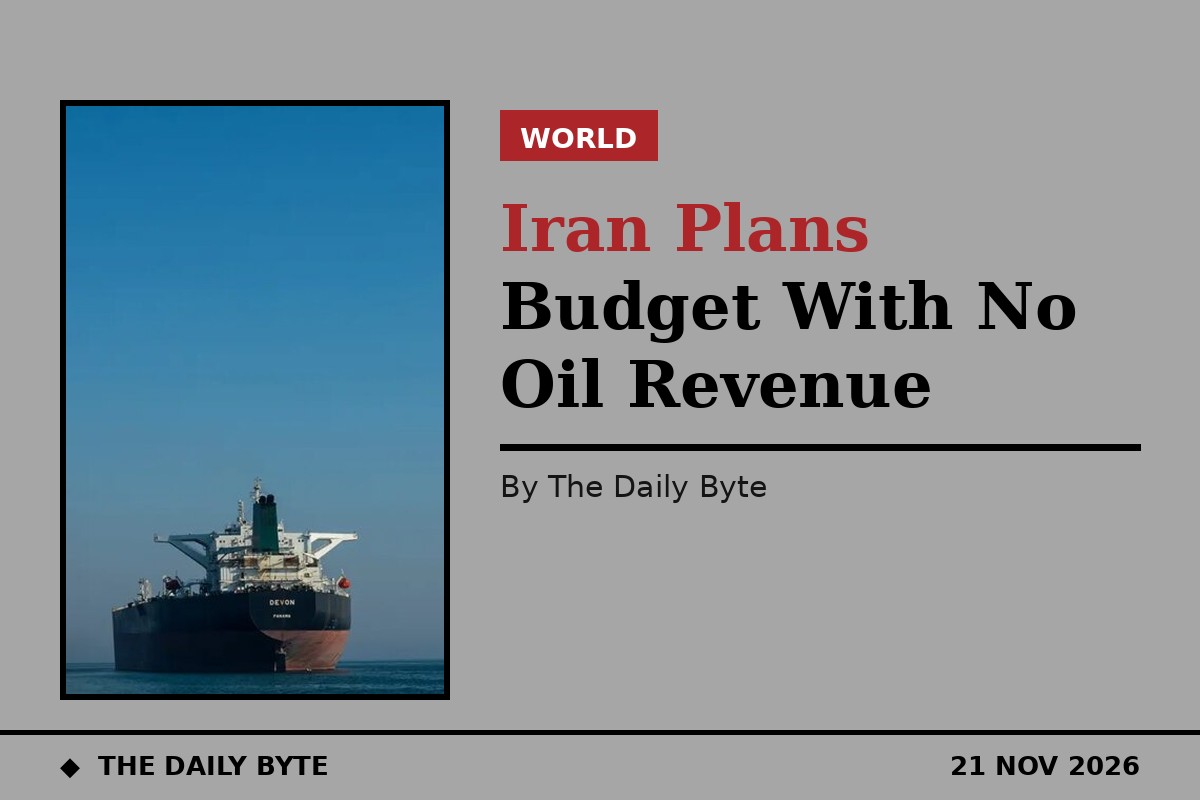
Iran is drafting next year's budget on the assumption that oil revenue could fall to zero, as a United States naval blockade drains the export earnings that pay for about a third of government spending. The budget is due to be sent to parliament between 22 November and 21 December, and officials have been told to prepare for the hardest spending plan in years.
Mohammad Ghasemi, a senior official at Iran's Plan and Budget Organization, told the government on Monday to plan for a scenario in which oil brings in nothing at all. The warning comes as the country appears to be weeks away from that eventuality, with crude export revenues expected to stop around the middle of December.
Exports have already stopped
Iran has loaded no crude since 25 August, according to the US Treasury. The oil it held at sea outside the blockade zone fell from 88.8 million barrels in mid-July to zero by mid-October, while another 43 million barrels remain stranded inside the zone, according to energy intelligence firm Kpler.
Because Chinese buyers typically pay one to two months after delivery, the revenue cutoff lags behind the physical cutoff. Kpler expects the money to stop arriving around mid-December. Figures from United Against Nuclear Iran, published this month, show Iran exported just 15,806 barrels per day in October, a single shipment of liquefied petroleum gas, down from 50,789 barrels per day in September. Exports to China, its main buyer, were zero in both September and October.
Production has also contracted sharply. Kpler puts Iranian output below two million barrels per day in the months before late October, down from 3.59 million in February, the month the war began. The latest OPEC report puts output at almost half its pre-war level. US Central Command estimates the blockade has already denied Tehran at least 25 billion US dollars in oil revenue.
A budget built without oil
Oil directly accounts for roughly 30 percent of the government budget, according to Gregory Brew of Eurasia Group and Miad Maleki of the Foundation for Defense of Democracies. Maleki puts oil's share of total regime revenue at 50 to 60 percent once indirect income is counted.
Tehran's plan for next year promises to keep paying salaries and pensions without printing money, but offers little to replace the oil income that paid for much of it. Ghasemi has put salaries, pensions and debt payments at the top of a three-tier spending plan and ruled out direct borrowing from the Central Bank. The government also plans to extend its Kalabarg electronic coupon system to about 45 million low-income Iranians, and is counting on oil deposit certificates, customs duties and tighter tax collection for revenue.
Next year's budget sets up a fight between a government that has to cut spending and a parliament with a record of raising it. Last year the government proposed a budget only 2 percent larger than the year before, and lawmakers raised that to about 30 percent.
Prices surge as the rial slides
Ordinary Iranians are already feeling the squeeze. Iran has not adjusted the minimum wage since setting it in March, while the prices of basic foods have more than doubled. Eggs rose 149 percent, imported rice 115 percent, milk 113 percent and red meat 104 percent since last December, according to figures cited by Tehran lawmaker Hossein Samsami. The Statistical Centre put year-on-year inflation at 88.7 percent in the month ending 22 October.
The rial has fallen with it. The dollar's price on Iran's open market doubled over the same period, from about 130,000 toman to 260,000, with one toman worth 10 rials. The government offers importers a cheaper official rate of about 189,000 toman, but since 21 October that rate applies to only 66 categories of goods.
Cash crunch, not collapse, for now
Analysts caution against reading the December deadline as the moment Iran runs out of money. Maleki describes it as a cash-flow disruption rather than a collapse, with serious trouble starting only when Iran can no longer pay for goods imported over land.
Esfandyar Batmanghelidj, founder of the Bourse and Bazaar Foundation, calls the situation a deep recession caused by an external shock rather than a collapse, noting that the fall in non-oil output after six months of war was about one-seventh of Ukraine's contraction after Russia's invasion. Iran's Statistical Centre put total GDP 10.1 percent lower year on year in the three months to 20 June, with non-oil output down 4.6 percent.
Tehran-based economist Isaac Saidian told Al Jazeera the government could survive this longer than its citizens could, warning that the real danger is that it stays afloat on paper while passing the cost on to the public.


